

Explosion proof distribution boxes for chemical plants are only as reliable as the classification data and cable entry plan behind them. In thirty years of specifying and installing these systems, I have seen more issues come from unclear Zone ratings, wrong gland choices, and compressed delivery schedules than from the enclosures themselves. This article lays out the selection sequence we use for chemical plant wiring: establish the hazardous area classification, decide the protection method, resolve cable entries, size the circuit layout, and verify the certification before release. If you follow that order, the box becomes a straightforward confirmation of your design rather than a last-minute procurement risk.
What Should You Confirm Before Choosing Explosion Proof Distribution Boxes?
Area classification comes first. A plant owner or design institute must state whether the location is Zone 1, Zone 2, Class I Division 1, or Class I Division 2, and which gas group applies: IIA, IIB, or IIC. That last point matters in chemical plants because hydrogen, acetylene, or carbon disulfide pushes the gas group toward IIC and tightens the flame path, gland, and temperature class requirements.
Temperature class is the data point most specifications delay. If the process involves ethyl acetate or another solvent with a low autoignition temperature, the box may need T5 or T6, which reduces the allowable surface temperature and can derate the components inside.
Ambient temperature and corrosion are not secondary. An acid vapor stream, coastal salt, or frequent wash-down can compromise a standard aluminum enclosure long before the electrical life ends. At a medium-sized chemical plant in Mexico, our team found flammable gas and dust hazards that had not been fully mapped to the existing wiring. The correction work included gas detectors, junction and distribution boxes, static discharge devices, and anti-corrosion equipment, and took about three months to make the installation safe. The real lesson was that classification review had to happen before any box was selected.
What Protection Method Fits Chemical Plant Distribution Circuits?
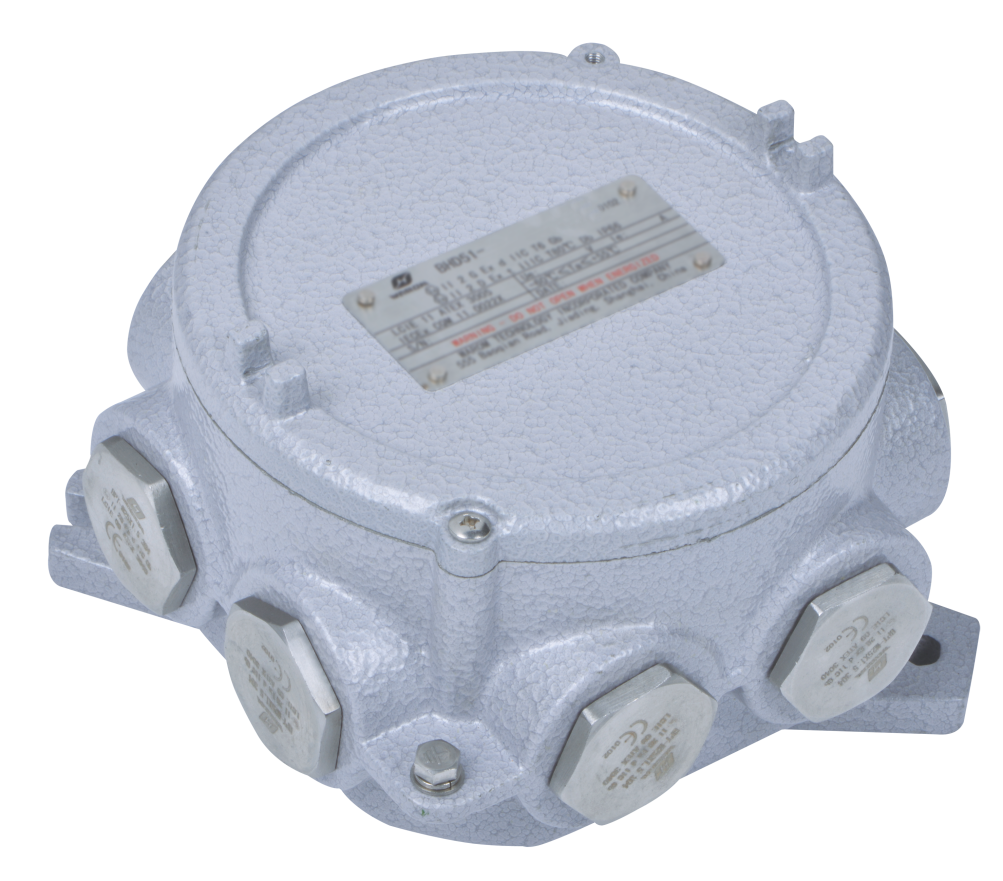
Once the area classification is fixed, the next choice is Ex d, Ex e, or a hybrid. Ex d flameproof boxes contain an internal explosion and quench the flame path before hot gases escape. They fit circuit breakers, contactors, and anything that arcs during operation. Ex e increased safety boxes are designed so arcs or hot spots do not occur under normal operation; they depend on careful terminal work, specified creepage and clearance distances, and a clean installation.
Many chemical plant distribution boards use a hybrid because the switching devices need Ex d protection while the outgoing terminations and cable spreading can sit in an Ex e chamber. That is not a compromise; it is a design logic. The sparking components stay separated from the non-sparking terminations, and the enclosure spends less time open during maintenance.
| Decision point | Ex d flameproof | Ex e increased safety | Hybrid Ex d/e |
| Fault control | Contains internal explosion | Prevents arcs and hot spots in normal service | Contains switching faults; keeps terminations in increased safety |
| Opening during maintenance | Requires de-energization before opening | Can be opened for termination work under controlled conditions | By compartment; terminal chamber can be accessed while switching chamber remains isolated |
| Typical chemical plant use | Breakers, contactors, arrancadores de motor | Terminal marshalling, distribution with protected outgoing circuits | Lighting or power distribution with switches and multiple outgoing circuits |
| Gland requirement | Ex d certified gland matched to flame path | Ex e certified gland with IP and strain relief | By compartment; each entry must be assigned to the correct chamber |
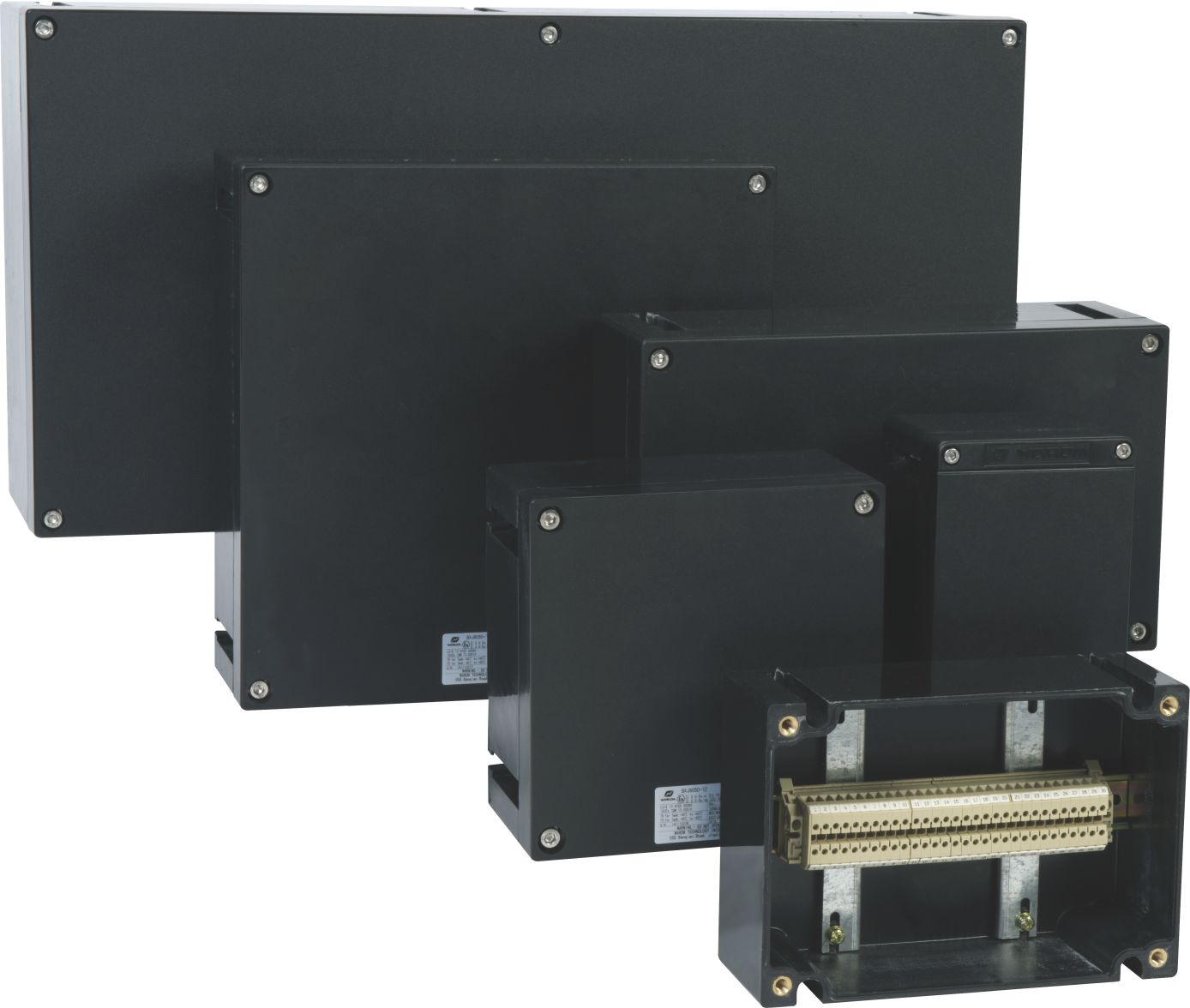
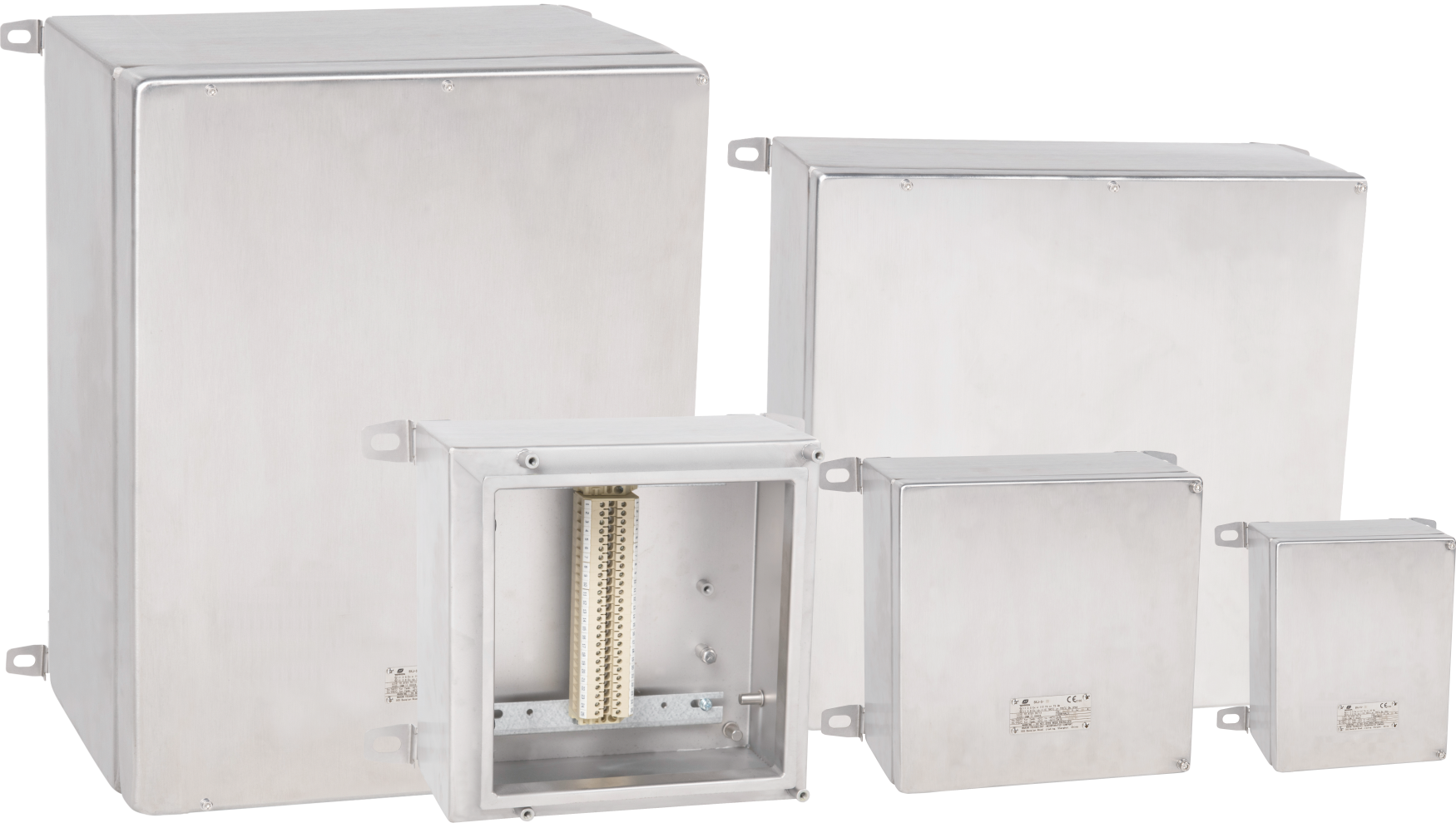
The BXM(D)8050 cuadros de distribución de iluminación use a compound Ex d and Ex e structure with a GRP enclosure and IP66 protection. Rated current reaches 250 A and rated voltage reaches 690 V AC, which covers many chemical plant lighting and small power distribution roles. Material selection follows the same logic. Aluminum suits normal atmospheres where weight matters. Stainless steel moves up when coastal salt, caustic wash-down, or frequent cleaning is part of the installation. GRP handles highly corrosive chemical atmospheres but has different mechanical limits for large gland plates and impact loads.
How Do You Resolve Cable Entries and Circuit Layout Before Ordering?
Most drawing loops start with the enclosure and then discover the cables. The better order is to freeze the cable schedule first: how many incoming and outgoing cables, their outside diameter, whether they are armored, and whether the plant uses metric or NPT threads. Chemical plant wiring commonly mixes older metric entries from European packages with NPT entries from skid-mounted equipment, and that mix can force adaptors that the certificate does not cover.
For armored cables, the gland is part of the explosion protection, not a fitting. The flame path must match the gland type, and the armor must be terminated so the earth connection survives a fault. If the armor is not bonded, the box may pass a visual inspection and still fail the electrical safety review.
Chemical plant cable entries are where flame path discipline and cable termination practice meet. <Explosion Proof Glandes de cables for SWA Armored Cable Safety> covers why the gland must match the armoring, not just the cable diameter, and explains how a missed armor bond becomes a certification and safety failure at the gland plate.
Circuit layout is the next fixed point. The outgoing circuits determine the busbar rating, main incomer, branch breaker ratings, neutral and earth bar sizes, and spare capacity. We normally ask for the single line diagram before accepting a material grade because a 4 mm² terminal can carry 32 A in a terminal box, while a 6 mm² terminal moves to 41 A, and the change from one to the other alters enclosure size and the entry plate layout. Chemical plant sites also need spare circuits. I have seen a three-circuit box specified to the exact drawing, then modified at commissioning when a small exhaust fan or analyzer loop was added. Adding one spare circuit during design is far cheaper than recertifying an entry plate later.
If the shutdown schedule will not be finalized until after the box drawing is due, confirm the spare circuit count and cable entry positions before release. Send the single line diagram and cable schedule to gm*@***om.com and we will flag conflicts before the enclosure goes into production.
What Must You Verify Before Releasing an Explosion Proof Distribution Box Order?
Certificate verification should not be the last step. Before release, check that the certificate covers the protection method, gas group, temperature class, ambient range, and the internal components. A certificate for an empty enclosure does not automatically cover the breakers, contactors, meters, or terminals installed inside. The nameplate must show the same Ex marking, not a general company capability statement. For a Zone 1 gas and dust location, a typical nameplate may read Ex db eb IIC T6 Gb and Ex tb IIIC T80°C Db.
Ambient range is another source of mistakes. A chemical plant in a hot region may need +60 °C, while a cold storage or outdoor installation may require -40 °C or lower. The HRMD92 and HRMD93 distribution panels carry an ambient range from -60 °C to +60 °C with a +40 °C note for some configurations. Factory records matter less than the certificate, but they still matter. Request the routine test report, wiring continuity check, earth continuity, and torque verification records. If the box has a busbar system, ask for the busbar torque and clearance documentation.
En un farmacéutica API facility that used distribution boxes for workshops, warehouses, tank farms, and pump controls, early coordination with the design institute and the project owner prevented interface gaps during phased delivery. The boxes arrived to match construction progress, and the documentation moved with the delivery. That early coordination is what made receipt inspection straightforward rather than a discovery process.
How We Review Chemical Plant Distribution Requirements Before Quotation
Most chemical plant distribution box specifications reach us with two unresolved points: cable entries that have not been reconciled with the field cable schedule, and temperature class assumptions that may not match the solvent inventory. We review the hazardous area plot plan, single line diagram, cable schedule, and the product certificate before quoting. That review catches conflicts between the enclosure rating and the actual circuits, the gland type and the cable construction, and the declared ambient range and the site location.
Send the part number, circuit count, cable entry details, and required delivery to gm*@***om.com or call +86 21 39977076 or +86 21 39972657. We will confirm material, protection method, entry arrangement, and testing scope in the quotation so the order can move into production without a drawing loop.
What Else Do Plant Engineers Ask About Explosion Proof Distribution Boxes?
Do these boxes always need bottom cable entry?
Not always, but bottom entry is the standard for most chemical plant installations because it limits water and debris ingress and gives the gland a downward run. Top entry is possible when the incoming feed comes from an overhead tray, but it increases the risk of condensation entering the enclosure if glands are not drained. Confirm the entry direction before freezing the bill of materials.
Can one enclosure mix Ex d and Ex e circuits?
It is a common assumption that an enclosure must be either Ex d or Ex e. In practice, a hybrid design often does exactly what the name says: the breaker or contactor sits in a flameproof chamber, while the outgoing terminations sit in an increased safety chamber. The condition is that the manufacturer has certified the assembly as a complete unit, including the glands, barriers, and internal wiring. An uncertified field modification voids that protection.
Which matters more for chemical plant service: IP rating or temperature class?
That depends on where the box sits. In an outdoor wash-down area, IP66 matters immediately because water entering the enclosure causes corrosion and false trips. In a process area with a low autoignition solvent, temperature class becomes the limiting factor because the surface temperature must stay below the gas ignition threshold. For most chemical plants, IP66 is the baseline, then T4, T5, or T6 is selected from the gas data. If your project has both an aggressive wash-down specification and a low-temperature-class solvent, send both data sets to gm*@***om.com cURL Too many subrequests by single Worker invocation. To configure this limit, refer to https://developers.cloudflare.com/workers/wrangler/configuration/#limits
Si está interesado, consulte estos artículos relacionados:
Enclosures de fibra de vidrio GRP: Protección definitiva contra la corrosión
OGA 2024 en marcha
El “Feria de Cantón” florece el estilo de “WAROM”
Warom en Vietnam ETE 2024
Con más de una década de experiencia, es un Ingeniero Eléctrico a prueba de explosiones con experiencia en el diseño y fabricación de productos de seguridad y a prueba de explosiones. Posee una experiencia profunda en áreas clave que incluyen sistemas a prueba de explosiones, iluminación nuclear, seguridad marina, protección contra incendios y sistemas de control inteligente. En Warom Technology Incorporated Company, ocupa roles de liderazgo dual como Subgerente de Ingeniería para Negocios Internacionales y Jefe del Departamento Internacional de I+D, donde supervisa iniciativas de I+D y garantiza la entrega precisa de la documentación de diseño para proyectos internacionales. Comprometido con avanzar la seguridad industrial global, se enfoca en traducir tecnologías complejas en soluciones prácticas, ayudando a los clientes a implementar sistemas de control más seguros, más inteligentes y fiables en todo el mundo.

Qi Lingyi