Указание взрывозащиты кабельными флегмами for an offshore wind farm starts with the cable data sheet and the area classification drawing, not with a product catalogue. I have watched project schedules slip when the interface between armoured submarine cable and Ex rated enclosure is treated as a late stage commodity item. The rework usually appears after the cable has been pulled, when the gland clamp range, armour bonding, and certification marking no longer line up. This article sets out the specification, protection concept, material, installation, and documentation decisions I use when approving these glands for marine hazardous areas.
Offshore Wind Farm Cabling Zones and the Explosion Proof Cable Gland Requirement
Offshore wind farm cabling does not automatically create a hazardous area. The classified zones usually sit in transformer spaces, battery and fuel storage compartments, hydrogen-ready equipment corridors, and any room where flammable gas or vapour can collect. The explosion proof cable gland decision is driven by those zones, and by the type of enclosure each cable enters. A cable entering an Ex d flameproof enclosure must terminate in a gland that holds the explosion inside. A cable entering an Ex e increased safety enclosure needs a gland with the correct protection concept, creepage and clearance, and a cable construction that matches the gland’s seal and clamping range.
One complication on offshore wind projects is the cable itself. Inter-array and export cables are not simple round power cables. They usually carry a lead sheath, steel wire armour, and a thick polyethylene outer sheath. The gland has to do four jobs at once: seal the outer sheath, bond the armour, keep moisture out of the inner bedding, and maintain the explosion protection concept at the enclosure entry. In project reviews I see more drawing deviations caused by cable gland dimensional mismatch than by any other single cable accessory. The outer diameter tolerance, the armour wire diameter, the bedding layer thickness, and the sheath type all have to be confirmed against the gland certificate before the drawing is released.
| Project condition | Cable gland selection outcome |
|---|---|
| Transformer or switchgear in a classified zone | Ex db IIC or Ex eb IIC gland matched to the enclosure entry and cable construction |
| Battery room or hydrogen-ready space | IIC gas group, confirm the certificate includes Ex db IIC Gb |
| Ex d enclosure entry | Flameproof cable gland with flame path per EN/IEC 60079-1 and armour bonding |
| Ex e enclosure entry | Increased safety cable gland per EN/IEC 60079-7, verify cable construction and sealing |
| Armoured composite inter-array cable | Barrier or armoured gland with compound or diaphragm seal where the cable is not gas tight |
Offshore wind platforms and drilling installations share the same pressure to close out hazardous area certification before startup. <Взрывозащищенное оборудование: безопасность опасных зон при бурении на шельфе> covers how accessible maintenance is often lost once equipment is installed offshore and why certification gaps become much more expensive after installation than at the drawing stage.
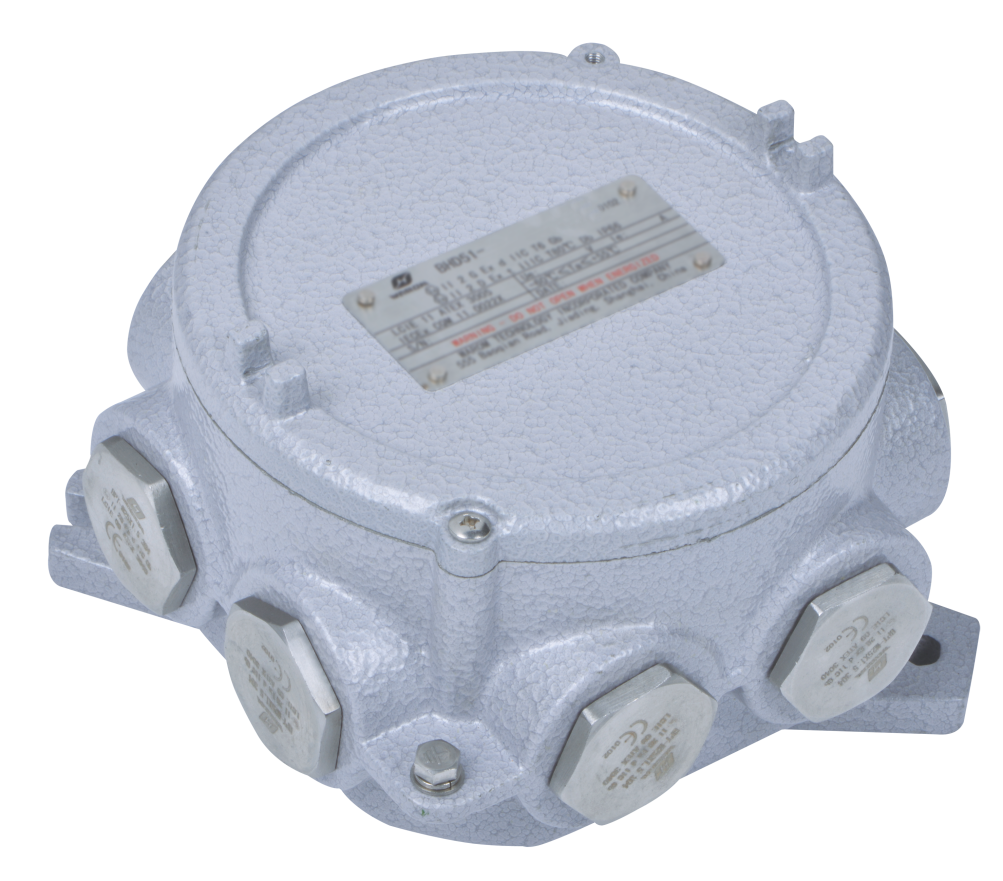
Zone and gas group then finish the selection. For offshore wind platform switchgear and transformer equipment, I normally specify Ex db IIC or Ex eb IIC glands unless the area classification report gives a clear reason to accept IIB only. The IIC group covers hydrogen from battery rooms and the widest gas range. A IIB-only position may be cheaper at the start, but a later battery or hydrogen addition can make it invalid. The DQM-III/II series cable glands we use for such projects are marked Ex db IIC Gb, with IECEx TUR 22.0035X and TÜV 22 ATEX 8855X certificates, a service range from -60°C to +90°C, and IP66 ingress protection. That covers most offshore wind installation points without a special evaluation.
Ex d and Ex e Explosion Proof Cable Glands for Marine Enclosures
Flameproof and increased safety are not interchangeable entry solutions. A flameproof cable gland uses a controlled flame path between the cable and the gland body. When an internal explosion occurs, hot gases escape through that path and cool below the ignition temperature of the surrounding atmosphere before reaching the outside. That is why the thread engagement, flame path length, and cable sealing arrangement have to remain exactly as the certificate describes.
An Ex e increased safety cable gland does not rely on containing an explosion. It relies on preventing arcs, sparks, and hot surfaces in normal operation. The cable terminations inside an Ex e enclosure are protected by separation distances, creepage and clearance, and a gland that holds the cable without compromising the enclosure’s increased safety design. The gland may still need an ingress protection seal, but the core safety duty is different.
On offshore wind projects I see both concepts used in the same turbine platform. Ex d glands typically terminate power and control cables into switchgear, motors, and flameproof terminal boxes. Ex e glands are more common on lighting, auxiliary power, and non-sparking control circuits where the enclosure has been designed for increased safety. The choice does not come from preference; it comes from the enclosure marking, the cable construction, and the area classification.
A barrier type flameproof gland becomes relevant when the cable has an open or hygroscopic construction. The compound barrier seals the cable around individual cores and prevents flammable gas from passing along the cable into the enclosure. For offshore composite submarine cables, the outer sheaths and armouring may not suit a conventional barrier gland unless a special entry arrangement is used. This is where the manufacturer’s application review matters more than a catalogue dimension table.
Material, Plating, and Ingress Protection for Explosion Proof Cable Glands in Marine Environments
Offshore wind is a C5 marine environment for much of the installed equipment: salt spray, high humidity, thermal cycling, UV, and splash in some locations. A cable gland in this environment fails by corrosion more often than by direct mechanical force. The material pairing matters. Nickel plated brass is a common offshore gland material because the nickel plating resists salt spray while the brass body machines to a reliable flame path. Stainless steel is specified where the atmosphere is more aggressive or where the cable entry sees consistent washing.
The plating and the enclosure material have to work as a pair. If a brass gland enters an aluminium enclosure, the combination must avoid galvanic corrosion at the thread. Where this is a concern, a stainless steel or suitably plated gland with a compatible thread lubricant and sealing washer is one way to reduce the risk. The same consideration applies to the cable armour: if the armour is galvanized steel, the earthing ring and clamping components should be chosen so the armour does not become the sacrificial element.
Ingress protection is a separate requirement from explosion protection. A gland marked IP66 can resist strong water jets and most offshore weather. The DQM-III/II series we use for armoured cable carries IP66. Where an installation is in a splash zone or subject to intermittent immersion, many project specifications push to IP67 or better for the connected enclosure. That higher requirement does not change the flame path, but it usually changes the outer seal, the sealing washers, and the installation sequence.
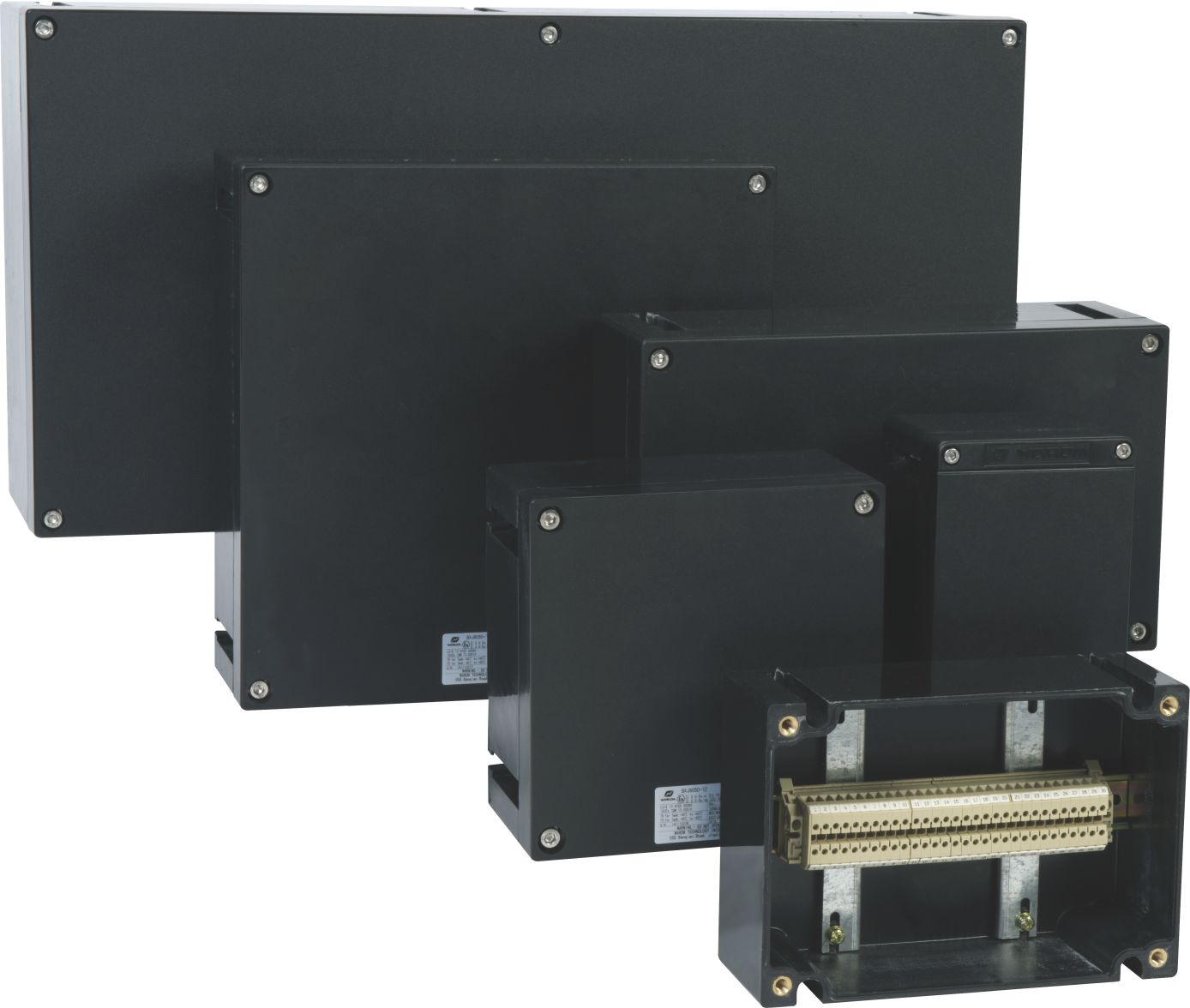
One point worth confirming early is the gland material and cable sealing range against the actual cable data sheet. If your offshore wind project includes mixed cable types or IIC gas group classifications, send the cable schedule to gm*@***om.com and we can check the DQM marking before the bill of materials is frozen.
Armoured Cable Termination and Installation Checks That Prevent Offshore Gland Failures
Most offshore gland failures I investigate are installation failures. The catalogue part was usually acceptable. The outer sheath was stripped too far, the armour wires were not evenly clamped, the inner bedding was left exposed to moisture, or the gland was tightened in the wrong sequence. Those mistakes show up later as water inside the terminal box, corrosion on the armour, or a failed inspection after a battery of megger and visual checks.
A steel wire armoured cable works as a system only when the armour is clamped at the correct circumference and the outer seal closes on the intact outer sheath. If the armour wires are not pushed under the cone or claw, they can move under vibration. Once one wire settles, the remaining wires lose tension and leave small openings. Offshore turbine platforms vibrate enough that an uneven clamp will loosen over time. The same applies to the earthing arrangement. The armour bond must be continuous and low resistance; if the installer relies only on the gland body without checking the earthing ring, the safety function may look correct and still fail.
The installation check sequence matters. I ask commissioning teams to verify the cable outer diameter against the gland marking range, check the sheath cut length, confirm the armour wires sit evenly under the cone, tighten in the manufacturer’s sequence, and verify the inner seal is compressed. This is not a quality talk track. On offshore projects where the cable has already been pulled through a J-tube, rectifying a gland at the tower base is far more expensive than repeating a bench test at the supplier’s factory.
The product certificate does most of the work before installation. For the DQM-III/II series, the glands are supplied with IECEx and ATEX certification and need to be matched to the same cable range shown on the drawing. If the cable outer diameter drifts outside that range because of project changes, the gland cannot be made compliant by tightening harder. The part has to change.
Documentation and Sourcing Checks for Explosion Proof Cable Glands on Offshore Wind Projects
At the sourcing stage, the difference between a controlled gland and a catalogue claim is documentation. Before I accept a cable gland for an offshore wind package, I ask for the IECEx certificate, the ATEX certificate, the schedule of actual cable ranges covered, the marking code, and the manufacturer’s installation instructions. A certificate for the product family is not enough. The exact gland size and thread type on the drawing must appear on the schedule. If the supplier cannot provide that, I do not put the gland on the approved list.
The same discipline applies to material and traceability. Offshore projects increasingly want full traceability for the gland body, the plating, and the sealing material. A batch test report may not be required for every small gland, but the supplier should be able to map the delivered gland to its production batch. This matters when a later corrosion or certificate question turns into a site query.
A manufacturer with internal engineering support can also close the gap between the cable maker, the enclosure supplier, and the installation contractor. In our team, we review the cable data sheet against the DQM-III/II range and the enclosure entry detail before drawing approval. That step removes the most common late stage conflict: a gland that matches the cable but not the enclosure thread, or the enclosure thread but not the cable seal.
The same factory audit discipline applies when a cable gland supplier is added to an offshore wind project vendor list. <Оценка влагозащищенных электротехнических поставщиков в Китае для промышленной безопасностиcURL Too many subrequests by single Worker invocation. To configure this limit, refer to https://developers.cloudflare.com/workers/wrangler/configuration/#limits
cURL Too many subrequests by single Worker invocation. To configure this limit, refer to https://developers.cloudflare.com/workers/wrangler/configuration/#limits gm*@***om.comcURL Too many subrequests by single Worker invocation. To configure this limit, refer to https://developers.cloudflare.com/workers/wrangler/configuration/#limits
cURL Too many subrequests by single Worker invocation. To configure this limit, refer to https://developers.cloudflare.com/workers/wrangler/configuration/#limits
cURL Too many subrequests by single Worker invocation. To configure this limit, refer to https://developers.cloudflare.com/workers/wrangler/configuration/#limits
cURL Too many subrequests by single Worker invocation. To configure this limit, refer to https://developers.cloudflare.com/workers/wrangler/configuration/#limits
cURL Too many subrequests by single Worker invocation. To configure this limit, refer to https://developers.cloudflare.com/workers/wrangler/configuration/#limits
cURL Too many subrequests by single Worker invocation. To configure this limit, refer to https://developers.cloudflare.com/workers/wrangler/configuration/#limits
cURL Too many subrequests by single Worker invocation. To configure this limit, refer to https://developers.cloudflare.com/workers/wrangler/configuration/#limits
cURL Too many subrequests by single Worker invocation. To configure this limit, refer to https://developers.cloudflare.com/workers/wrangler/configuration/#limits
cURL Too many subrequests by single Worker invocation. To configure this limit, refer to https://developers.cloudflare.com/workers/wrangler/configuration/#limits
cURL Too many subrequests by single Worker invocation. To configure this limit, refer to https://developers.cloudflare.com/workers/wrangler/configuration/#limits gm*@***om.com cURL Too many subrequests by single Worker invocation. To configure this limit, refer to https://developers.cloudflare.com/workers/wrangler/configuration/#limits
Если вас интересует, ознакомьтесь с этими связанными статьями:
OGI 2023, Индонезия
Экспертное руководство: Выбор временных распределительных коробок
Explosion-Proof Hand Lamps: Необходимая безопасность для опасных зон
2025 Международный форум по технологии взрывозащиты промышленности успешно прошёл в Шанхае
WAROM едет на Australian Energy Producers Conference & Exhibition в Перт!
С более чем десятилетним опытом он — опытный инженер по взрывобезопасности электротехники, специализирующийся на проектировании и производстве безопасной и взрывобезопасной продукции. Он обладает глубокими знаниями в ключевых сферах, включая системы взрывозащиты, освещение для атомной энергетики, морскую безопасность, пожарную защиту и интеллектуальные системы управления. В Warom Technology Incorporated Company он занимает две руководящие должности: заместитель главного инженера по международному бизнесу и руководитель отдела международных НИОКР, где курирует исследования и разработки и обеспечивает точную передачу проектной документации для международных проектов. Стремясь к продвижению глобальной промышленной безопасности, он сосредоточен на преобразовании сложных технологий в практические решения, помогающие клиентам внедрять более безопасные, умные и надёжные системы управления по всему миру.
Qi Lingyi