
I have watched enough bulk cable gland enquiries stall at the quotation stage to know the failure point is rarely the supplier. Explosion proof glándulas de cable for a multi-line order need the same discipline as a valve or instrument package: a full cable schedule, a defined certification path, and entry data that matches the installation. RFQs that arrive as a part number and a quantity place the whole technical risk on the vendor. Buyers who specify the hazardous area data, cable construction, thread standard, and documentation requirements get comparable bids and fewer post-order replacements. This article sets out the fields I would want to see before quoting a bulk gland package.
Hazardous Area Data for an Explosion Proof Cable Gland RFQ
Start the RFQ with the installation boundaries, not the gland list. State the zone, gas group, temperature class, and protection concept for each area where the glands will be installed. A single project can combine Zone 1 storage, Zone 2 utilities, and a dust zone in a milling area, and the same gland size may not cover all three. When the seller has to infer this from a project name, the quote either carries risk contingency or comes back with a long clarification list.
Split the requirements into site-wide and line-item fields. Replace the phrase “certified for hazardous area” with the named scheme and marking. For IECEx packages, a manufacturer may reference a family such as DQM-III with certificate IECEx TUR 22.0035X and Ex db IIC Gb marking for M and NPT threads, IP66, and an ambient range of -60°C to +90°C. An ATEX package may carry TUV 22 ATEX 8855X under EN 60079-0, EN 60079-1, EN 60079-7 and EN 60079-31. A North American package may require NEC/CEC data and NPT threads. Those few lines are cheaper to write than the rework they prevent.
| RFQ field | What to specify | Common error |
|---|---|---|
| Entry thread | Metric M20 or M25 series, or NPT size for each line | Writing “standard” and assuming the supplier knows the location |
| Cable construction | Armoured, braided, screened or unarmoured; outer sheath diameter range | Missing the inner bedding or screen diameter |
| Clasificación de área peligrosa | Zone, gas group, temperature class and protection concept | Repeating a blanket certification without zone mapping |
| Certificate required | IECEx, ATEX, NEC/CEC or project-specific approval | Asking for “certified” without naming the scheme |
| Quantity per size | Per thread size and cable range, plus spare glands | Combining total quantity without a size breakdown |
| Delivery schedule | Partial shipments by area or package, with documentation deadline | Requesting all at once despite phased construction |
Cable Construction and Explosion Proof Gland Matching Rules
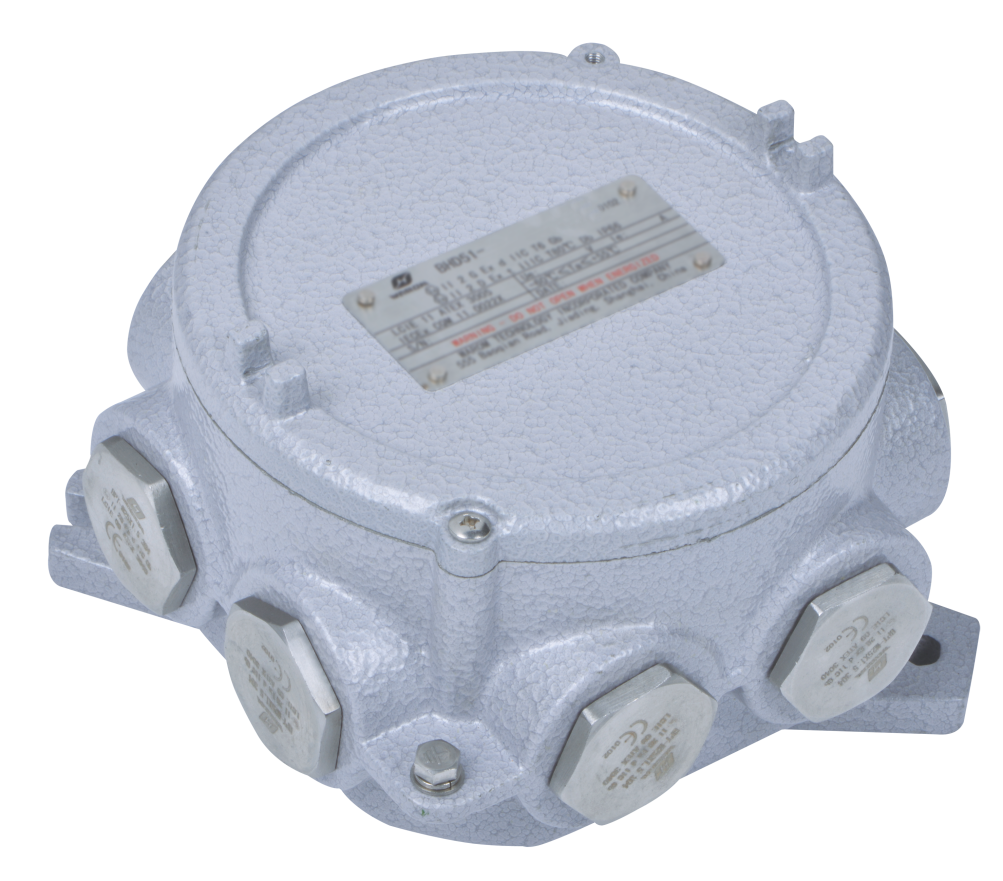
The cable schedule is the part of the RFQ that decides whether the quote is firm or conditional. For every line, state the cable outer sheath diameter, the inner bedding diameter if present, armouring type and dimensions, and whether the cable has a screen, braid, or filler. A gland that seals an unarmoured cable may not clamp a wire braid. A gland that clamps steel wire armour may not seal a screened instrument cable without an additional entry component. When the RFQ lists only the cable OD and the part number, the supplier has to assume which construction detail matters, and the buyer inherits that assumption.
Armoured cables need the armouring dimensions stated separately from the sheath OD. For single wire armour, the gland specification should say whether the entry needs an armour cone and a seal boot or a compound barrier. That decision comes from the cable construction and the installation, not from the gland series alone. Unarmoured and screened cables need the screen termination method declared because it changes the gland arrangement and the earthing path.
If the package includes NPT entries for a US or Middle East scope, the thread standard should be explicit rather than assumed. <NPT Explosion Proof Cable Glands for US & Middle East Projects> covers why NPT entries are treated differently and how the matching cable range changes the gland selection.
If the package mixes armoured SWA feeders and unarmoured instrument cables across one bulk order, it is worth confirming whether every entry needs an Ex d flamepath or an Ex e sealing arrangement before the RFQ is issued. Send the cable schedule to gm*@***om.com and we will check entry size, gland type, and certificate coverage for each line.
Certification and Marking Evidence to Request Up Front
Request a certificate list tied to each line item, not a general statement that the company holds the correct approvals. The list should show the certificate number, the issuing body, the marking printed on the gland, and any special conditions for safe use. IECEx and ATEX product family certificates may cover a range of sizes, but the RFQ should ask the bidder to confirm which entries in that range fall under the certificate. That prevents a certificate for one size being assumed to cover the whole order.
Pay attention to the X suffix. An IECEx or ATEX certificate ending in X carries attached conditions. Those conditions can restrict cable types, fix the sealing components, or change the installation requirements. A credible bidder should state those restrictions in ordinary language inside the quote. If the bidder cannot, the package has not been reviewed by an engineer. Also ask whether certificates and the declaration of conformity will be supplied as controlled PDFs before shipment. For bulk deliveries, the site receiving team often needs the file package before the boxes arrive.
Packaging and Documentation Rules for Bulk Delivery
cURL Too many subrequests by single Worker invocation. To configure this limit, refer to https://developers.cloudflare.com/workers/wrangler/configuration/#limits
cURL Too many subrequests by single Worker invocation. To configure this limit, refer to https://developers.cloudflare.com/workers/wrangler/configuration/#limits
cURL Too many subrequests by single Worker invocation. To configure this limit, refer to https://developers.cloudflare.com/workers/wrangler/configuration/#limitsCosto de Equipamiento a Prueba de Explosiones: Comprendiendo los Factores que Impulsan la InversióncURL Too many subrequests by single Worker invocation. To configure this limit, refer to https://developers.cloudflare.com/workers/wrangler/configuration/#limits
cURL Too many subrequests by single Worker invocation. To configure this limit, refer to https://developers.cloudflare.com/workers/wrangler/configuration/#limits
cURL Too many subrequests by single Worker invocation. To configure this limit, refer to https://developers.cloudflare.com/workers/wrangler/configuration/#limits
cURL Too many subrequests by single Worker invocation. To configure this limit, refer to https://developers.cloudflare.com/workers/wrangler/configuration/#limits gm*@***om.com cURL Too many subrequests by single Worker invocation. To configure this limit, refer to https://developers.cloudflare.com/workers/wrangler/configuration/#limits
cURL Too many subrequests by single Worker invocation. To configure this limit, refer to https://developers.cloudflare.com/workers/wrangler/configuration/#limits
cURL Too many subrequests by single Worker invocation. To configure this limit, refer to https://developers.cloudflare.com/workers/wrangler/configuration/#limits
cURL Too many subrequests by single Worker invocation. To configure this limit, refer to https://developers.cloudflare.com/workers/wrangler/configuration/#limits
cURL Too many subrequests by single Worker invocation. To configure this limit, refer to https://developers.cloudflare.com/workers/wrangler/configuration/#limits
cURL Too many subrequests by single Worker invocation. To configure this limit, refer to https://developers.cloudflare.com/workers/wrangler/configuration/#limits
cURL Too many subrequests by single Worker invocation. To configure this limit, refer to https://developers.cloudflare.com/workers/wrangler/configuration/#limits
cURL Too many subrequests by single Worker invocation. To configure this limit, refer to https://developers.cloudflare.com/workers/wrangler/configuration/#limits
cURL Too many subrequests by single Worker invocation. To configure this limit, refer to https://developers.cloudflare.com/workers/wrangler/configuration/#limits
cURL Too many subrequests by single Worker invocation. To configure this limit, refer to https://developers.cloudflare.com/workers/wrangler/configuration/#limits gm*@***om.com cURL Too many subrequests by single Worker invocation. To configure this limit, refer to https://developers.cloudflare.com/workers/wrangler/configuration/#limits
Si está interesado, consulte estos artículos relacionados:
Evaluación de proveedores de cajas de distribución a prueba de explosiones chinas
CIPPE 2024
Asociación de Promoción de Marketing a Prueba de Explosiones Warom 2024
Luminarias colgantes: seguridad esencial para áreas peligrosas
A prueba de explosiones OEM: Cuando la ingeniería personalizada eleva la seguridad industrial
Con más de una década de experiencia, es un Ingeniero Eléctrico a prueba de explosiones con experiencia en el diseño y fabricación de productos de seguridad y a prueba de explosiones. Posee una experiencia profunda en áreas clave que incluyen sistemas a prueba de explosiones, iluminación nuclear, seguridad marina, protección contra incendios y sistemas de control inteligente. En Warom Technology Incorporated Company, ocupa roles de liderazgo dual como Subgerente de Ingeniería para Negocios Internacionales y Jefe del Departamento Internacional de I+D, donde supervisa iniciativas de I+D y garantiza la entrega precisa de la documentación de diseño para proyectos internacionales. Comprometido con avanzar la seguridad industrial global, se enfoca en traducir tecnologías complejas en soluciones prácticas, ayudando a los clientes a implementar sistemas de control más seguros, más inteligentes y fiables en todo el mundo.

Qi Lingyi