
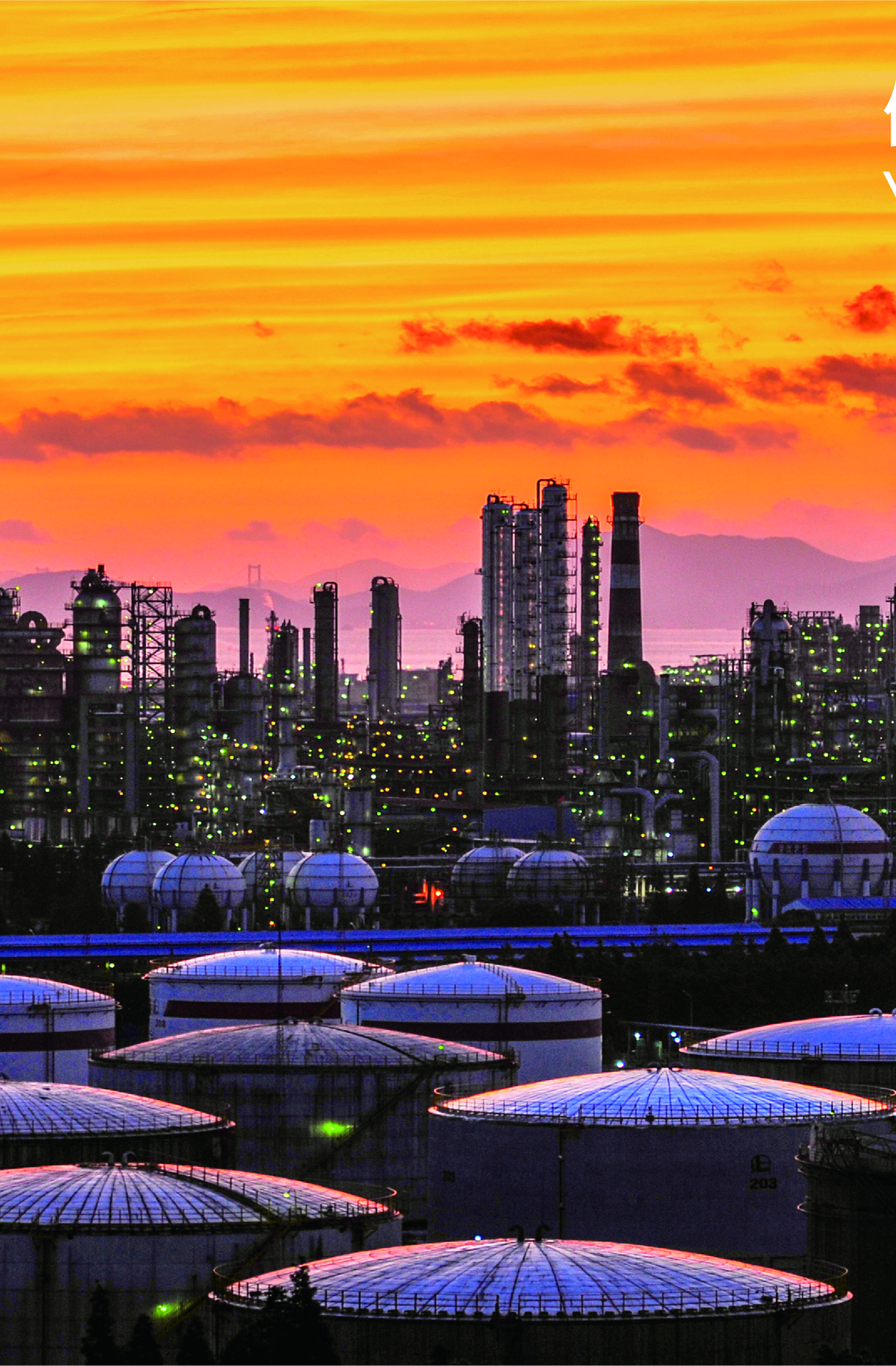
Explosion proof distribution cabinets for ilaç plants are usually specified as though the plant were a small refinery, and that assumption creates most of the problems later. A pharma site rarely holds one large process area. It holds solvent dispensing benches, reactor charging floors, centrifuge and dryer discharge points, and powder weighing rooms, and the first group carries a gas risk while the last carries a dust risk. A cabinet with only a gas marking will pass the supplier’s offer and fail the safety review. The specification has to start at the area classification drawing and finish at documentation the quality unit can file, with the circuit schedule fitted between the two.
Why a pharmaceutical plant changes the cabinet specification
A refinery hands the electrical engineer one large Zone 1 envelope, a few hundred kilowatts of motor load, and a classification study that stays valid for a decade. A pharmaceutical plant hands over the opposite. Each suite has its own classification, its own solvent list and its own cleaning regime, and the cabinet serving a dispensing bench may sit close to another serving a tablet press.
The first difference is hazard mixing. Solvent vapour and combustible powder are often present in the same building and occasionally in the same room. A cabinet installed where both hazards exist needs both markings, and a gas certificate alone does not cover the dust case.
The second is campaign change. A multipurpose suite may run one solvent this quarter and a different one next year after a change control. If the new solvent has a lower autoignition temperature or belongs to a different gas group, the temperature class and group marking on the cabinet may no longer be conservative. Cabinets are long-lived assets; the classification file is not.
The third is cleaning. Pharma walls and equipment are washed with alcohol, caustic and hypochlorite solutions at frequencies a refinery never applies. Coated aluminium and 304 stainless both lose that argument eventually, and the failure usually appears at gaskets, fastener threads and the earthing stud rather than on the visible face.
Documentation is the fourth difference and the one that delays projects. A cabinet in a pharma project belongs to a qualification package. Material certificates, surface finish records, wiring schedules and change notes sit beside the explosion protection certificate, and an auditor asks for them in the same conversation. Published guidance on hazardous area distribution usually treats this case as a footnote. The real distinction is that the specification must satisfy two review processes at once: the explosion protection assessment and the quality unit’s qualification file.
Reading the area classification before you size the cabinet
Every cabinet decision descends from the area classification drawing. IEC 60079-10-1 defines the gas zones and IEC 60079-10-2 defines the dust zones, and neither document is a purchasing specification [1], [2]. The cabinet specification quotes their output: zone, gas group or dust group, temperature class or maximum surface temperature, and ambient range.
Zone 0 and Zone 20 rarely matter for a cabinet, because an atmosphere present continuously is not a place to install switchgear at all. The working range is Zone 1 and Zone 2 for gas, Zone 21 and Zone 22 for dust.
| Zone | Typical pharmaceutical location | Asgari EPL | What it demands of the cabinet |
|---|---|---|---|
| Zone 1 (gas) | Reactor charging, solvent transfer, centrifuge discharge | Gb | Flameproof, compound, increased safety with certified components, or pressurized |
| Zone 2 (gas) | Solvent stores, corridors beside dispensing rooms | Gc | Ex ec, flameproof, or pressurized construction |
| Zone 21 (dust) | Powder weighing, milling, blending, dryer discharge | Db | Dust marking with a stated maximum surface temperature |
| Zone 22 (dust) | Tablet compression, packing, bag handling | Dc | Dust marking or better, checked against layer build-up |
Equipment protection levels turn the zone into a marking requirement: Gb for Zone 1, Gc for Zone 2, Db for Zone 21 and Dc for Zone 22 [3]. Ask for the EPL in writing rather than inferring it from the zone number.
The temperature class follows the gas, not the cabinet. T3 permits 200 °C, T4 permits 135 °C, T5 permits 100 °C and T6 permits 85 °C, and the marking must remain valid at the highest ambient the room can reach [3]. A cabinet rated T4 at 40 °C may not hold T4 at 55 °C, because internal heat rise adds to ambient rather than replacing it. Dust marking works differently. It states a maximum surface temperature in degrees Celsius instead of a T class, and the permitted value is derived from the dust cloud and layer ignition temperatures with the margin defined in IEC 60079-0 [3].
Gas group is where pharma projects get caught. The solvents used in extraction, chromatography and cleaning, including ethanol, methanol, isopropyl alcohol and acetone, commonly fall in group IIA, while ethers and some specialty solvents sit in IIB. A room that later adds a hydrogen supply or a battery charging area moves to IIC and resets the equipment requirement across the whole enclosure family.
Where solvent and powder handling share a room, the nameplate has to carry both strings, for example Ex db eb IIC T6 Gb together with Ex tb IIIC T80 °C Db. A supplier who offers only the gas string has offered half a cabinet, and the omission is easy to miss because the enclosure looks identical from the outside.
Flameproof, increased safety, compound or pressurized
The protection concept decides what may be installed inside the box, not only how the box is built. That distinction matters more in pharma than in heavy process plants, because pharma cabinets carry many small outgoing ways, meters and control relays that get replaced during the asset’s life.
| Yöntem | İgnisyon riskini nasıl kontrol eder | Where it fits in a pharma plant | Ana sınırlama |
|---|---|---|---|
| Ex d alev geçirmez | Contains an internal explosion and quenches the flame through the joint | Switching and protection compartments, motor circuits | Certified entries only; cast enclosure is heavy; joints need care on reassembly |
| Ex e artan güvenlik | Prevents sparks and hot surfaces in normal operation | Terminal and busbar chambers, lighting and small power ways | Every internal device must be a certified Ex e component |
| Ex de compound | Flameproof chamber for switching, increased safety chamber for terminals | Project-specific distribution cabinets | Larger footprint and higher cost than a single-concept box |
| Ex tb dust | Limits dust ingress and surface temperature | Cabinets in Zone 21 and 22 powder rooms | Must be combined with gas protection where both hazards exist |
| Ex basınçlı | Holds positive pressure with protective gas, allowing standard components | Large panels with many instruments and frequent access | Purge controls, gas supply and alarms add maintenance points |
A flameproof enclosure, defined in IEC 60079-1, contains an internal explosion and quenches the flame through the joint before it reaches the surrounding atmosphere [4]. Because the enclosure supplies the protection, standard industrial breakers and meters may sit inside, provided the total heat release keeps every internal and external surface within the marked temperature class. That thermal condition is the one most often lost when a circuit schedule grows during detailed engineering.
An increased-safety enclosure works the other way. IEC 60079-7 relies on the absence of sparks and hot surfaces in normal operation, so every device inside must be a certified Ex e component with the correct creepage and clearance, and devices that open a circuit under load are restricted [5]. A standard miniature circuit breaker dropped into an Ex e box is a non-conformance even when the box itself is genuine.
Dust protection adds a separate marking rather than a variant of the gas marking. IEC 60079-31 covers dust ignition protection by enclosure, and the resulting Ex tb string states the dust group and the maximum surface temperature the enclosure will reach [6].
Compound construction, normally marked Ex de, splits the difference and is the usual answer for project-specific distribution. The switching devices sit in a flameproof chamber and the terminals and busbars sit in an increased-safety chamber, so field wiring stays accessible without opening a flameproof joint. A cabinet built this way, such as the HRMD92 series from Warom, separates the two chambers, carries IP66 protection and is rated for an ambient range from -60 °C to +60 °C.
Pressurization, covered by IEC 60079-2, keeps the enclosure at positive pressure with a protective gas and permits standard components throughout [7]. It suits large panels with many instruments and frequent maintenance access, at the cost of purge controls, pressure monitoring, alarms and a gas supply the utility team has to maintain.
Enclosure material, finish and ingress protection
Material choice in a pharma plant is a cleaning decision before it is a corrosion decision. The question is not which metal is best in general but which surface survives the plant’s actual disinfectants for the life of the asset.
| Malzeme | Where it works | Nerede başarısız olur | Typical use |
|---|---|---|---|
| 304 paslanmaz çelik | Dry technical areas with low chloride exposure | Hypochlorite attack, pitting at welds and under gaskets | Clean utilities, non-aggressive plant rooms |
| 316L paslanmaz çelik | Solvent and chloride exposure, routine washdown | Cost, and weld finishing discipline | Dispensing suites, washdown walls, swabbed surfaces |
| GRP | Corrosive atmospheres, lighter wall-mounted units | Lower mechanical strength, coating-dependent UV performance | Increased-safety terminal and lighting distribution |
| Coated copper-free aluminium | Standard flameproof construction | Coating damage at flanges, solvent attack on the film | Flameproof switching chambers |
316L stainless, the low-carbon molybdenum grade, holds up against chloride-bearing washdown and most solvent wipe-down, and it is the default where the quality unit will swab surfaces. The cost is material: a 316L cabinet costs more than a painted aluminium equivalent, and the welds need pickling and passivation or the heat-affected zone becomes the first corrosion site.
304 stainless is adequate in dry technical areas without chloride exposure, and it is often specified by habit rather than by assessment. Hypochlorite disinfectants pit 304 over time, and the pits appear first at weld seams and under gaskets where residue stays wet.
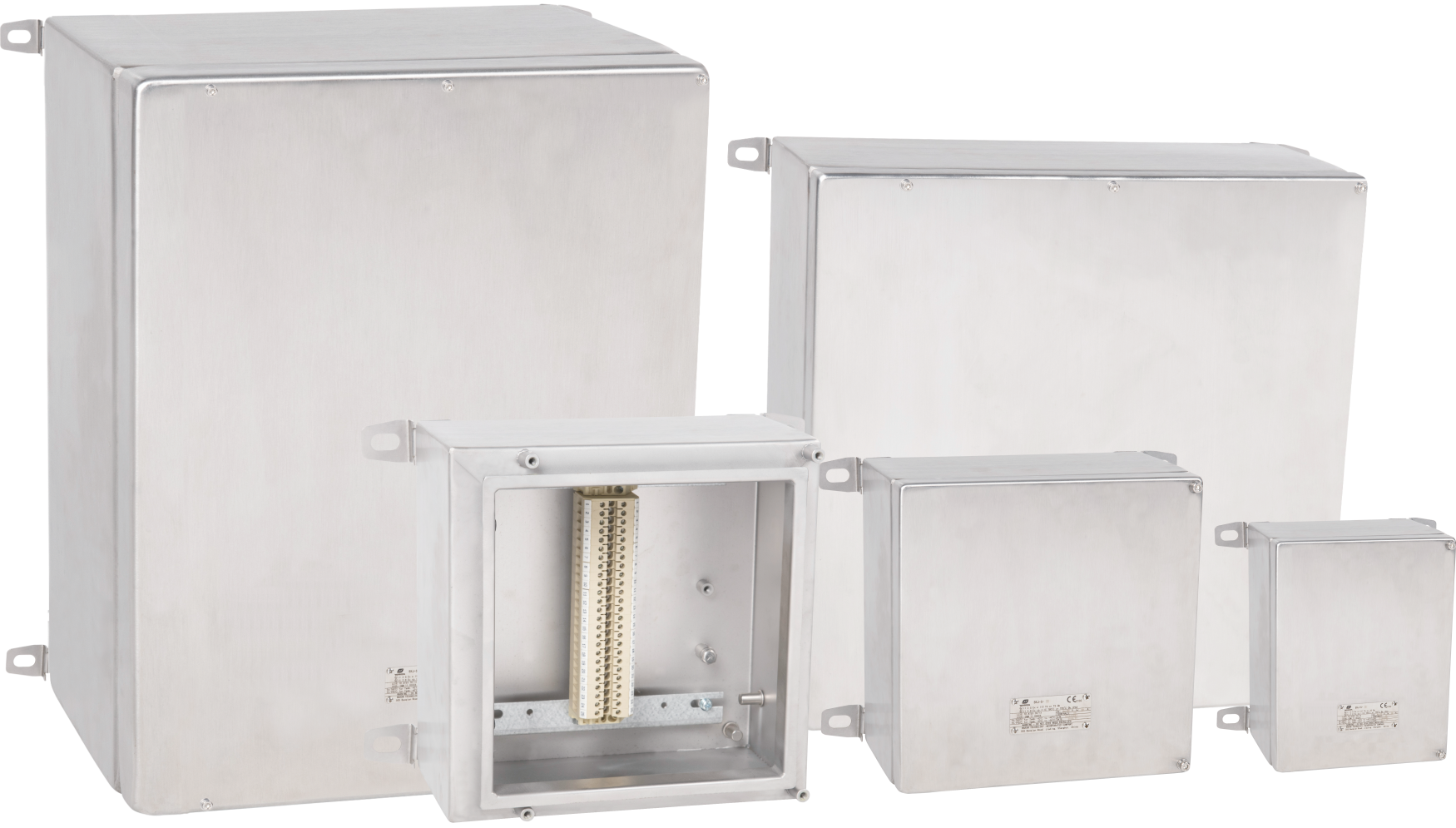
GRP, glass-fibre reinforced polyester, solves the corrosion problem in increased-safety construction and keeps the weight down, which matters for wall-mounted units in plant rooms. It is rare in flameproof construction because the flame path and impact requirements favour cast metal.
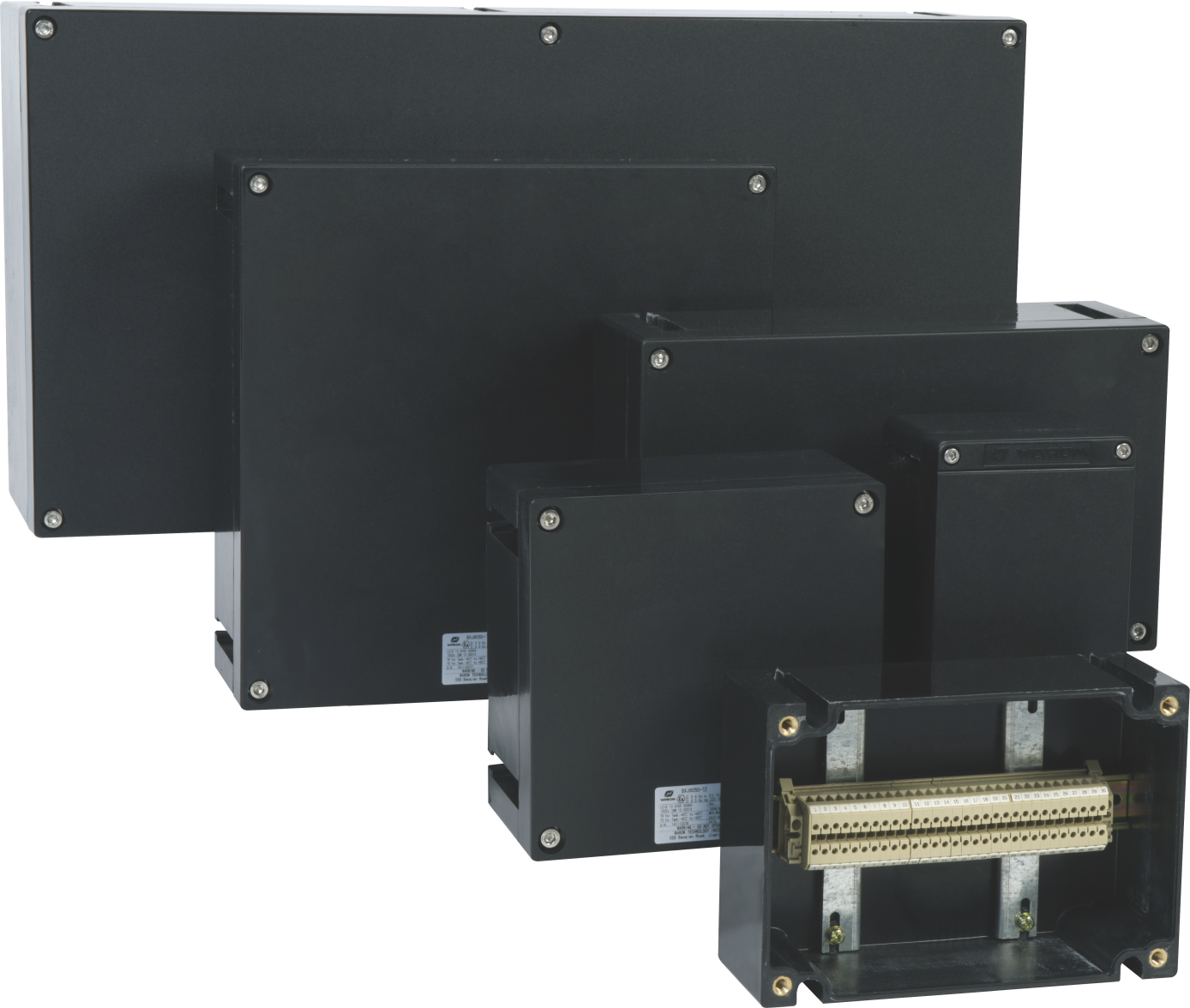
Copper-free aluminium with a powder coating is the standard flameproof material. Copper-free matters because acetylene, the group IIC reference gas, reacts with copper. The coating then has to survive the same cleaning regime as the wall behind it, and coating damage at the flange is both a corrosion start and an earthing question, since the bond has to pass through coated faces.
IP66 is the usual starting point and is tested under IEC 60529 against dust ingress and powerful water jets [8]. It is not a kimyasal resistance rating and it is not a cleanroom rating. Neither the standard nor the marking says whether the gasket swells in isopropyl alcohol, whether the coating sheds particles, or whether the enclosure survives a high-pressure hot wash. That last case calls for the IPX9 test in IEC 60529 rather than IP66 [8].
Gasket material deserves a direct question. EPDM resists water and many polar solvents and swells in non-polar hydrocarbons. Silicone tolerates temperature but degrades against some solvents. PTFE-encapsulated gaskets are the expensive answer when both are aggressive. Ask for compatibility data against the named cleaning agents, not against water.
Two details separate a cabinet that survives five years from one that survives fifteen. Unused threaded entries must be closed with certified plugs of the correct thread and material, and every external fastener should be stainless and anti-loosening so it can be reopened after a washdown cycle without shearing.
What goes inside the cabinet, from circuits to cable entry
The circuit schedule is the document the panel builder works from, and it needs to be complete before the enclosure is ordered. Incoming device, busbar rating, outgoing ways and types, metering, control voltage, spare capacity and the location of residual current protection all change the enclosure volume and the heat balance.
Every outgoing way is a heat source. A cabinet with forty ways at a couple of amperes looks light and is not, because forty breakers, forty terminal pairs and a meter all release heat into a sealed box. The manufacturer declares a maximum dissipation for the enclosure at a given temperature class, and the installed load has to stay under that figure with margin. When a late change adds metering or a larger incomer, that declaration is the first document to re-check, not the last.
Spare capacity is a legitimate pharmaceutical requirement, because suites get re-purposed and instrument loops get added. It is also a thermal commitment. Empty ways add almost nothing to the heat balance, ways fitted with breakers add a little, and ways fitted with breakers plus energised instrument supplies add more.
Residual current protection at 30 mA is standard for socket-outlet circuits and increasingly specified for wet process areas. Inside an Ex e enclosure the device must itself be a certified component, which pushes many projects to place the residual current device upstream in a non-hazardous switchroom and keep only the protected final circuits in the hazardous-area cabinet.
Power and instrumentation should not share a terminal rail. The 24 V signal wiring from load cells, flow meters and analysers is usually the reason a pharma cabinet is larger than the load suggests, and segregation is easier to hold when instrument terminals have their own rail, their own gland plate and their own identification.
Final circuits for emergency lighting should be separately protected and clearly identified so that a monthly test does not disturb process supplies.
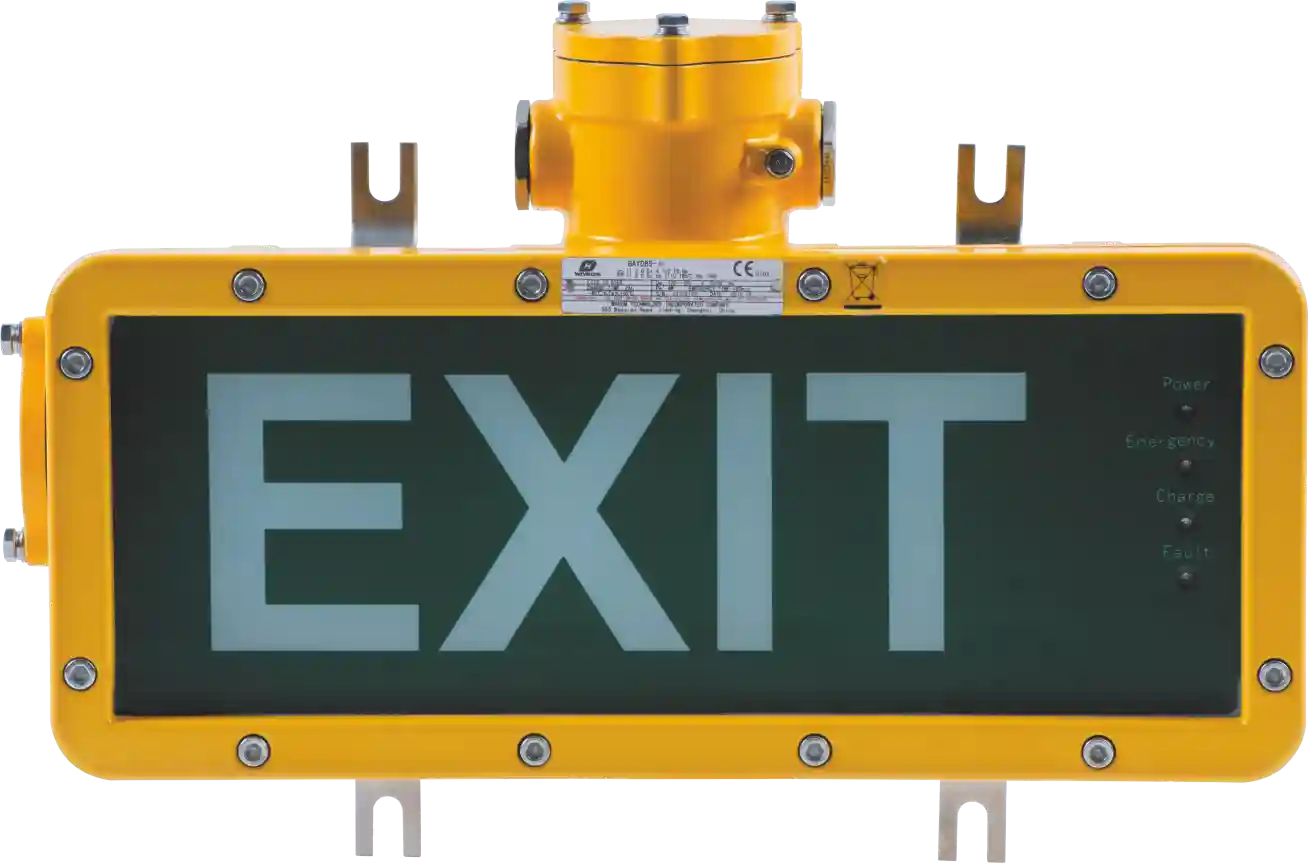
Lighting ways inside the same cabinet follow the same logic. Corridor and flood circuits are often grouped on one side of the panel, with the switch and protection for each group labelled to match the room numbering rather than the panel builder’s sequence.
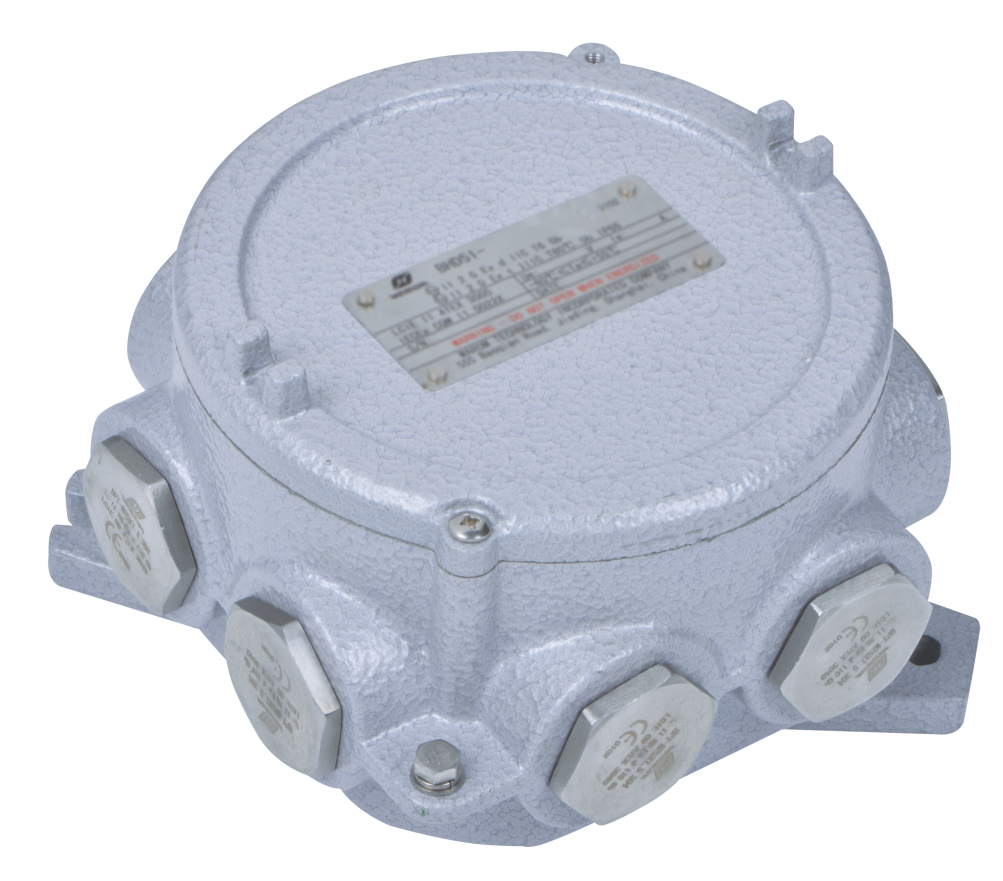
Cable entry is where a certified cabinet quietly becomes an uncertified one. Each gland has to match the cable’s actual outer diameter and the enclosure’s protection concept: a barrier gland for armoured cable entering a flameproof enclosure, an increased-safety gland into an Ex e enclosure. One cable per entry, and unused entries closed with certified plugs. Drilling an extra entry outside the certified arrangement voids the type examination, and moving entries onto a gland plate is acceptable only where the certificate permits it.
Earthing is checked twice, at the factory and at the installation. Internal and external earthing studs sized for the fault current, a separate protective conductor bar rather than reliance on the enclosure shell, and a continuity measurement recorded in the verification dossier. Bottom entry is the standard for a reason, since it sheds water instead of channeling it toward the gasket.
Documentation, certification and factory acceptance
Under the ATEX Directive 2014/34/EU, equipment for explosive atmospheres carries an EU-type examination certificate from a notified body, a quality assurance notification covering production, an EU declaration of conformity, and the CE and Ex markings; the directive has applied since 20 April 2016 [9]. The IECEx system delivers a certificate of conformity plus a quality assessment report for the same product family, and most export projects now expect both sets of paper.
The certificate covers a type, not an assembly. Two checks catch most mismatches. First, compare the certificate number and the full marking string on the nameplate against the certificate schedule. Second, read the schedule of limitations, because it commonly fixes the permitted cable entries, the ambient range, the internal component families and the maximum dissipation.
For a plant built to North American practice, the equivalent framework runs through Articles 500 and 502 of NFPA 70 for Class and Division marking, and Articles 505 and 506 for the zone system [10]. A cabinet built to a European specification will not carry the North American marking, and the reverse is also true, so the requirement belongs in the enquiry rather than in a post-award clarification.
A cabinet built for a European pharmaceutical client and one built for a US client can hold identical components and still need different marking, documentation and approval routes. <Patlamaya Dayanıklı Motor Bağlantı Kesiciler: ATEX ve NEC Uyumu> covers how ATEX and NEC compliance requirements differ for the same switching duty.
Factory acceptance is the last point where a wrong breaker, a missing plug or a reversed terminal is cheap to correct. The checks worth witnessing are the marking and nameplate against the certificate, point-to-point wiring continuity against the schedule, insulation resistance, functional operation of every breaker, residual current trip test, meter readout, terminal torque, gland and plug verification against the cable schedule, and internal separation and labelling.
The installation standards then take over. IEC 60079-14 governs design, selection and erection, including verification of the completed installation, and IEC 60079-17 governs inspection and maintenance with a graded initial inspection [11], [12]. Neither replaces the quality unit’s expectations. EU GMP Annex 1 sets cleanroom finish and contamination control expectations that reach the electrical enclosure, and although it does not certify equipment, an auditor reads the cleanability of a cabinet in the same way as a wall panel [13].
The RFQ fields and the claims that do not survive review
An enquiry that lists only a model and a circuit count returns quotes that cannot be compared, because each supplier will fill the gaps with its own assumptions. These six fields close most of the distance.
| RFQ field | Ne belirtmeli | Why the answer changes |
|---|---|---|
| Area classification | Zone, gas group or dust group, EPL, temperature class or maximum surface temperature, ambient range | Sets the marking, the enclosure family and the permitted internal dissipation |
| Koruma konsepti | Ex d, Ex e, Ex de or Ex p, and which applies to which compartment | Decides whether standard components are allowed inside |
| Circuit schedule | Incomer rating, outgoing ways and types, spare ways, metering, control voltage, residual current location | Drives heat load, busbar size and enclosure volume |
| Malzeme ve yüzey işlemi | 304 or 316L stainless, GRP, coated aluminium, coating system, gasket material | Drives cost and the cleaning regime the cabinet will survive |
| Cleaning and ingress | IP rating, washdown method, named cleaning agents, cleanroom class | Separates IP66 from IPX9 and from chemical compatibility |
| Belgeler | ATEX and IECEx certificates, quality assessment report, material certificates, test reports, drawings, spare parts list | Decides whether the cabinet is released without a second paperwork round |
Certificates and markings answer narrower questions than project teams expect. The table below separates what each record supports from what it cannot.
| Kayıt | Yöntem bağlamı | Sorumlu kullanım | İnferans yapmayın |
|---|---|---|---|
| IECEx certificate of conformity for the cabinet type | Issued against the IEC 60079 series for a defined variant | Confirms the certified variant meets the standard for the stated marking | That added cable entries, a different breaker family or a larger incomer stay inside the certification |
| IP66 marking | Dust and jet tests to IEC 60529 | Confirms ingress protection against dust and water jets | That the gasket resists the plant’s cleaning agents or that the surface is cleanroom-compatible |
| T4 temperature class at 40 °C ambient | Surface temperature assessed at declared load and ambient | Confirms surfaces stay below 135 °C under those conditions | That the class holds after circuits are added or the room runs hotter |
| Ex tb IIIC marking with a stated surface temperature | Dust ignition protection by enclosure | Confirms suitability for the stated dust group and temperature limit | That it covers a solvent vapour hazard in the same room |
| Supplier statement of GMP compliance | The supplier’s internal quality procedure | Supports the documentation, finish and cleanability discussion | That the equipment holds a GMP certificate, since GMP applies to processes and systems rather than to a cabinet |
A specification that survives both reviews is usually shorter than project teams expect. It quotes the classification study, names the protection concept for each compartment, states the material and cleaning exposure, and asks for the certificate schedule against the actual bill of materials. Everything else follows from those four decisions.
Send the classification and the circuit schedule
Most of the delay in a pharmaceutical cabinet order comes from three documents arriving at different times: the area classification drawing, the circuit schedule and the cleaning regime. Sent together, they let the proposal be built around the plant instead of around a catalogue number.
For a comparison you can act on, include the zone, gas group or dust group, equipment protection level and temperature class; the ambient range and the named cleaning agents; the incomer rating, outgoing ways, spare capacity and metering; the cable entry sizes, thread standard and gland type; the enclosure material and finish; and the certification you need to see before shipment, whether ATEX, IECEx or both.
Warom Technology Incorporated Company builds compound Ex de and increased-safety distribution cabinets for pharmaceutical and chemical projects, and the engineering team can review a draft specification against the classification drawing before an enquiry becomes an order. Email gm*@***om.com or call +86 21 39977076 / +86 21 39972657 with the documents above.
SSS
Do pharmaceutical plants need both gas and dust certification on one cabinet?
Only where both hazards exist in the same room, which happens more often than most specifications assume. If the classification study shows Zone 1 or Zone 2 for solvent vapour and Zone 21 or Zone 22 for powder, the nameplate should carry both strings, for example Ex db eb IIC T6 Gb and Ex tb IIIC T80 °C Db. A gas-only cabinet leaves the dust case uncovered, and adding a dust marking later usually means a different enclosure family rather than an extra label.
Can a standard miniature circuit breaker go inside an Ex e cabinet?
No, unless the breaker is certified as an Ex e component. Increased safety relies on the absence of arcs and hot surfaces in normal operation, so IEC 60079-7 places requirements on the devices themselves as well as on the enclosure [5]. The same breaker is acceptable inside a flameproof enclosure, where the box contains the fault, provided heat release stays within the marked temperature class. The mix-up is common because both cabinets look like grey boxes on a drawing.
Is an IP66 cabinet suitable for cleanroom washdown?
IP66 covers dust tightness and powerful water jets to IEC 60529 and says nothing about chemical attack, particle shedding or high-pressure hot washing [8]. A cabinet washed with hypochlorite needs a 316L surface and a gasket compatible with that agent; a cabinet cleaned with a high-pressure lance needs the IPX9 test rather than IP66. Treat ingress protection, chemical resistance and cleanroom compatibility as three separate requirements with three separate pieces of evidence.
How many spare ways should a pharmaceutical distribution cabinet carry?
There is no universal figure, and a number copied from another project is a guess. Work from the suite’s change history and its instrument loop forecast, then check the thermal consequence with the manufacturer: each spare way fitted with a breaker adds dissipation, and the declared maximum for the enclosure at the required temperature class has to absorb that addition. A cabinet with generous spare capacity and no dissipation headroom is a cabinet that will need replacing.
Does an ATEX certificate cover a project-specific assembly?
The certificate covers the type and the variants described in its schedule, and a cabinet built to your circuit schedule is covered only while it stays inside that schedule. Extra entries, a different breaker family, a larger incomer or an added meter each move the assembly away from the certified configuration. Ask for the certificate schedule and the bill of materials side by side before release, and record the comparison in the project file.
Kaynaklar
[1] IEC 60079-10-1:2020, “Patlayıcı atmosferler – Bölüm 10-1: Alanların Sınıflandırılması – Patlayıcı gaz atmosferleri,” Uluslararası Elektroteknik Komisyonu, Cenevre, 2020.
[2] IEC 60079-10-2:2015, “Explosive atmospheres – Part 10-2: Classification of areas – Explosive dust atmospheres,” International Electrotechnical Commission, Geneva, 2015.
[2] IEC 60079-0:2017, “Patlayıcı atmosferler – Bölüm 0: Ekipman – Genel gereksinimler,” Uluslararası Elektroteknik Komisyonu, Cenevre, 2017.
[6] IEC 60079-1:2014, “Patlayıcı ortamlar – Bölüm 1: Alev geçirmez muhafazalar ‘d’ ile ekipman koruması,” Uluslararası Elektroteknik Komisyonu, Cenevre, 2014.
[5] IEC 60079-7:2017, “Explosive atmospheres – Part 7: Equipment protection by increased safety ‘e’,” International Electrotechnical Commission, Geneva, 2017.
[8] IEC 60079-31:2013, “Patlayıcı ortamlar – Bölüm 31: Muhafaza ‘t’ ile ekipman toz tutuşma koruması,” Uluslararası Elektroteknik Komisyonu, Cenevre, 2013.
[7] IEC 60079-2:2014, “Explosive atmospheres – Part 2: Equipment protection by pressurized enclosure ‘p’,” International Electrotechnical Commission, Geneva, 2014.
[5] IEC 60529:1989+AMD1:1999+AMD2:2013, “Kapsamlar tarafından sağlanan koruma dereceleri (IP Kodu),” Uluslararası Elektroteknik Komisyonu, Cenevre, 2013.
[9] Directive 2014/34/EU of the European Parliament and of the Council of 26 February 2014 on the harmonisation of the laws of the Member States relating to equipment and protective systems intended for use in potentially explosive atmospheres, Official Journal of the European Union, L 96, 29 March 2014.
[4] NFPA 70, “Ulusal Elektrik Kodu,” Ulusal Yangın Koruma Derneği, Quincy, MA, 2023.
[5] IEC 60079-14:2013, “Patlayıcı atmosferler – Bölüm 14: Elektrik tesisatlarının tasarımı, seçimi ve montajı,” Uluslararası Elektroteknik Komisyonu, Cenevre, 2013.
[9] IEC 60079-17:2013, “Patlayıcı atmosferler – Bölüm 17: Elektrik tesisatlarının denetimi ve bakımı,” Uluslararası Elektroteknik Komisyonu, Cenevre, 2013.
[13] European Commission, “EU Guidelines for Good Manufacturing Practice for Medicinal Products for Human and Veterinary Use, Annex 1: Manufacture of Sterile Medicinal Products,” Brussels, 2022.
İlginizi çekiyorsa, bu ilgili makalelere göz atabilirsiniz:
EMC Patlama Dayanıklı Kablo Kızakları Korumalı Kontrol Kabloları İçin: Teknik bir Kılavuz
Warom Patlayıcıya Dayanıklı Tedarikçi Toplantısı 2024
NEMA 7 ile ATEX Onaylı Patlamaya Dayanıklı Kontrol İstasyonları
İlerleyici Rüzgar: Patlamaya Dayanıklı Elektrik Güvenlik Çözümleri
On yılı aşkın deneyime sahip olan o, güvenlik ve patlamaya dayanıklı ürünlerin tasarımı ve üretimi konusunda uzmanlaşmış deneyimli bir Patlamaya Dayanıklı Elektrik Mühendisidir. Patlama dayanıklı sistemler, nükleer güç aydınlatması, deniz güvenliği, yangın koruması ve akıllı kontrol sistemleri dahil olmak üzere ana alanlarda derin uzmanlığa sahiptir. Warom Teknoloji Enstitüsü Şirketi’nde Uluslararası İşlerden Sorumlu Baş Mühend, Uluslararası Ar-Ge Departmanı Başkanı olarak çift liderlik rolüne sahiptir; burada Ar-Ge girişimlerini denetler ve uluslararası projeler için tasarım dokümantasyonunun kesin teslimatını sağlar. Küresel endüstriyel güvenliği ilerletmeye kendini adayan, karmaşık teknolojileri pratik çözümlere dönüştürmeye ve müşterilerin dünyanın dört bir yanındaki daha güvenli, akıllı ve daha güvenilir kontrol sistemlerini uygulamasına yardımcı olmaya odaklanır.

Qi Lingyi