Hail & Gasha Project
- Project Overview
The HAIL&GASHA Project, full name Hail and Ghasha Development Project, is a large-scale offshore sour gas field development project led by the Abu Dhabi National Oil Company (ADNOC). It is part of the Ghasha Concession, the world’s largest offshore sour gas development area. This project is strategically significant for the UAE to achieve natural gas self-sufficiency, expand energy export capacity, and advance its 2045 operational net-zero emission target.Relying on professional technical solutions and product strength, Warom successfully won bids for two core categories of the project: the lighting package and the distribution box package, with a total order value exceeding USD 10 million, becoming a key performance driver for the company’s foreign trade business.
- Customer background and challenges
Abu Dhabi National Oil Company (ADNOC) is the initiator, leader and the largest equity holder of the project, with a 55% stake in the project. As a national core energy enterprise of the UAE, ADNOC covers the entire industrial chain of oil and gas exploration and development, refining and chemical processing, transportation, and sales. It not only undertakes the responsibility of ensuring the UAE’s domestic energy supply, but also holds significant influence in the global energy market. The company has been advancing its comprehensive natural gas master plan, and the HAIL&GASHA Project is a crucial component of this plan. Meanwhile, the project serves as a core initiative for ADNOC to fulfill its 2045 operational net-zero emission target, thereby strengthening its image as a responsible energy producer.
As an ultra-large offshore sour gas field development project, HAIL&GASHA faces intensive technical challenges across multiple core aspects, including sour gas treatment, special pipeline design, construction in complex marine environments, and the implementation of low-carbon technologies. Each of these aspects demands rigorous technical adaptation and problem-solving efforts.In addition, as a offshore project, it imposes extremely stringent anti-corrosion requirements on equipment, necessitating suppliers to demonstrate proven capabilities in equipment surface treatment technology.
- OurSolution
In response to the project’s complex environmental conditions, as well as the diverse types of equipment and installation methods involved, our company actively coordinated with the customer on technical solutions to meet their requirements. Despite having little prior experience with CX anti-corrosion treatment, we conducted thorough research and development on coating processes to ensure compliance.
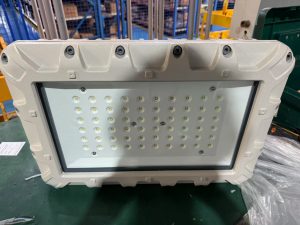
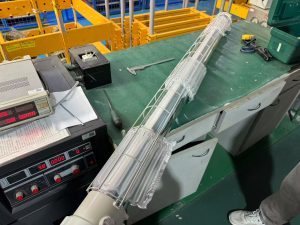
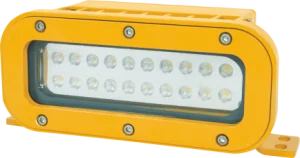
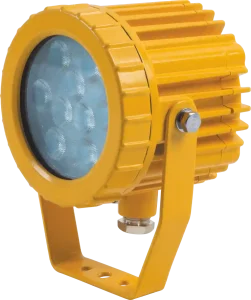
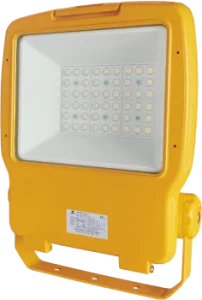
The core configuration includes BAY51-D explosion-proof linear lights, BAT86 floodlights, and BAM52 street lights. It is also equipped with 3m, 6m, 9m, and 20m light poles, along with winch lifting systems for height adjustment. Additionally, the electrical supporting components consist of BXJ8050 series explosion-proof junction boxes and BXMD series explosion-proof plugs and sockets.
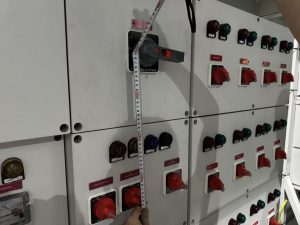
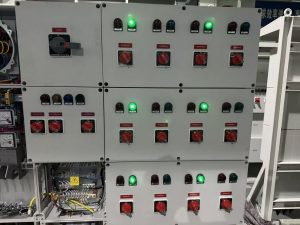
The system adopts the BXMD8050 distribution box series, internally fitted with humidity controllers (HTC-302) and temperature controllers (CERx 020-100w) to adapt to the harsh climatic conditions of offshore platforms. The external paint coating thickness reaches 300 microns, meeting the strict high anti-corrosion requirements.
All products have passed sample testing at the Warom Laboratory, including tests for high pressure, high temperature, and especially anti-corrosion performance. The light poles have also successfully met the wind load calculation requirements specified by the project.
- Implementation Process &Timeline
April 2024: Completed bidding and technical clarification.
June-August 2024: Finalized contract signing, and completed technical scheme review and approval.
August-November 2024: Achieved mass production of the first batch of products.
November 2024-February 2025: Conducted product inspection and subsequent rectification.
March 2025: Fulfilled the delivery of the first batch of products.
June-December 2025: Carried out production and delivery of the second and third batches of orders.
- Results & Data Highlights
Warom secured an order of over USD 10 million for the HAIL&GASHA Project, covering a complete set of equipment including various types of lamps, light poles, junction boxes, and explosion-proof distribution boxes, with a wide coverage area. There is potential for supplementary contracts in the future, making this project one of the main contributors to Warom’s foreign trade performance.
The surface anti-corrosion coating process integrates multiple procedures including anodizing, hot-dip galvanizing, and spray painting, ensuring that the equipment can be used for a long time in harsh environments with high acidity and humidity. Within 6 to 12 months after delivery, no corrosion or paint peeling issues have been reported. Except for minor bumps on a very small number of products, the qualification rate of the coating treatment reached 100%.
- Customer Feedback
“As a world-class large-scale offshore sour gas field development project, the significance of HAIL&GASHA is self-evident. Warom Technology has always adhered to a customer-centric approach, striving to meet project requirements to the fullest extent. It has also allocated resources multiple times to support the on-site project schedule. When problems arise, the team proactively communicates with us and resolves issues from our perspective. This has built a high level of mutual trust and laid a solid foundation for future cooperation between our two parties.”—— Saipem H&G Project Team
- Lessons & Insights
Although the production and delivery of each batch proceeded smoothly during the project execution, some issues emerged in the initial technical clarification phase. For example, there were discrepancies in the supply scope of installation accessories for the lighting package, and a failure to fully understand the single-line diagrams for the distribution box package led to missing components.
Therefore, in the execution of future projects, we should adhere to the principle of extreme attention to detail, maintain close communication with customers, and promptly clarify and resolve any problems that arise.
In terms of delivery schedules, we should maintain close contact with the production and scheduling departments, track production status in real time, provide timely progress updates to customers, and ensure that delivery timelines are kept under strict control.