

Floating Production Storage and Offloading vessels operate where hydrocarbons are processed, stored, and transferred continuously—conditions that leave no margin for electrical system failure. Explosion proof marine products form the backbone of FPSO electrical safety, preventing ignition sources from reaching flammable atmospheres while withstanding salt spray, vibration, and temperature extremes. The equipment selection process involves matching protection methods to hazardous area classifications, verifying certifications against flag state and class society requirements, and confirming that materials will survive decades of offshore service. This article walks through the safety challenges specific to FPSO operations, the protection technologies available, certification pathways, and how integrated electrical systems maintain operational continuity.
What Makes FPSO Electrical Safety Different from Fixed Platforms
FPSO vessels combine production, processing, and storage functions on a single hull that moves with wave action and weathervanes around its mooring. This creates electrical safety challenges that fixed platforms rarely face. Hydrocarbon processing equipment sits meters from accommodation modules. Cargo tanks expand and contract with temperature cycles, releasing vapors into surrounding spaces. The hull flexes, stressing cable runs and junction boxes in ways that rigid structures do not.
Zone classifications on FPSOs shift with operational modes—tank cleaning, cargo transfer, and maintenance activities all change the hazardous area boundaries temporarily. Electrical equipment must tolerate these transitions without requiring recertification or physical relocation. The Tilenga project in Uganda, where explosion-proof lighting and electrical systems were supplied for wellpads and a Central Processing Facility, demonstrated that even onshore facilities with similar hydrocarbon exposure require equipment capable of performing under extreme conditions with zero safety incidents. FPSO applications demand the same reliability plus resistance to marine-specific degradation.
Static discharge presents another concern unique to floating operations. Cargo transfer hoses, helicopter operations, and even personnel movement across deck coatings can generate sparks if bonding and grounding systems fail. Explosion proof products must integrate with vessel-wide bonding schemes rather than functioning as isolated components.
How Flameproof, Increased Safety, and Intrinsically Safe Methods Compare
Explosion protection methods each address ignition prevention through different mechanisms. Selecting the appropriate method depends on the equipment function, the zone classification, and the gas groups present.
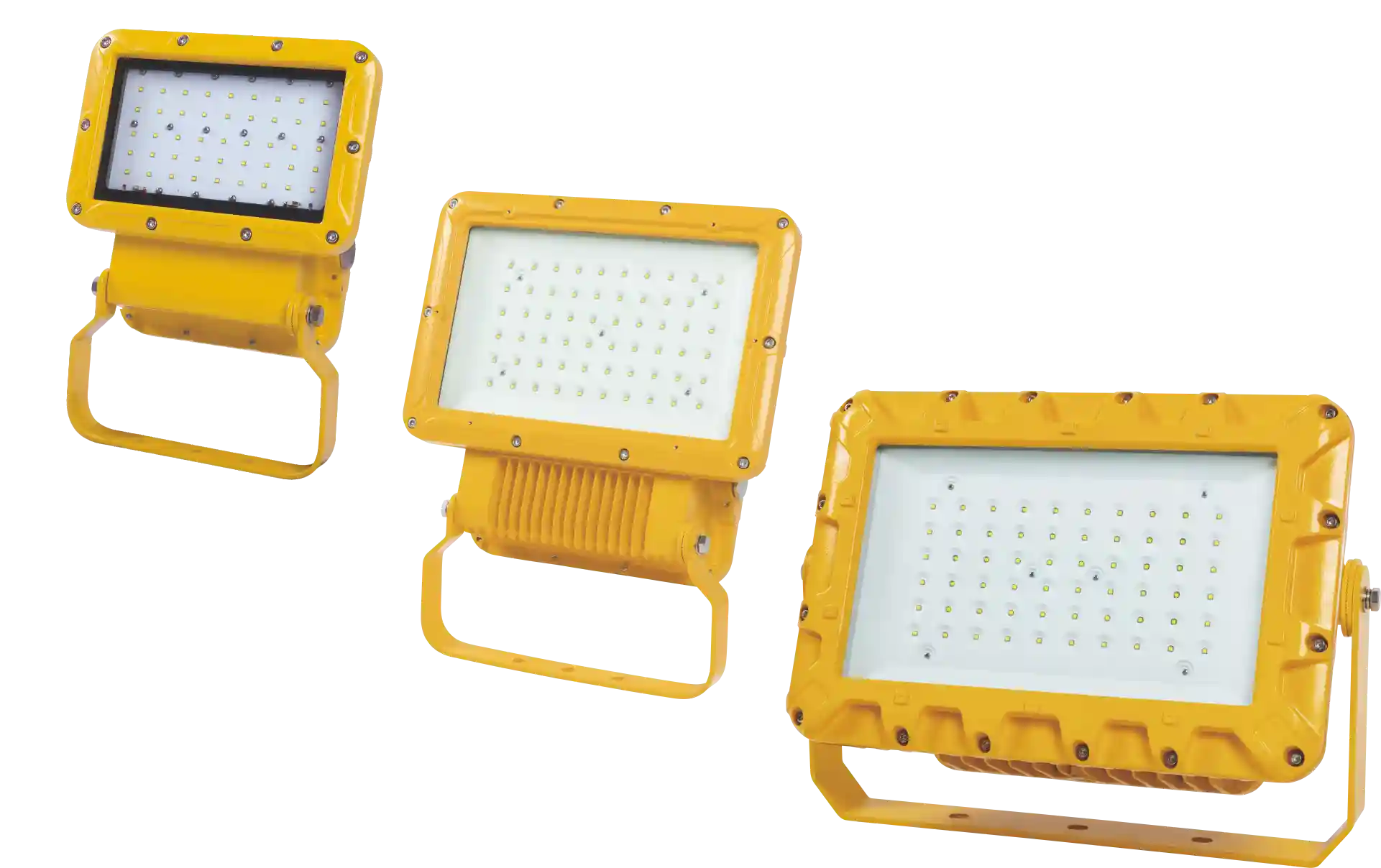
Flameproof enclosures, designated Ex d, contain any internal explosion and cool escaping gases through precisely machined flame paths. The explosion cannot propagate to the surrounding atmosphere. This method suits motors, switchgear, and control panels where internal arcing or sparking is unavoidable during normal operation. The BAT86 Explosion-proof LED Floodlights use this approach, housing the driver electronics in a steel enclosure with powder-coated surfaces that resist corrosion while maintaining flame path integrity.
Increased safety construction, designated Ex e, eliminates sparks and excessive temperatures during normal operation through enhanced insulation, wider clearances, and temperature-limited components. Terminal boxes, junction boxes, and certain lighting fixtures use this method. It works well in Zone 1 and Zone 2 areas where the equipment itself does not produce arcs but must tolerate the surrounding atmosphere without becoming an ignition source.
Intrinsically safe circuits, designated Ex i, limit electrical and thermal energy below the ignition threshold of the hazardous atmosphere. Instrumentation, sensors, and communication devices commonly use this protection method because it allows maintenance without de-energizing circuits or evacuating the area. The energy limitation means intrinsically safe equipment cannot power high-current loads, restricting its application to low-power devices.
| Protection Method | Mechanism | Typical Applications | Zone Suitability |
|---|---|---|---|
| Ex d (Flameproof) | Contains internal explosion, cools escaping gases | Motors, control panels, high-power lighting | Zone 1, Zone 2 |
| Ex e (Increased Safety) | Prevents sparks and hot surfaces | Terminal boxes, junction boxes, certain fixtures | Zone 1, Zone 2 |
| Ex i (Intrinsically Safe) | Limits circuit energy below ignition threshold | Sensors, instrumentation, communication devices | Zone 0, Zone 1, Zone 2 |
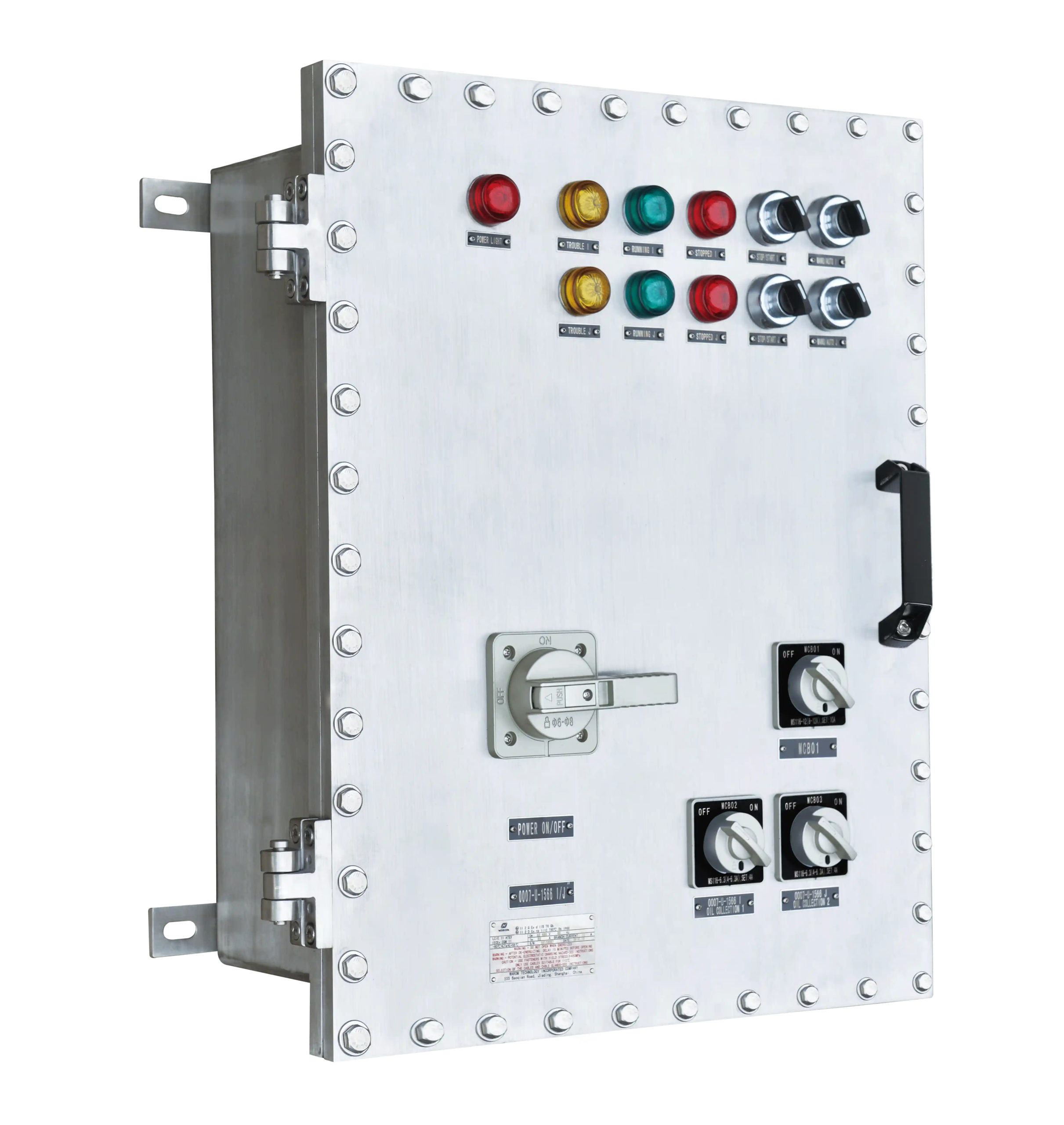
The HRMD92 Series Explosion Proof Distribution Panels combine flameproof and increased safety chambers in a single unit, allowing power distribution components to sit in Ex d compartments while terminal connections occupy Ex e sections. This modular approach reduces the number of separate enclosures required and simplifies cable routing.
Which Certifications Actually Matter for FPSO Equipment Procurement
Certification requirements for explosion proof marine products involve overlapping regulatory frameworks. Understanding which certifications apply to a specific FPSO project prevents procurement delays and rejection during class surveys.
ATEX certification applies to equipment entering the European market, covering both the equipment directive (2014/34/EU) and workplace directive (1999/92/EC). The certification mark indicates the equipment category, gas group, and temperature class. FPSOs flagged in EU member states or operating in EU waters require ATEX-certified equipment in hazardous areas.
IECEx certification provides international recognition without geographic restriction. The scheme includes a certificate of conformity for the equipment and a quality assessment report for the manufacturing facility. Many operators specify IECEx as the baseline requirement because it simplifies procurement across multiple projects in different jurisdictions.
Marine type approvals from classification societies—DNV, ABS, Lloyd’s Register, Bureau Veritas—confirm that equipment meets the additional requirements for shipboard installation. These approvals address vibration resistance, temperature range, electromagnetic compatibility, and material suitability for marine atmospheres. An explosion proof product with ATEX and IECEx certification but without marine type approval may be rejected during FPSO construction or conversion surveys.
Flag state requirements add another layer. Some flag administrations accept classification society approvals directly; others require separate national certification. The procurement specification should identify the flag state early and confirm which certifications that administration recognizes.
Products certified by IECEx, ATEX, UL, CCS, BV, LCIE, PTB, Nemko, and DNV cover most FPSO project requirements, but the specific combination needed depends on the vessel’s flag, operating location, and operator preferences.
What Material and Construction Features Extend Service Life Offshore
Marine environments degrade electrical equipment through mechanisms that rarely affect onshore installations. Salt spray penetrates enclosures through cable entries and breathing devices. Humidity condenses inside housings during temperature cycles. Ultraviolet radiation breaks down polymer components. Vibration from propulsion systems, cargo pumps, and wave action fatigues mounting brackets and loosens connections.
Ingress protection ratings indicate resistance to water and dust penetration. IP66 ratings, as specified for the BHD91 Series Explosion-proof Junction Boxes, confirm that the enclosure resists powerful water jets and complete dust ingress. IP67 and IP68 ratings indicate temporary or continuous immersion capability, relevant for equipment in areas subject to wave wash or firefighting water.
Material selection determines corrosion resistance. Stainless steel enclosures resist chloride attack but add weight and cost. Powder-coated carbon steel provides adequate protection in many applications if the coating remains intact. GRP composite materials, used in the BCZ8060 Series Explosion-proof Plugs and Sockets, combine corrosion resistance with light weight and high mechanical strength.
Cable glands require particular attention because they penetrate the enclosure boundary. The DQM-III/II Series Explosion Proof Cable Glands carry IECEx and ATEX certification, maintaining the enclosure’s protection rating while providing strain relief and sealing around armored or unarmored cables. Incorrect gland selection or installation compromises the entire enclosure’s certification.
Thermal management affects both safety and longevity. LED lighting fixtures generate less heat than legacy technologies, reducing the temperature rise that contributes to insulation degradation and premature component failure. The BAT86 floodlights incorporate constant current and constant voltage driver power with overload protection, preventing thermal runaway that could damage the fixture or create a hazard.
How Integrated Systems Reduce Risk Beyond Individual Component Performance
Individual explosion proof products provide protection at specific points. Integrated systems extend that protection across the entire electrical installation, creating layered defenses that respond to changing conditions.
Gas detection systems connected to explosion proof control panels can isolate power to specific zones when hydrocarbon concentrations approach dangerous levels. The BXM(D)8050 Explosion-proof Illumination Distribution Boxes support this integration, allowing automated load shedding without manual intervention. The response time between detection and isolation determines whether the system prevents an incident or merely documents it.
The General Paint electrical safety upgrade project illustrated how integration improves outcomes. On-site diagnosis identified specific vulnerabilities, and the solution combined gas detectors, explosion-proof plugs, and junction boxes into a coordinated system. The result was measurably improved safety and prevention of potential fires that individual components alone could not have achieved.
If your FPSO project involves multiple hazardous area zones with different classification levels, discussing the integration architecture with the equipment supplier before finalizing specifications helps avoid compatibility issues during installation.
Project coordination affects integration success as much as product selection. The Fushilai Pharmaceutical CM/CDMO construction project demonstrated that early coordination between the equipment supplier and project team ensured timely delivery of explosion-proof distribution boxes for workshops, warehouses, and tank farms. Late-stage changes to integrated systems create schedule delays and increase the risk of installation errors.
What Surveillance and Monitoring Equipment Operates in Hazardous Zones
FPSO operations require visual monitoring of hazardous areas for security, safety, and operational purposes. Standard cameras cannot operate in Zone 1 or Zone 2 atmospheres without creating ignition risks. Explosion proof cameras provide continuous surveillance while meeting hazardous area certification requirements.
The BJK-S/G Series Explosion Proof Camera carries IP66 and IP68 ratings, confirming resistance to water jets and submersion. H.265 video compression reduces bandwidth requirements for transmission to control rooms, relevant for FPSOs where communication links may have limited capacity. The camera housings use the same protection methods as other explosion proof equipment, containing any internal faults within the enclosure.
Positioning cameras in hazardous zones requires coordination with the hazardous area classification study. Camera locations that provide useful coverage may fall in higher-risk zones than anticipated, requiring more stringent protection methods or alternative mounting positions. The classification study should inform camera placement rather than the reverse.
Lighting affects camera performance. Explosion proof LED floodlights provide consistent illumination without the color temperature shifts and warm-up delays of legacy technologies. The Helicopter Landing Platform Aid System demonstrates how lighting designed for severe environments maintains reliable function despite moisture, vibration, and corrosion exposure.
Where Smart Technologies Fit in FPSO Explosion Protection
Digitalization introduces new capabilities to explosion protection systems without compromising safety fundamentals. Remote diagnostics allow shore-based engineers to assess equipment condition without traveling to the vessel. Automated safety checks confirm that protection systems remain functional between manual inspections. Predictive maintenance algorithms identify degradation patterns before failures occur.
These technologies require explosion proof equipment that supports digital communication protocols. Ethernet connections, wireless transmitters, and sensor interfaces must all meet hazardous area certification requirements. The protection methods remain the same—flameproof enclosures, intrinsically safe circuits, increased safety construction—but the equipment inside those enclosures performs additional functions.
Regulatory frameworks continue evolving to address digitalization. Classification societies update their rules to cover cybersecurity, software verification, and remote monitoring. Equipment suppliers must demonstrate that digital features do not compromise the underlying explosion protection or introduce new failure modes.
The practical benefit for FPSO operators is reduced inspection burden and earlier warning of developing problems. A flameproof motor with embedded temperature and vibration sensors can signal bearing wear weeks before failure, allowing planned replacement during a scheduled shutdown rather than emergency repair during production.
Frequently Asked Questions About Explosion-Proof Marine Products
What protection methods suit Zone 1 versus Zone 2 areas on FPSO vessels?
Zone 1 areas, where explosive atmospheres are likely during normal operation, require equipment certified for that classification—typically Ex d flameproof or Ex e increased safety construction, depending on the equipment type. Zone 2 areas, where explosive atmospheres occur only briefly under abnormal conditions, may use equipment with less stringent protection methods, though many operators specify Zone 1-rated equipment throughout to simplify maintenance and spare parts inventory. The hazardous area classification study for the specific FPSO determines zone boundaries and the corresponding equipment requirements.
How do temperature classes affect explosion proof equipment selection?
Temperature classes indicate the maximum surface temperature the equipment reaches during operation. The gas or vapor present determines the required temperature class—methane ignites at higher temperatures than some heavier hydrocarbons. Equipment rated T4 (135°C maximum surface temperature) suits most FPSO applications involving crude oil and associated gases. Specifying a higher temperature class than necessary adds cost without safety benefit; specifying too low a class creates ignition risk. The process safety data for the specific hydrocarbons handled determines the appropriate temperature class.
What maintenance intervals apply to explosion proof equipment offshore?
Maintenance intervals depend on the equipment type, protection method, and operating environment. Flameproof enclosures require periodic inspection of flame paths for corrosion or damage. Cable glands need torque verification and seal inspection. Lighting fixtures require lamp replacement and lens cleaning. Classification society rules and manufacturer recommendations provide baseline intervals, but actual conditions may require more frequent attention. Equipment in areas with heavy salt spray or vibration typically needs shorter intervals than equipment in protected locations. Establishing a maintenance program that accounts for site-specific conditions extends equipment life and maintains certification validity. For projects where maintenance access is limited, discussing extended-interval equipment options with the supplier during specification development can reduce lifecycle costs.
You might also be interested in these related articles:
Explosion-Proof Solenoid Valves: Gas Pipeline Control Safety
OGI 2024 Jakarta is underway
Warom at 2025 ADIPEC
Zone 21 Dust Hazards: Essential Explosion Proof Electrical Equipment
With over a decade of experience, he is a seasoned Explosion-Proof Electrical Engineer specializing in the design and manufacture of safety and explosion-proof products. He possesses in-depth expertise across key areas including explosion-proof systems, nuclear power lighting, marine safety, fire protection, and intelligent control systems. At Warom Technology Incorporated Company, he holds dual leadership roles as Deputy Chief Engineer for International Business and Head of the International R&D Department, where he oversees R&D initiatives and ensures the precise delivery of design documentation for international projects. Committed to advancing global industrial safety, he focuses on translating complex technologies into practical solutions, helping clients implement safer, smarter, and more reliable control systems worldwide.

Qi Lingyi