

Explosion proof equipment for tank farm loading and unloading areas prevents catastrophic incidents because these transfer zones create transient high-risk atmospheres that demand certified, integrated electrical and monitoring systems. Tank farms handling gasoline, diesel, crude oil, ethanol, and chemicals release flammable vapors during every truck, railcar, or ship loading operation. A single spark from a non-certified electrical device or a static discharge can ignite a vapor cloud with devastating consequences. After three decades designing and delivering explosion-proof solutions for refineries, chemical plants, and marine terminals, I have seen that the difference between a safe operation and a near miss often lies in how well the electrical infrastructure is matched to the actual process conditions at the loading rack, not just a generic hazardous area classification.
What Are the Explosion Hazards at Tank Farm Loading and Unloading Areas
The loading and unloading zone is one of the most dynamic hazardous areas in any tank farm. Unlike storage tanks, which usually operate at steady pressure and temperature, transfer operations bring product movement, vapor displacement, and frequent human and vehicle interaction. Flammable gas or vapor can be released from open fill hatches, vent stacks, leaking connections, or during disconnection of loading arms. The area immediately around a loading platform is typically classified as Zone 1 or Class I Division 1, extending several meters from potential leak points, with Zone 2 or Division 2 covering a wider radius under normal conditions.
What makes these areas particularly challenging is the transient nature of the hazard. A loading bay may be within Zone 2 for most of the day but enter Zone 1 during the start and end of a transfer when connections are made or broken. Any fixed electrical installation in this zone must therefore withstand repeated exposure to flammable atmospheres without relying on the assumption that the hazard only exists under rare fault conditions. We design for Zone 1 as the baseline around the loading point, then extend Zone 2 coverage for the surrounding electrical infrastructure such as lighting masts, cable runs, and junction boxes. In one pharmaceutical project with a dedicated solvent tank farm, all equipment within 5 meters of the loading nozzle was specified as Ex d or Ex e for Zone 1 IIC T4, even though the client’s initial hazard drawing showed Zone 2. Our team’s insistence on this boundary, based on vapor dispersion measurement during commissioning, prevented a potential ignition event when a fitting leaked during a night shift. That is the level of conservatism that loading areas require.
Static electricity buildup is another significant ignition source. Non-conductive hoses, fast-flowing product, and the absence of verified bonding can generate potentials well above the minimum ignition energy of common vapors. A static discharge at a tank truck filling point is invisible and instantaneous, yet it can be fatal. That is why equipment such as static grounding clamps with interlocked control circuits, overfill prevention sensors, and intrinsically safe level transmitters must be part of the core explosion-proof package for any loading zone.
Essential Explosion Proof Equipment for Loading and Unloading Zones
The minimum explosion-proof equipment set for a tank farm loading or unloading area includes lighting, cable glands, junction and terminal boxes, distribution panels, and often monitoring and control devices. Each category must be correctly certified for the gas group and temperature class present. I will walk through the primary equipment types and what to specify.
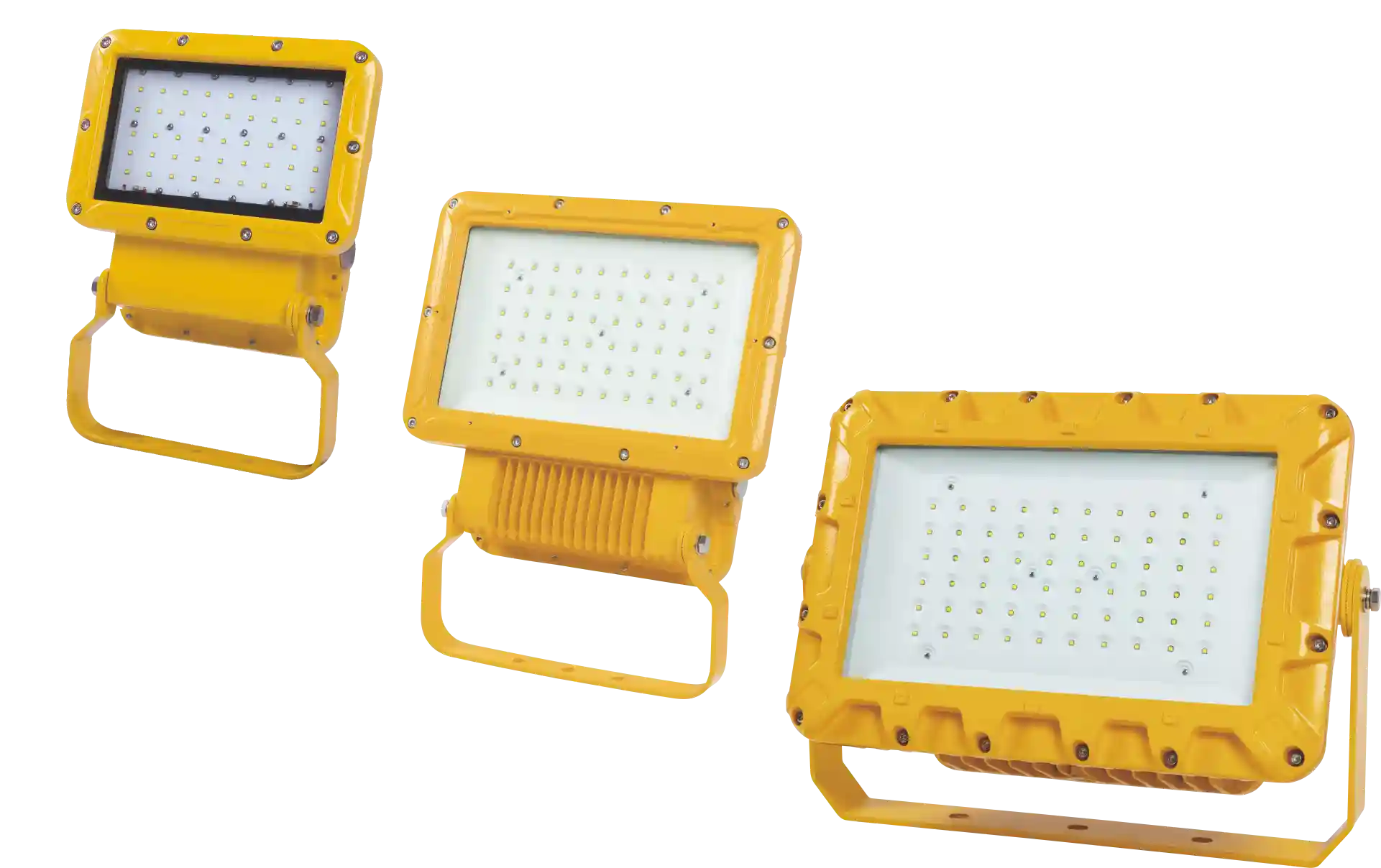
Lighting at loading bays must provide uniform illumination for operators to connect hoses, read gauges, and detect spills, without becoming an ignition source. LED floodlights with an Ex d flameproof enclosure and IP66 protection are the current industry standard. For a typical tank truck loading rack, we install BAT86 explosion-proof LED floodlights rated at 90 W or 120 W, with a color temperature of 5000 K and mounting height of 6 to 8 meters, angled to eliminate shadows without causing glare for drivers. These fittings are certified to IEC 60079, with ambient temperature range from minus 60 °C to plus 60 °C, making them suitable for Arctic and desert installations alike. The explosion proof pendant light HRY51-G C series is a good choice for low canopy areas where overhead suspension is required.
Electrical connections in the loading area must never rely on standard industrial connectors. Every cable entry point needs a certified flameproof cable gland matched to the cable type. For steel wire armored cable commonly used in petrochemical projects, the DQM-III Ex d cable gland with nickel-plated brass construction provides both explosion protection and corrosion resistance. The gland’s flame path is designed to cool escaping hot gases below the ignition temperature of the surrounding atmosphere before they reach the outside. We have supplied DQM-III glands for projects where the specification called for direct burial and exposure to salt spray, and the nickel plating plus stainless‑steel fasteners eliminated corrosion failures that had plagued the previous installation using unplated brass glands.
Armoured M20~M115 For Hazardous Area)
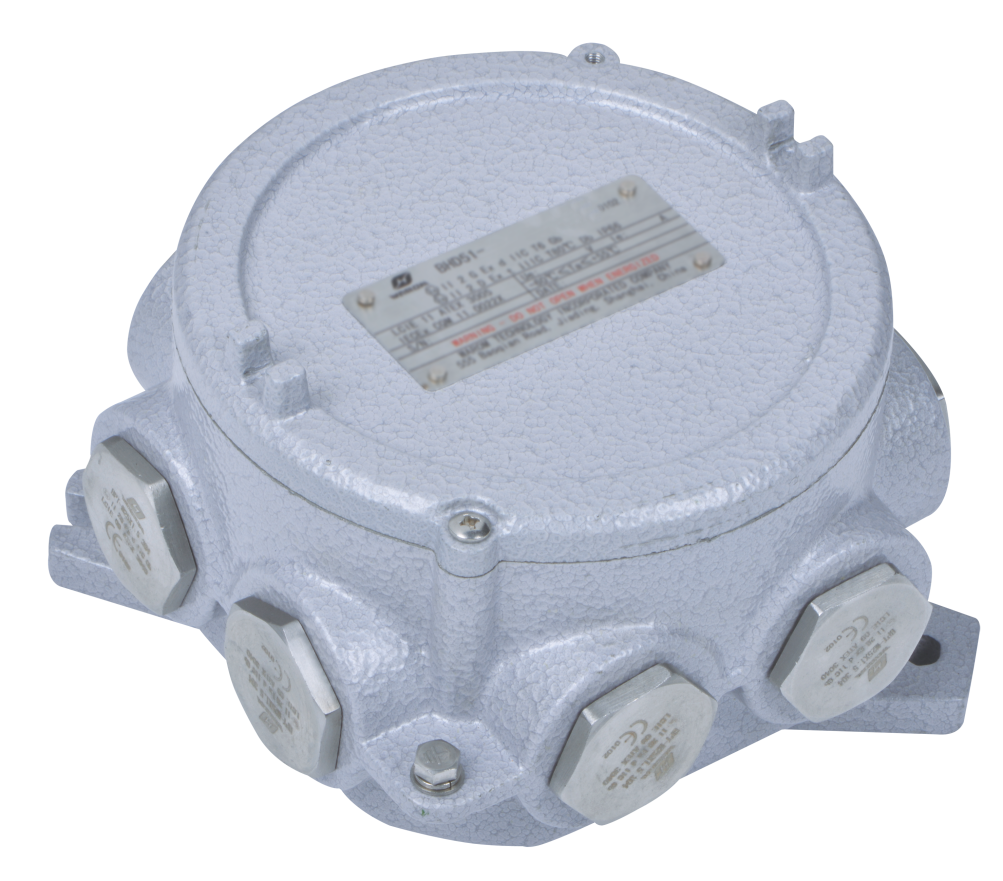
Power distribution in a loading area is often a mix of lighting circuits, pump controls, and monitoring signals. This calls for modular explosion-proof distribution panels that combine an Ex e increased safety main enclosure with Ex d flameproof branch circuit compartments. The HRMD93 series distribution panels, built with copper‑free aluminum alloy enclosure and IP66 protection, allow safe routing of multiple circuits from a single point, with color‑coded operating switches to prevent misoperation during night shifts. When the loading area has multiple bays, each bay’s lighting and pump can be fed from a dedicated circuit within the same panel, simplifying isolation during maintenance. A junction box like the BHD91 series in Ex d construction can serve as the intermediate connection point between the panel and the final device, while terminal boxes such as the BXJ8050 series in GRP are used where increased safety Ex e wiring is needed for centralized instrumentation.
Control and monitoring equipment pushes the safety envelope further. Caution spotlight fittings with audio-visual alarms, like the BBJ86 series, provide immediate warning if a loading operation exceeds preset parameters. In a sugar distillery we equipped, a BBJ86 beacon was linked to the overfill sensor so that the operator at the loading arm received both a flashing red light and a 110 dB siren the moment the tank reached 90% capacity, preventing spillover into a hot pump motor area. That combination of visual and audible alert, directly wired into the Ex d circuit, caught three overfill events in the first year alone.
Understanding ATEX, IECEx, and NEC Certifications for Tank Farm Safety
Certification is not a paperwork formality for tank farm equipment; it is the only objective proof that a product has been tested under the conditions it will face. For loading areas, you will see ATEX, IECEx, and NEC marks, and understanding the difference determines whether your equipment is legally permitted on site.
ATEX (ATmosphères EXplosibles) is the European Union directive requiring equipment to be assessed by a notified body such as LCIE, PTB, or Nemko. An ATEX certificate for a floodlight in Zone 1 will show a marking like “II 2 G Ex db IIC T4 Gb,” meaning the equipment is flameproof, suitable for IIC gases including hydrogen and acetylene, with a maximum surface temperature of 135°C (T4), and a high level of protection. We insist on ATEX certificates from an EU‑recognized notified body, not just a manufacturer’s self‑declaration. That distinction is critical: a self‑declared ATEX compliant product may have never been tested by a third party, and we have encountered projects in the Middle East where such products were rejected at the pre‑commissioning inspection, causing months of delay.
IECEx, governed by the IEC System for Certification to Standards Relating to Equipment for Use in Explosive Atmospheres, provides a single international certificate accepted in many countries. The advantage is that a product tested to IEC 60079 by a recognized Ex testing laboratory such as TÜV or SGS can be used across multiple regions without re‑testing, provided the local regulations accept IECEx. In practice, for tank farms in Africa or Southeast Asia, we specify IECEx because it simplifies the importer’s compliance burden. The DQM‑III cable gland, for example, carries IECEx TUR 22.0035X as well as ATEX TÜV 22 ATEX 8855X, so it covers both European and international projects from a single part number.
NEC (National Electrical Code) with its Class/Division system is used in North America and some Middle Eastern projects that follow US standards. The equivalent of Zone 1 for a loading bay is Class I Division 1. UL listing is required. A key practical difference is that NEC cable entry threads are often NPT, while ATEX/IECEx equipment uses metric threads. When we supply explosion proof distribution panels for a US‑funded refinery in the Middle East, the cable glands are ordered with NPT threads, and the entire panel receives a UL listing. Mismatching thread types at the loading rack is a common installation error that compromises the flame path integrity. Always verify whether your site specification calls for metric or NPT before ordering.
The table below summarizes the typical protection levels for tank farm loading area equipment:
| Standard | Zone / Division | Protection Method | Typical Equipment |
|---|---|---|---|
| ATEX/IECEx | Zone 1 | Ex d, Ex e | Floodlights, junction boxes, control stations |
| ATEX/IECEx | Zone 2 | Ex n, Ex e | Distribution panels, terminal boxes |
| NEC | Class I Div 1 | Explosionproof | Lighting, receptacles, switches |
| NEC | Class I Div 2 | Non-incendive | Enclosures, motors |
Integrating Systems: Distribution, Monitoring, and Grounding for Safe Transfers
Safe loading and unloading requires more than individual certified components; it requires an integrated system that shuts down the transfer when any safety parameter is exceeded. The distribution panel serves as the central point where power and control signals converge. We configure the HRMD series panels with dedicated circuits for lighting, pump motor starters, gas detection, and the emergency shutdown loop.
A typical integration sequence for a four-bay truck loading rack works like this: each bay has an overfill sensor wired back to a control station. If the sensor detects high level, the signal activates a shutdown relay in the distribution panel that cuts power to the loading pump for that bay, and simultaneously triggers the audio-visual beacon. A separate gas detector, wired through an intrinsically safe barrier in the same panel, monitors the lower explosive limit (LEL) at the rack. When LEL reaches 20%, the system closes an emergency isolation valve and stops all pumps. This level of integration requires the distribution panel to handle mixed circuits: intrinsically safe for sensors, flameproof for power circuits, and increased safety for terminals. The BXJ8050 terminal boxes in Ex e construction handle the sensor wiring while maintaining the separation required by IEC 60079‑14.
Grounding and bonding verification is a non-negotiable part of this integration. We include a static grounding controller that monitors the connection between the tank truck and the grounding grid. If the resistance exceeds 10 ohms, the controller inhibits the start of the loading pump. The grounding controller’s relay output is connected as a permissive to the motor starter circuit inside the explosion-proof distribution panel. I have seen a project where this interlock prevented a fire when the operator forgot to attach the grounding clamp before starting the pump. The system simply would not energize the motor; the operator checked, found the clamp detached, and corrected it.
For remote tank farms, wireless explosion proof monitoring systems are now feasible. An explosion proof camera with IP66 and H.265 video, such as the BJK-S/G series, can be mounted overlooking the loading bay and linked to a control room kilometers away. Combined with process data from temperature transmitters and flow meters, this gives the safety manager a real-time view without walking into the hazardous area. We deploy these monitoring packages when the customer’s operations team is not 24/7 onsite.
Evaluating Explosion Proof Equipment Manufacturers for Tank Farm Projects
Sourcing explosion proof equipment for a tank farm loading area is not like buying standard electrical goods. The manufacturer’s ability to prove compliance, deliver on time, and support site acceptance testing directly affects project schedule and safety. I always advise three evaluation steps.
First, verify the third-party certification documents. Request the full ATEX or IECEx certificate, not just a catalog page, and check the issuing body is a recognized Ex testing laboratory. Cross-check the certificate number on the laboratory’s online database. This step alone eliminates many suppliers who offer non‑certified equipment that looks identical.
Second, assess the manufacturer’s experience in projects similar to yours. Ask for references in the same industry, preferably with contact details. For tank farm applications, the manufacturer should have supplied complete packages including distribution panels, lighting, cable glands, and monitoring devices, not just individual items. A supplier who can integrate the electrical design from the loading rack through to the control room reduces the risk of interface gaps. Our company has delivered such integrated packages for oil and gas terminals, chemical solvent tank farms, and pharmaceutical facilities, each with different gas groups and temperature classes.
Third, demand a factory acceptance test before shipment. For a distribution panel destined for a Zone 1 tank farm, the test should include high‑voltage dielectric test, verification of all interlock functions, inspection of flame path gaps, and pressure testing of the enclosure to IP66. We include these tests as standard for our HRMD panels and provide the test report with photographs to the customer. This practice caught a manufacturing defect in a contactor auxiliary contact during a test for an LNG terminal project last year, which was corrected before the panel left the factory. The site would have lost a week troubleshooting if it had been found during commissioning.
Cost should be evaluated on a total ownership basis over at least 10 years, not purchase price alone. A cheap die‑cast junction box with an unknown certification may fail within two years due to corrosion at the cable entries, requiring hot work permit and production shutdown to replace. A properly engineered junction box in copper‑free aluminum with nickel‑plated glands might cost more initially but will avoid that failure. We have seen customers save 30% on upfront cost only to spend three times that on replacement labor and lost throughput.
Common Questions About Explosion Proof Equipment for Tank Farm Loading Areas
Do I need explosion proof equipment for vapor recovery unit areas?
Yes. Vapor recovery units process concentrated hydrocarbon vapors and the area around them is typically classified as Zone 1. All electrical equipment including lighting, pumps, and instrumentation connected to the VRU must be certified for the relevant gas group. We apply the same explosion proof standards as for the loading bay itself, often increasing the temperature class to T4 or T3 depending on the vapor composition.
Can I use standard weatherproof enclosures in a Zone 2 loading area?
Weatherproof alone, even at IP66, is not sufficient. Equipment in Zone 2 must carry at least an Ex n or Ex e marking. While an IP66 enclosure may prevent water ingress, it does not guarantee that internal components will not produce sparks or hot surfaces under fault conditions. If your project has a mix of weatherproof and explosion proof requirements, a competent supplier can help you differentiate—but never substitute one for the other in a classified area.
How often should explosion proof equipment be inspected?
Industry practice, guided by IEC 60079-17, requires initial detailed inspection before startup and periodic inspections at intervals not exceeding three years for most equipment, or more frequently in corrosive environments. For loading areas where hoses and cables are frequently handled, I recommend visual inspections every six months to check for gland tightness, enclosure corrosion, and integrity of the earthing conductor. A documented inspection log is part of your site’s safety case.
What is the most common installation mistake at tank farm loading racks?
Using the wrong cable gland thread type. I have seen sites where NPT glands were forced into metric entries, destroying the flame path. Always confirm the thread specification of the enclosure entries before ordering glands. Our team provides a gland entry schedule with each panel drawing so the installer cannot make that mistake.
Does the tank truck itself need to be bonded even if the loading pump is explosion proof?
Absolutely. Static charge is generated inside the truck tank, not just at the pump. The truck must be bonded to the site grounding system before any product transfer begins. The bonding is typically monitored by a static grounding controller that interlocks with the pump starter. This is a fundamental safety requirement, independent of whether the electrical equipment on the loading rack is explosion proof.
Selecting the right explosion proof equipment for tank farm loading and unloading is a multi‑disciplinary task that blends process safety, electrical engineering, and certification knowledge. If your project involves a specific gas group, ambient temperature extreme, or interface with an existing control system, we can review your specification and confirm the equipment package that meets both safety and operational requirements. Share your equipment list or project scope at gm*@***om.com or call +86 21 39977076.
If you’re interested, check out these related articles:
WAROM to Exhibit at Oil & Gas Asia Kuala Lumpur 2025
WAROM Technology Successfully Concludes 2025 Outstanding Employees Commendation Conference
Explosion Proof Equipment Cost: Understanding Investment Drivers
WAROM Shines at CSSOPE 2025
Shanghai Emergency Management Bureau expert bank electrical explosion-proof safety professional group learning seminar was held in Warom.
With over a decade of experience, he is a seasoned Explosion-Proof Electrical Engineer specializing in the design and manufacture of safety and explosion-proof products. He possesses in-depth expertise across key areas including explosion-proof systems, nuclear power lighting, marine safety, fire protection, and intelligent control systems. At Warom Technology Incorporated Company, he holds dual leadership roles as Deputy Chief Engineer for International Business and Head of the International R&D Department, where he oversees R&D initiatives and ensures the precise delivery of design documentation for international projects. Committed to advancing global industrial safety, he focuses on translating complex technologies into practical solutions, helping clients implement safer, smarter, and more reliable control systems worldwide.

Qi Lingyi