

Most procurement specifications treat Zone 1 and Zone 2 as adjacent risk levels on the same classification chart, but the engineering distance between them dictates fundamentally different equipment architectures, maintenance burdens, and total cost profiles. If your project applies Zone 2 equipment where a Zone 1 assessment would have required flameproof enclosures, the compliance gap may not surface until the pre-commissioning audit—at which point the cost of correction is an order of magnitude higher than the initial specification difference. This article examines the protection method, certification, installation, and lifecycle cost distinctions that determine which equipment category belongs in each zone, drawing on three decades of manufacturing and project delivery experience across oil, gas, chemical, and pharmaceutical sites.
How Zone Classification Determines Equipment Protection Methods
Zone classification describes the probability and duration of a flammable atmosphere, and that probability directly selects the protection concept. Zone 1 is defined as an area where an explosive gas atmosphere is likely to occur in normal operation. Zone 2 is an area where an explosive gas atmosphere is not likely to occur in normal operation and, if it does occur, will persist for a short period only.
The practical consequence is that Zone 1 equipment must contain an internal explosion, limit energy, or prevent the flammable atmosphere from reaching ignition sources even when the equipment is operating normally and the gas is present. Flameproof (Ex d) enclosures are the most common Zone 1 solution: the enclosure is designed to withstand an internal gas explosion and quench the flame as it passes through the machined flame path so the external atmosphere never ignites. Increased safety (Ex e) designs, which eliminate arcs and hot surfaces by design rather than containing them, are also used in Zone 1 for lighting and terminal boxes but require stricter installation controls.
Zone 2 equipment operates under a different assumption: the flammable atmosphere is present only under abnormal conditions. Protection methods like Ex n (non-sparking) or Ex ec (a less restrictive increased-safety variant) are permitted because the statistical overlap between an equipment fault and a gas release is acceptably low. No flame path is required. Enclosures are lighter, cable entry arrangements are simpler, and the cost per unit drops significantly.
I have seen this distinction play out on a single refinery plot where a Zone 1 pump motor area required Ex d disconnecting switches with machined flame paths and minimum 6 mm bolt spacing on the covers, while Zone 2 instrumentation junction boxes 20 meters away used Ex e enclosures with standard gasketed lids. Both installations passed third-party inspection, but the Zone 1 hardware cost roughly 2.5 times more per unit. The difference was not overengineering—it mapped directly to the gas dispersion study that placed the pump seals inside the Zone 1 contour.
Certification and Marking: What Zone 1 and Zone 2 Require
Certification is where many tender comparisons go wrong because buyers compare certificate presence instead of certificate scope. A Zone 1 certificate covers Zone 2 application under the IEC 60079 framework, but the reverse is never true. When a manufacturer offers “Zone 2 certified” equipment, the certification body has only verified that the design meets the reduced requirements of protection concepts like Ex nA, Ex nR, or Ex ec. The equipment has not been tested to contain an internal explosion or withstand the flame path requirements of Ex d.
The equipment marking tells the full story. A Zone 1 Ex d enclosure carries a marking such as Ex db IIC T6 Gb, where “db” indicates a flameproof protection level suitable for Zone 1, “IIC” covers the widest gas group including hydrogen and acetylene, “T6” limits surface temperature to 85°C, and “Gb” indicates equipment protection level for Zone 1. A Zone 2 equivalent might read Ex ec IIC T4 Gc. The “ec” and “Gc” characters are the decisive ones: they tell the installation inspector that this equipment is not rated for Zone 1, regardless of what the enclosure looks like externally.
Across the projects our team has supported, the most frequent certification finding during factory acceptance testing is that a specification listed “Ex d IIB T4” for a Zone 1 area but the gas present was hydrogen, which requires IIC. The second most common is that a procurement package mixed Zone 1 and Zone 2 equipment without checking that the Zone 2 items carried a certificate that explicitly declares the Gc protection level. If your project involves mixed zones, request the full IECEx or ATEX certificate for each line item and check the EPL character before accepting the quotation.
Installation and Cable Entry Differences That Affect Project Cost
Cable gland selection reveals the zone boundary more clearly than any enclosure rating. Zone 1 Ex d equipment requires a flameproof cable gland that maintains the flame path integrity at the entry point. The gland must carry the same Ex d certification as the enclosure, and the installer must verify that the compound barrier or elastomeric seal meets the same gas group and temperature class. When the cable is armored, the gland must also terminate the armor and maintain the flame path simultaneously. These glands are machined components with controlled flame path lengths and diameters—they are not interchangeable with industrial weatherproof glands.
Zone 2 Ex e or Ex n equipment accepts increased-safety glands or, in many cases, standard industrial cable glands rated for the ingress protection level. The cost difference per entry point is typically 3 to 5 times, and on a distribution panel with 20 cable entries, that difference alone can shift the installed cost by several thousand dollars.
Beyond the gland, the wiring practices diverge. Zone 1 Ex e terminal boxes require that every conductor termination maintains the specified creepage and clearance distances under the increased-safety standard. Zone 2 non-sparking terminal boxes have less restrictive spacing requirements. The installation labor and inspection time for Zone 1 circuits is measurably higher—something EPC estimators should capture in the indirect cost line items rather than burying in a per-unit allowance that does not differentiate between zones.
Enclosure Material and Environmental Overlaps
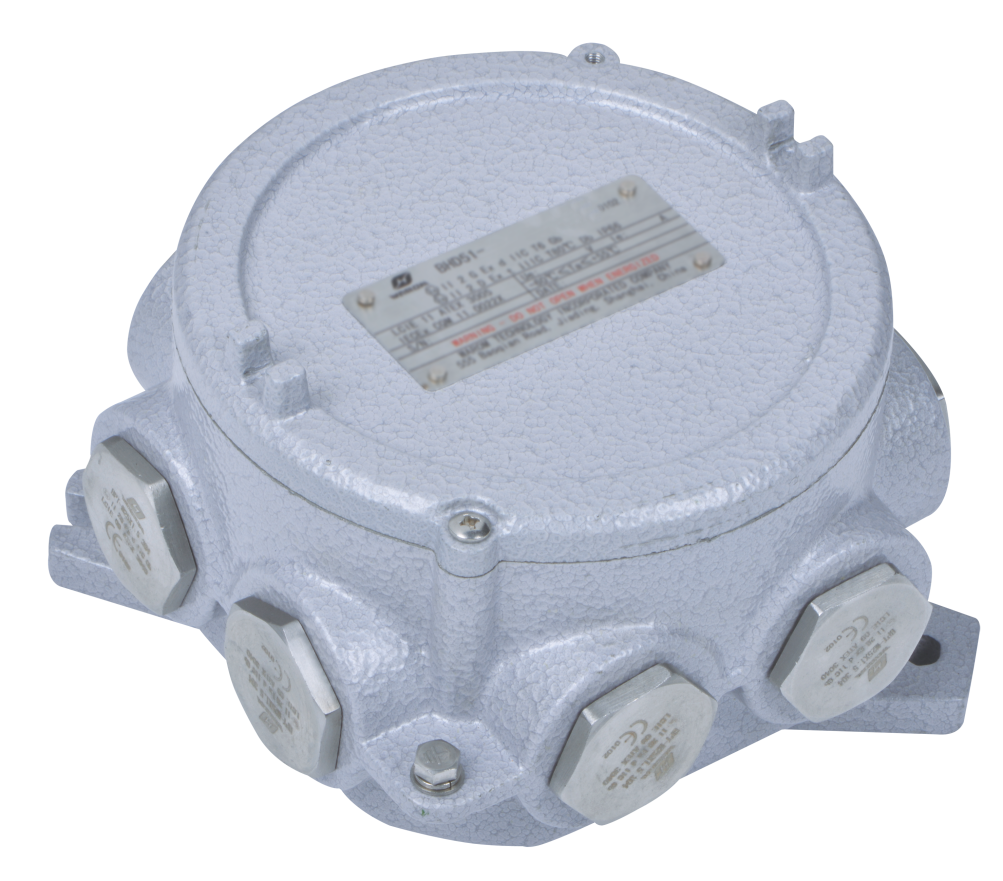
Zone classification defines the explosion protection method, but the ambient environment—salt spray, chemical exposure, temperature extremes—determines the enclosure material. On offshore platforms where Zone 1 gas groups typically include IIC (hydrogen from battery rooms) and IIB (hydrocarbon vapors on the topsides), the enclosure material selection is driven by corrosion resistance as much as explosion protection.
Copper-free aluminum alloy enclosures with powder-coated surfaces serve the majority of onshore Zone 1 and Zone 2 applications and provide IP66 ingress protection with WF2 corrosion resistance when properly specified. Our product library offers the HRMD92 and HRMD93 distribution panel series in this material, and we have shipped these enclosures to sites from desert tank farms to tropical chemical terminals without corrosion-related warranty claims over a ten-year observation window.
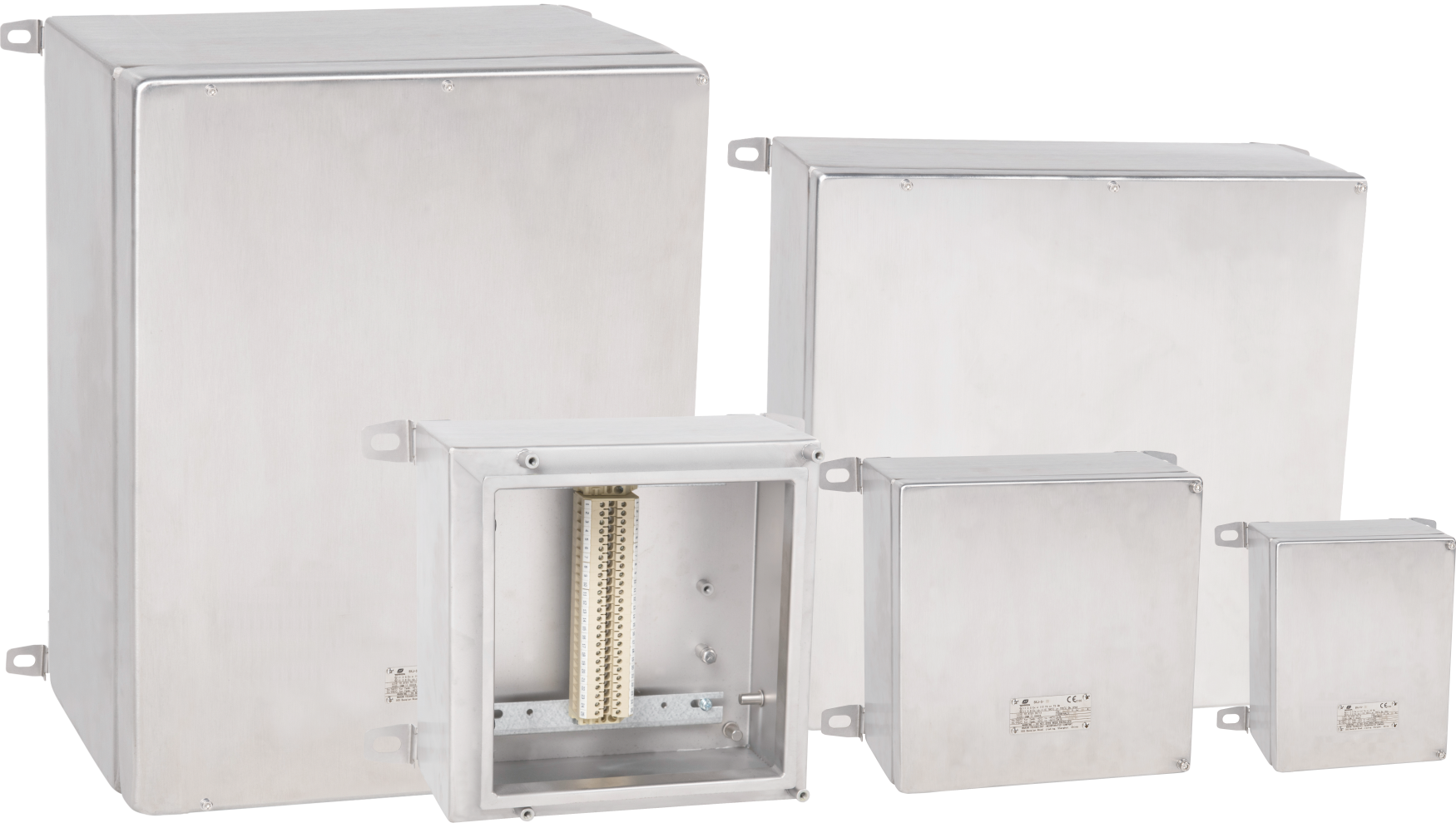
Stainless steel enters the specification when the external atmosphere contains chlorides at concentrations that attack aluminum. Marine topsides, coastal LNG terminals, and dockside loading areas fall into this category. The BXJ-S terminal box series uses 316L stainless steel enclosures for exactly these installations. The material cost premium over aluminum is approximately 60 to 80 percent, but it eliminates the periodic enclosure replacement that aluminum would require in a salt-laden Zone 1 environment.
One material choice that creates a genuine Zone 1 vs. Zone 2 decision point is fiberglass-reinforced polyester (GRP). GRP enclosures provide excellent corrosion resistance at a lower cost point than stainless steel, and they are widely used in Zone 2 and Zone 22 (combustible dust) applications. GRP is not typically certified for Ex d flameproof construction, so its use in Zone 1 is limited to Ex e increased-safety designs such as the BXM(D)8050 illumination distribution boxes in our product range. If your Zone 1 specification requires flameproof protection, GRP drops off the material list and the choice narrows to aluminum or stainless steel.
When Zone 2 Equipment Becomes the Smarter Commercial Choice
The technical discussion can leave the impression that Zone 1 equipment is always the safer or more conservative choice, but that logic breaks down under project budget constraints. Zone 2 equipment exists because the risk analysis determined that the flammable atmosphere probability does not justify the full flameproof architecture, and specifying Zone 1 equipment in Zone 2 areas increases capital expenditure without a corresponding safety benefit.
The commercial case for Zone 2 equipment is strongest in large-area installations where the gas dispersion study confirms Zone 2 classification: tank farm perimeter lighting, compressor shelter ventilation fans, and cable junction boxes along pipe racks are typical examples. Replacing a Zone 1 Ex d floodlight with a Zone 2 Ex nR floodlight on a tank farm with 40 poles reduces the lighting package cost materially, and the safety case is fully supported by the hazardous area classification drawing.
If your project includes both zones, consolidating the equipment order with a manufacturer that produces both Zone 1 and Zone 2 certified products simplifies the documentation package and eliminates the finger-pointing that occurs when two suppliers each claim the interface is the other’s responsibility. A single-source supplier can also factory-assemble mixed-zone distribution cabinets—for instance, a Zone 1 Ex d main incomer chamber with Zone 2 Ex e outgoing circuits—which reduces field assembly time and avoids the certification ambiguity of site-built combinations.
Common Questions About Zone 1 and Zone 2 Equipment Selection
Can I install Zone 2 certified equipment in a Zone 1 area if I add additional safety measures?
No. Additional external measures—gas detection, ventilation interlocking, administrative procedures—do not change the equipment certification. The equipment EPL (Gb for Zone 1, Gc for Zone 2) is determined by the protection concept built into the equipment and verified by the certification body. A Zone 2 Ex n luminaire remains a Gc device regardless of how many gas detectors are installed in the area. The only accepted path to use Zone 2 equipment in Zone 1 is if the equipment itself carries dual certification for both protection levels, which is extremely rare and would be explicitly stated on the certificate.
How much more does Zone 1 explosion proof electrical equipment cost compared to Zone 2?
The multiplier depends on the product category. For lighting, a Zone 1 Ex d floodlight typically costs 2 to 2.5 times the equivalent Zone 2 Ex n floodlight. For distribution panels, the ratio can reach 3 to 4 times because the flameproof enclosure requires thicker wall sections, machined flame paths, and certified cable entry components. The total installed cost gap is wider still once you account for flameproof cable glands and the additional inspection hours. In our project experience, a mixed-zone approach—Zone 1 hardware only where the classification drawing requires it, Zone 2 elsewhere—reduces the overall electrical package cost by 20 to 30 percent compared to a blanket Zone 1 specification.
What happens if an inspector finds Zone 2 equipment installed in a Zone 1 area?
The inspector will issue a non-conformance report and the equipment will be flagged for replacement before the facility receives its operational permit. This is not a minor observation that can be closed with a risk assessment addendum. The equipment certification does not support Zone 1 operation, and the inspector has no discretion to accept it. The replacement cost includes not just the hardware but the installation labor, re-termination, re-inspection, and the schedule delay—all of which compound if the non-conformance is found during pre-commissioning rather than during the equipment submittal review phase. This is why we advise EPC contractors to submit the full certificate, not just the datasheet, during the approval cycle.
Does the temperature class requirement change between Zone 1 and Zone 2?
The temperature class selection is driven by the gas or vapor present, not by the zone. Hydrogen requires T1 (450°C maximum surface temperature), but in practice equipment rated T6 (85°C) is specified because the LED drivers and electronic components in modern Ex equipment already meet T6 or T5 without additional cost. The zone influences which protection concepts are available, but once the protection concept is selected, the temperature class requirement for a given gas is identical in Zone 1 and Zone 2. Acetylene always requires T2 or better regardless of which zone it occupies. The practical difference is that Zone 1 Ex d enclosures have greater thermal mass and may run cooler under the same internal heat load, which can make T6 easier to achieve in Zone 1 than in a compact Zone 2 Ex n luminaire with less surface area for heat dissipation.
Is it safer to simply specify Zone 1 equipment for the entire hazardous area?
Not necessarily. Blanket Zone 1 specification introduces its own problems. Zone 1 equipment is heavier, which complicates structural mounting on pipe racks and vessel platforms. The larger enclosure volumes increase the internal gas volume that must be purged or inerted in pressurized (Ex p) systems. Maintenance tasks take longer because Ex d enclosures require specific bolt torquing sequences and flame path gap verification when covers are replaced. None of these factors improves safety in a Zone 2 area—they add operational burden without a risk reduction justification. The safest approach is to follow the hazardous area classification drawing exactly: Zone 1 equipment in Zone 1, Zone 2 equipment in Zone 2.
For projects where the hazardous area classification drawing shows mixed zones, consolidating both Zone 1 and Zone 2 explosion proof equipment with a manufacturer that holds certification for both categories simplifies the approval package and eliminates interface gaps. Send your equipment list and zone classification data to gm*@***om.com or call +86 21 39977076, and our engineering team will confirm the correct protection method for each tag number before quotation.
If you’re interested, check out these related articles:
Warom Held The 2024 Outstanding Employee Commendation Conference
Explosion-Proof Solenoid Valves: Gas Pipeline Control Safety
The New Factory of WAROM MENA
Explosion Proof Terminal Boxes: Securing Instrument Cable Connections
With over a decade of experience, he is a seasoned Explosion-Proof Electrical Engineer specializing in the design and manufacture of safety and explosion-proof products. He possesses in-depth expertise across key areas including explosion-proof systems, nuclear power lighting, marine safety, fire protection, and intelligent control systems. At Warom Technology Incorporated Company, he holds dual leadership roles as Deputy Chief Engineer for International Business and Head of the International R&D Department, where he oversees R&D initiatives and ensures the precise delivery of design documentation for international projects. Committed to advancing global industrial safety, he focuses on translating complex technologies into practical solutions, helping clients implement safer, smarter, and more reliable control systems worldwide.

Qi Lingyi