

Ammonia refrigeration plants demand specialized safety systems because ammonia presents both toxic and explosive hazards. A leak that goes undetected for even a few minutes can create conditions that injure personnel or destroy equipment. Explosion proof gas detection is not simply a compliance checkbox—it is the primary technical control that separates a contained incident from a catastrophic one. These systems monitor ambient air continuously, trigger alarms at preset thresholds, and initiate shutdowns before concentrations reach dangerous levels.
Why Ammonia Creates Dual Hazards in Refrigeration Facilities
Ammonia works exceptionally well as a refrigerant. Its thermodynamic properties and cost profile explain why large cold storage, food processing, and chemical plants still rely on it despite the availability of synthetic alternatives. The problem is that those same properties make it dangerous when it escapes containment.
At low concentrations, ammonia irritates eyes and respiratory passages. At moderate levels, it causes chemical burns to skin and mucous membranes. Above roughly 300 ppm, lung damage becomes likely. Fatal exposures occur in the 1500–2000 ppm range, sometimes within minutes. OSHA sets permissible exposure limits precisely because even short-term contact at elevated concentrations produces irreversible harm.
The flammability risk receives less attention in many facilities, partly because ammonia’s lower explosive limit sits at 15 percent by volume—far higher than natural gas or propane. That number creates a false sense of security. In a confined mechanical room or a poorly ventilated compressor enclosure, a major leak can reach the LEL faster than operators expect. Once ignition occurs, the resulting explosion propagates through any connected ductwork or piping penetrations.
| Concentration (ppm) | Effect on Humans | Hazard Type |
|---|---|---|
| 5–50 | Odor detectable, mild irritation | Toxic |
| 100–300 | Moderate irritation, coughing | Toxic |
| 500–1000 | Severe irritation, lung damage | Toxic |
| 1500–2000 | Fatal after short exposure | Toxic |
| 150,000–280,000 | Lower Explosive Limit (LEL) | Flammable |
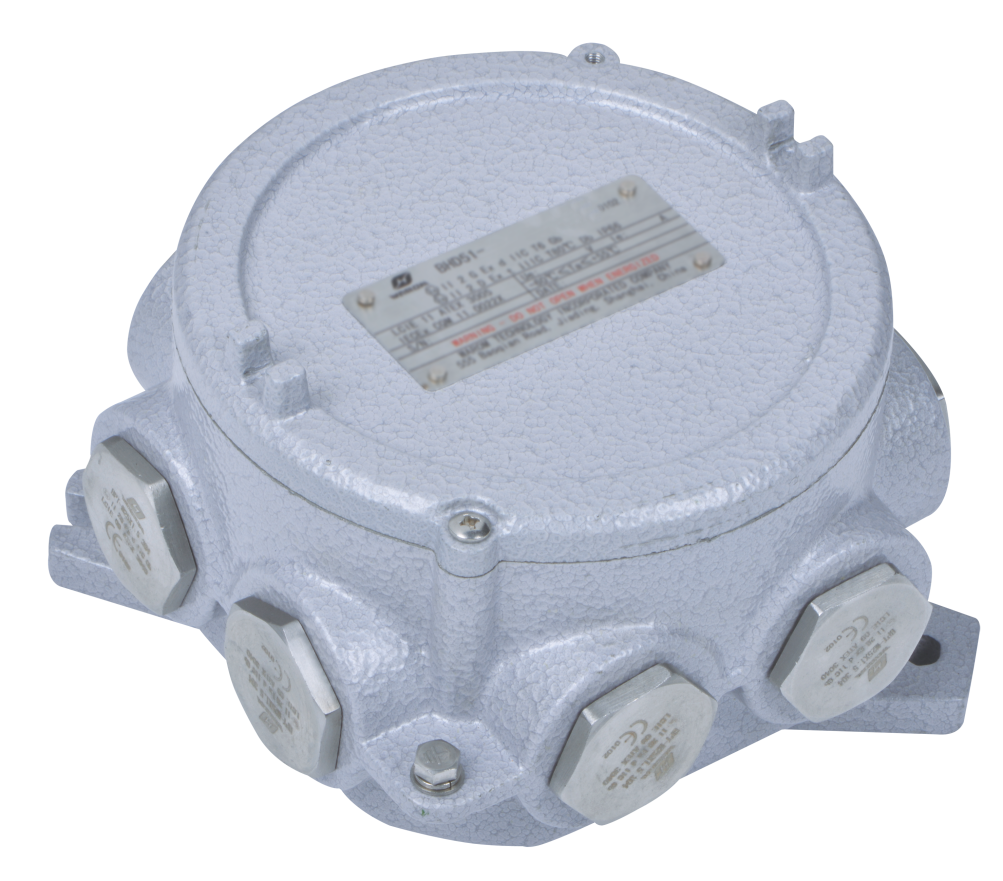
What Makes Gas Detection Equipment Explosion Proof
Standard electrical devices—switches, sensors, junction boxes—can generate sparks during normal operation or fault conditions. In an atmosphere already contaminated with ammonia, a single spark provides the ignition energy for an explosion. Explosion proof equipment eliminates that pathway through two main design philosophies.
Flameproof enclosures, classified Ex d under IEC standards, contain any internal explosion within the housing. The enclosure is engineered so that flame fronts cool and extinguish before they can exit through joints or cable entries. Increased safety designs, classified Ex e, take a different approach: they prevent sparks and excessive surface temperatures from occurring in the first place by using wider creepage distances, lower operating currents, and materials that resist arc formation.
During the Tilenga project in Uganda, our team supplied explosion proof lighting and electrical distribution systems for wellpads and the central processing facility. The project involved crude oil handling under extreme ambient conditions, with flammable vapor risks comparable to ammonia refrigeration environments. Zero safety incidents occurred across the installation and commissioning phases. That outcome did not happen by accident—it resulted from specifying equipment with ATEX and IECEx certifications matched to the actual zone classifications on site. Selecting equipment rated for a less severe zone than the application demands is a common procurement error that creates latent risk.
Components That Form a Complete Detection System
A gas detection system for ammonia refrigeration integrates several elements. Each component must carry appropriate hazardous area certification, and the system as a whole must be designed so that a single-point failure does not disable protection for an entire area.
Gas sensors mount at locations where leaks are most likely or where ammonia would accumulate—near compressor seals, valve packing, evaporator coils, and low points in mechanical rooms. Electrochemical sensors remain the dominant technology for ammonia detection because they respond quickly and maintain accuracy across the concentration ranges that matter for personnel safety. Infrared sensors see occasional use in applications where cross-sensitivity to other gases is a concern.
Control panels receive signals from sensors, compare readings against alarm setpoints, and activate outputs. A typical configuration includes a low alarm at 25 ppm, a high alarm at 50 ppm, and an emergency shutdown trigger at 150 ppm or the facility’s established action level. The panel also logs data for compliance reporting and incident investigation.
Alarms must be audible and visible throughout the protected area. Explosion proof horns and strobes ensure that personnel receive warning even if they are not monitoring a central display. In facilities with multiple refrigeration zones, annunciator panels in control rooms provide operators with zone-specific status at a glance.
The electrical infrastructure connecting these components—junction boxes, plugs, receptacles, cable glands—must match the protection concept of the sensors and alarms. Mixing certified sensors with standard junction boxes defeats the purpose of the entire system.
At a chemical plant operated by General Paint in Mexico, we identified exactly this kind of mismatch during a site assessment. The facility handled flammable solvents and generated combustible dust, yet portions of the electrical system used equipment rated for ordinary locations. Our solution included explosion proof plugs and receptacles, junction boxes, distribution panels, and static discharge devices. Within three months, the upgraded system was operational and the plant had incorporated our products into their standard procurement specifications. The project demonstrated that retrofitting explosion proof infrastructure into an existing facility is achievable without extended shutdowns when the scope is defined correctly.
| Component Type | Function | Certification Requirement |
|---|---|---|
| Gas sensor | Detects ammonia concentration | Ex d or Ex e, suitable for Zone 1 or Zone 2 |
| Control panel | Processes signals, triggers alarms | May be located in safe area or require Ex certification |
| Audible alarm | Alerts personnel | Ex d or Ex e, matched to zone |
| Visual alarm | Alerts personnel in high-noise areas | Ex d or Ex e, matched to zone |
| Junction box | Connects field wiring | Ex d or Ex e, matched to zone |
| Cable gland | Seals cable entry points | Certified for enclosure type |
How to Specify Detection Systems for Ammonia Refrigeration
Specifying a detection system starts with a hazardous area classification study. This study identifies which portions of the facility fall into Zone 1 (explosive atmosphere likely during normal operation) versus Zone 2 (explosive atmosphere possible but not likely during normal operation). Ammonia refrigeration mechanical rooms typically classify as Zone 2, but areas immediately adjacent to compressor seals or relief valve discharge points may warrant Zone 1 treatment.
Sensor placement follows from the classification study. The goal is to detect a leak before the plume reaches personnel breathing zones or accumulates to dangerous concentrations. Because ammonia is lighter than air, sensors often mount at elevated positions, though low-mounted sensors remain necessary in areas where cold ammonia vapor might initially sink before warming and rising.
Response time matters. A sensor that takes 60 seconds to reach 90 percent of its final reading provides less protection than one that responds in 15 seconds. Manufacturers publish T90 response times in product datasheets, and those numbers should influence sensor selection.
Maintenance intervals affect long-term reliability. Electrochemical sensors have finite lifespans, typically two to three years depending on exposure history. Calibration checks at quarterly or semiannual intervals catch drift before it causes missed alarms or nuisance trips. Facilities that defer calibration often discover sensor failures only after an incident.
If your facility is evaluating detection system upgrades or new installations, discussing sensor placement and zone classification with an engineer familiar with ammonia refrigeration hazards will reduce the risk of specification errors.
Regulatory Framework and Certification Standards
Multiple regulatory bodies govern ammonia refrigeration safety. In the United States, OSHA’s Process Safety Management standard (29 CFR 1910.119) applies to facilities with ammonia inventories above 10,000 pounds. The EPA’s Risk Management Program (40 CFR Part 68) imposes similar requirements with a focus on community impact. IIAR standards, particularly IIAR 2 for equipment design and IIAR 9 for minimum safety criteria, provide industry-specific guidance that regulators reference during inspections.
Equipment certifications follow international frameworks. ATEX certification, required for equipment sold in the European Union, indicates compliance with Directive 2014/34/EU. IECEx certification, administered by the International Electrotechnical Commission, provides a globally recognized alternative. Equipment carrying both certifications simplifies procurement for multinational facilities.
Certification marks on equipment housings include the protection concept (Ex d, Ex e, Ex ia, etc.), the gas group (IIC for hydrogen, IIB for ethylene, IIA for propane—ammonia falls into IIA), and the temperature class (T1 through T6, indicating maximum surface temperature). Specifying equipment with ratings that exceed the minimum requirements for ammonia provides margin against future process changes.
Integrating Detection with Emergency Response
Detection systems generate data. That data becomes useful only when it connects to response procedures. Alarm setpoints should align with the facility’s emergency action plan. A low alarm might trigger investigation by trained personnel. A high alarm might initiate evacuation of non-essential workers. An emergency shutdown alarm might close isolation valves and de-energize compressors automatically.
Automatic shutdowns require careful engineering. A spurious trip during peak production creates economic losses and may introduce its own hazards if the shutdown sequence is not properly designed. Facilities often implement time delays or voting logic—requiring two of three sensors in a zone to confirm an alarm before triggering shutdown—to balance sensitivity against false trip risk.
Communication systems must function during an ammonia release. Standard intercom systems may not be audible over alarm horns, and personnel wearing respiratory protection cannot use conventional telephones. Facilities with robust emergency response capabilities often install explosion proof intercom stations or rely on portable radios with intrinsically safe ratings.
Maintenance Practices That Preserve System Integrity
Detection systems degrade over time. Sensor elements age, wiring connections loosen, and enclosure seals deteriorate. A maintenance program that addresses these failure modes preserves the protection the system was designed to provide.
Bump testing verifies that a sensor responds to a known concentration of ammonia. This test, performed weekly or monthly depending on facility risk tolerance, catches sensors that have failed or drifted significantly. Bump testing does not replace calibration but provides a quick check between calibration intervals.
Calibration adjusts sensor output to match known reference gas concentrations. Calibration gas cylinders must be traceable to national standards and must not be used beyond their expiration dates. Technicians performing calibration need training on the specific sensor models in use, as calibration procedures vary between manufacturers.
Enclosure inspections identify physical damage, corrosion, or seal degradation. Ammonia is corrosive to many materials, and enclosures in direct contact with refrigeration equipment may show accelerated wear. Replacing gaskets and repainting enclosures at scheduled intervals extends service life.
Documentation supports both regulatory compliance and incident investigation. Maintenance records should include sensor serial numbers, calibration dates, bump test results, and any repairs performed. Electronic maintenance management systems simplify record retrieval during audits.
Frequently Asked Questions
What concentration of ammonia triggers an alarm in a typical refrigeration plant?
Most facilities set a low alarm at 25 ppm, which is below the OSHA permissible exposure limit of 50 ppm for an eight-hour time-weighted average. A high alarm at 50 ppm or above prompts more urgent response. Emergency shutdown triggers vary by facility but commonly fall in the 150–300 ppm range. These setpoints balance early warning against nuisance alarms from brief, localized releases that dissipate quickly.
How often should ammonia gas sensors be calibrated?
Quarterly calibration is common in facilities with moderate risk profiles. Higher-risk facilities or those with regulatory consent decrees may calibrate monthly. Sensor manufacturers publish recommended calibration intervals, but actual intervals should reflect operating conditions—sensors exposed to high ammonia concentrations or corrosive atmospheres may require more frequent attention.
Can explosion proof detection systems be retrofitted into existing refrigeration plants?
Retrofitting is feasible and often less disruptive than facility managers expect. The key is completing a hazardous area classification study before selecting equipment, then scheduling installation during planned maintenance windows. Wiring runs may require conduit upgrades to maintain explosion proof integrity. Facilities that have completed retrofits typically report that the project timeline depends more on engineering and procurement than on physical installation.
What is the difference between Ex d and Ex e protection concepts?
Ex d (flameproof) enclosures are designed to contain an internal explosion and prevent it from igniting the surrounding atmosphere. They use heavy-walled housings with precisely machined flame paths. Ex e (increased safety) equipment prevents ignition sources from occurring by using enhanced insulation, wider clearances, and lower operating temperatures. The choice between them depends on the equipment type and the zone classification. Sensors often use Ex d housings, while junction boxes may use either concept. To discuss which protection concept fits your facility’s requirements, contact our engineering team for a site-specific recommendation.
If you’re interested, check out these related articles:
WAROM to Exhibit at Oil & Gas Asia Kuala Lumpur 2025
Weatherproof Products for Port Cranes: Ensuring Marine Reliability
WAROM at Australian Energy Producers Conference &Exhibition 2026
Local Caution Spotlights: Enhancing Safety in Hazardous Zones
2023 Malaysia Bi-Technical Exchange Concludes Successfully
With over a decade of experience, he is a seasoned Explosion-Proof Electrical Engineer specializing in the design and manufacture of safety and explosion-proof products. He possesses in-depth expertise across key areas including explosion-proof systems, nuclear power lighting, marine safety, fire protection, and intelligent control systems. At Warom Technology Incorporated Company, he holds dual leadership roles as Deputy Chief Engineer for International Business and Head of the International R&D Department, where he oversees R&D initiatives and ensures the precise delivery of design documentation for international projects. Committed to advancing global industrial safety, he focuses on translating complex technologies into practical solutions, helping clients implement safer, smarter, and more reliable control systems worldwide.

Qi Lingyi