
Weatherproof junction boxes are the unsung backbone of outdoor electrical infrastructure, shielding cable terminations from rain, dust, and ultraviolet radiation year after year. Yet far too many installations fail prematurely, not because the enclosure itself ruptures, but because the material was mismatched to the site conditions or the cable entries were not sealed properly. After three decades of designing and supporting industrial safety systems for offshore platforms, chemical plants, and remote infrastructure, I have seen the same pattern repeat itself: a junction box with an excellent IP rating fails within two years because water enters through a cable gland that was never tightened to the correct torque, or because the polycarbonate lid lost its structural integrity after prolonged UV exposure. This article moves past catalog specifications and addresses the practical decisions that determine whether an outdoor connection point will last a decade or become a maintenance headache.
What IP Rating Does Your Outdoor Junction Box Need
IP testing defines how well an enclosure keeps solids and liquids out, but the numbers alone do not tell the full story for outdoor use. The first digit, representing solid ingress protection, must be at least 5 for dusty environments and 6 for complete dust-tight sealing. The second digit is where outdoor selection often goes wrong. IPX4 rated enclosures are only protected against splashing water from any direction. Mounted under an overhang, they might survive a few seasons, but any sustained exposure to wind-driven rain or hose-down cleaning will push water past the seals. IPX5 adds resistance to low-pressure water jets, which is adequate for many exterior walls. For unshielded outdoor cable connections, however, IP66 has become the pragmatic minimum. An IP66 enclosure will withstand powerful water jets and remain dust-tight, handling everything from tropical downpours to the pressure washing used on food processing exteriors. IP67 and IP68 add immersion protection, but for above-ground junction boxes, the additional cost rarely justifies the benefit unless the box is installed in a flood-prone pit or an area subject to occasional submersion. NEMA ratings like NEMA 4X overlap significantly with IP66 but add requirements for corrosion resistance and ice formation, which can simplify specification for North American projects.
Choosing the Right Enclosure Material
The choice of enclosure material has a greater influence on the lifecycle cost of a weatherproof junction box than its IP rating. Three materials dominate the market, and each solves a different set of outdoor problems.
GRP (glass-reinforced polyester, also called fiberglass) offers high strength-to-weight ratio and near-total resistance to corrosion from salt spray, industrial atmospheres, and most chemicals. Unlike metals, GRP does not require a protective coating that can be scratched during installation. It also maintains its mechanical properties across a wide temperature range, typically from minus 40 °C to plus 55 °C, making it suitable for everything from arctic solar farms to desert gas plants. The main disadvantage is that GRP enclosures cannot be field-modified with standard metal drills without risking micro-cracks. All entry holes must be machined at the factory or using specified tooling.
Polycarbonate enclosures are lightweight, cheaper than GRP, and easy to machine on site. Their Achilles’ heel outdoors is ultraviolet radiation. Standard polycarbonate will yellow, become brittle, and lose impact resistance after three to five years of direct sunlight unless it is UV-stabilized and specifically rated for outdoor use. Even UV-stabilized grades have finite life, and in high-UV regions like the Middle East or high-altitude installations, I recommend inspecting polycarbonate enclosures annually after the fifth year.
Stainless steel (typically 304 or 316L) provides unmatched mechanical strength and can survive impacts that would crack a plastic enclosure. In marine and coastal environments, 316L is essential because the molybdenum content resists pitting corrosion from chloride ions. The trade-off is weight, cost, and the fact that stainless steel enclosures must be correctly earthed. Galvanic corrosion can also occur if the enclosure is mounted on a dissimilar metal without insulation.
A common mistake is selecting an enclosure material solely by upfront price. In a coastal petrochemical facility where we supported a cable distribution upgrade, the maintenance team had replaced polycarbonate junction boxes every four years due to UV embrittlement after they were installed without shade covers. Switching to UV-stabilized GRP enclosures eliminated the replacement cycle entirely, recovering the higher material cost within the second service interval.
Cable Entries and Sealing Are Where Most Failures Start
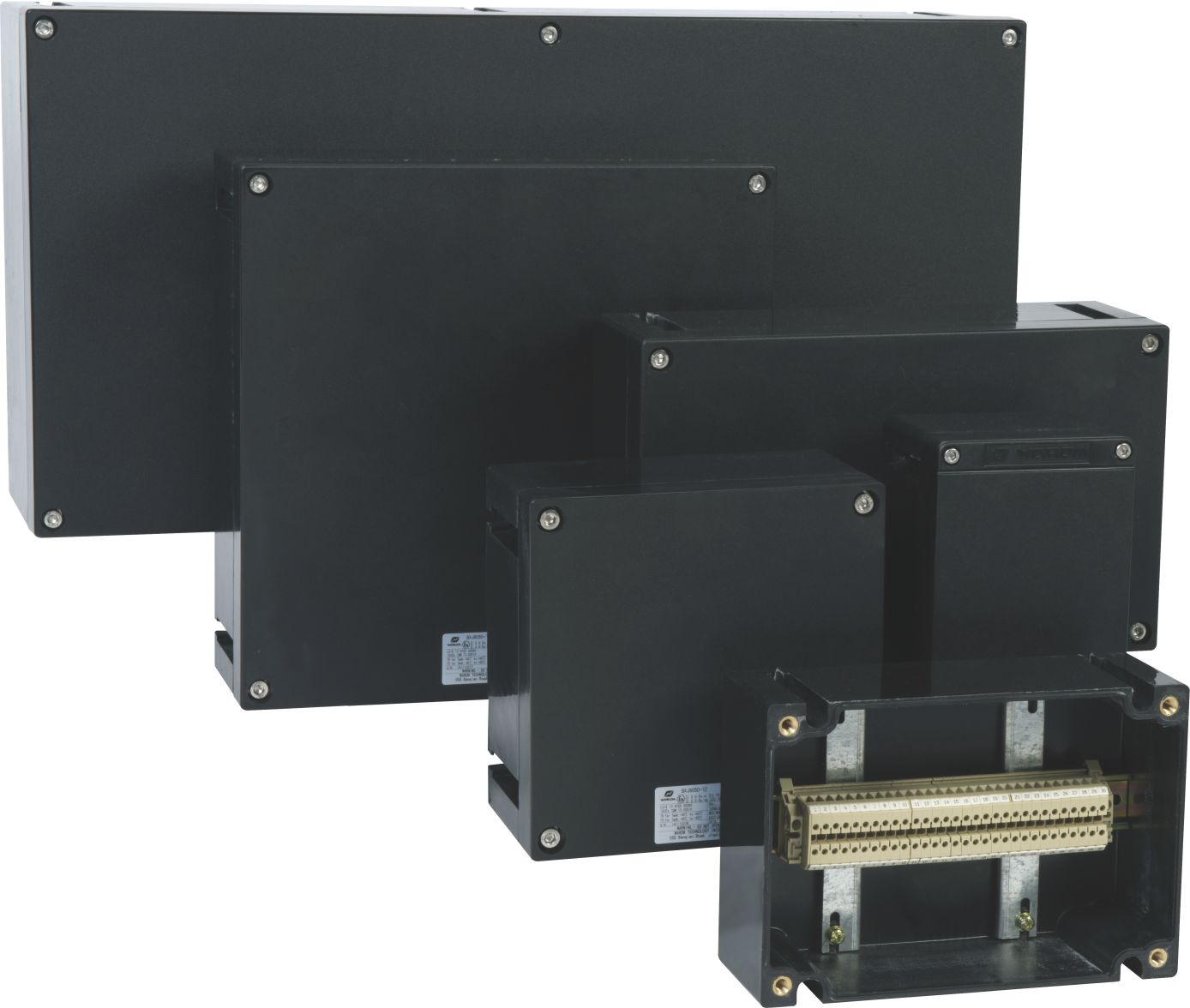
A weatherproof junction box is only as good as its cable entries. The highest IP rating on the enclosure label means nothing if a poorly installed gland lets water track along the cable sheath into the terminal chamber. Cable glands for outdoor use must match the cable diameter precisely. Most failures I investigate involve a gland that was one or two millimeters too large, with the installer compensating by over-tightening the compression seal until it deformed. That deformation creates a capillary path that draws water inward through thermal cycling.
For outdoor installations, use glands with a neoprene or silicone elastomer seal and an IP66 or IP68 rating on the gland itself. The sealing washer between the gland and the enclosure wall is equally important. Many site electricians reuse old washers or omit them entirely, assuming the thread seal will suffice. It will not. I recommend specifying flat elastomer sealing washers with every gland and checking that the gland’s O-ring seat is clean before assembly.
Unused cable entries must be plugged with metal or plastic stopping plugs that carry the same IP rating as the enclosure. Temporary plugs like PVC tape or silicone sealant are not acceptable for permanent outdoor installations; they deteriorate within months and provide a direct path for insects and moisture.
Environmental Stresses That Shorten Enclosure Life
Beyond water ingress, three environmental factors routinely degrade outdoor junction boxes: ultraviolet radiation, temperature cycling, and atmospheric corrosion.
UV exposure does more than fade plastic enclosures. It breaks the polymer chains in the material matrix, reducing impact strength and eventually causing surface cracking. GRP enclosures with a UV-inhibited gelcoat or polyurethane paint layer can resist this for decades. For polycarbonate, always verify that the manufacturer’s datasheet explicitly states outdoor UV suitability and that the stabilizer is integrated into the resin, not just a surface coating.
Temperature cycling presents a subtler problem. As the enclosure heats during the day and cools at night, the air inside expands and contracts. If the enclosure is sealed perfectly, a partial vacuum can form during cooling, pulling moisture past the seals. A breather drain with a sintered filter can equalize pressure without compromising the IP rating. These breather elements are often forgotten during specification but make a measurable difference in preventing condensation accumulation.
Corrosion from salt spray, sulfur-rich atmospheres near refineries, or ammonia near fertilizer plants attacks metal enclosures at the hinges, mounting feet, and lid screws. Stainless steel or GRP eliminates most of this risk. For aluminum enclosures, ensure they are copper-free (less than 0.4% copper) and finished with a powder coating that has been tested to ISO 12944 for the relevant corrosivity category. All external fasteners should be stainless steel, not zinc-plated steel, to avoid rust streaks that can seize the lid closed.
Key Installation Practices That Determine Long-Term Reliability
Even the best junction box will underperform if installed without attention to a few field details. Mount the enclosure so that the cable entries point downward or to the side; never drill entry holes on the top surface unless a drip shield is fitted above. Water that pools on the lid will eventually find a way in, especially if the gasket has aged.
Provide a service loop of cable below the enclosure to act as a drip point, preventing water from running directly along the cable and resting at the gland. Inside the box, leave enough slack to re-terminate conductors at least once without pulling new cable. Secure the enclosure to a rigid mounting surface with all provided fixing points; mounting with only two bolts on a four-hole box can warp the flange and compromise the lid seal.
Earthing must comply with local codes, but as a minimum, a dedicated external earth stud should connect the enclosure body to the site earth. If the box contains a DIN rail for terminals, bond it internally as well. This is particularly important for metallic enclosures but also applies to GRP boxes when they house metallic components that could become live under fault conditions.
After commissioning, include the junction box gasket in the preventive maintenance schedule. The gasket is a wear item. In high-temperature environments above 45 °C ambient, the elastomer can take a compression set and lose its rebound. I recommend replacing lid gaskets every five to seven years on outdoor enclosures, or immediately if any signs of cracking or permanent flattening appear.
If your project involves corrosive coastal air, wide temperature swings, or requires multiple large cable entries in a confined space, it is worth confirming the enclosure design and gland compatibility with your supplier before finalizing the bill of materials. Send your installation conditions and cable schedule to gm*@***om.com or call +86 21 39977076 for a technical review.
Common Questions About Weatherproof Junction Boxes
Is IP66 always enough for outdoor cable connections above ground?
IP66 is adequate for most above-ground outdoor locations where the box is not subject to prolonged immersion. It withstands heavy rain and high-pressure hose jets. The exception is when the box is mounted in a depression or on a vehicle underbody where water can pool; in those cases, IP67 or IP68 is warranted. The IP66 gasket must be intact and compressed uniformly, which requires correct screw torque on the lid.
Can I use an explosion-proof junction box outdoors without special adaptations?
Many explosion-proof enclosures also carry an IP66 or IP67 rating, making them suitable for weatherproofing as well. However, the flamepath surfaces must be protected from corrosion with a suitable grease, and the enclosure material must be rated for the outdoor environment. A cast iron Ex d enclosure in a coastal location will rust rapidly unless coated. If the location does not require explosion protection, a dedicated weatherproof enclosure is usually lighter and less expensive.
How do I know if a polycarbonate enclosure is truly UV-resistant?
Check for a manufacturer’s statement that the material is UV-stabilized for outdoor use according to UL 746C (f1 rating for outdoor suitability) or equivalent. A simple visual cue is that truly UV-stabilized polycarbonate often has a slight blue tint. If the datasheet does not mention UV performance, assume it is for indoor use only. If your project is in a high-sunlight region, share your location and annual UV index with the supplier to confirm the expected service life.
If you’re interested, check out these related articles:
Warom Successfully Passed the Partnering for Sustainability TFS Audit Certification
Choosing Explosion Proof Lights: An Expert Safety Guide
The 137th Canton Fair is Underway
With over a decade of experience, he is a seasoned Explosion-Proof Electrical Engineer specializing in the design and manufacture of safety and explosion-proof products. He possesses in-depth expertise across key areas including explosion-proof systems, nuclear power lighting, marine safety, fire protection, and intelligent control systems. At Warom Technology Incorporated Company, he holds dual leadership roles as Deputy Chief Engineer for International Business and Head of the International R&D Department, where he oversees R&D initiatives and ensures the precise delivery of design documentation for international projects. Committed to advancing global industrial safety, he focuses on translating complex technologies into practical solutions, helping clients implement safer, smarter, and more reliable control systems worldwide.

Qi Lingyi