
Choosing an explosion proof light fittings manufacturer is usually treated as a paperwork task: collect the ATEX and IECEx certificates, compare the numbers, then compare the price. The step that gets skipped is the one that decides whether the fitting in the crate is the fitting that was certified. A certificate proves that a design type was examined; the nameplate, the marked ambient range and the production record decide whether the delivered unit is covered by that examination. Verification therefore runs along a single trace from certificate to nameplate to routine test record, and the supplier’s job is to show that the trace survives every variation you order.
Why the Certificate Holder and the Factory Address Must Match
A certificate is issued to an organisation, not to a product category. Under the ATEX directive the manufacturer carries the obligation to hold the technical file, operate a production quality system and declare conformity, which is why the name on the certificate matters as much as the number [1]. When the company quoting you is not that company, the first question is who holds the certificate and who will amend it if the driver, LED module or enclosure changes.
Three arrangements appear in practice. The first is the original manufacturer that designs, machines, assembles and tests in its own plant. The second is a licensed rebadge, where a factory builds to another company’s specification and the brand holder holds the certificate. The third is a trader that buys from whichever factory has stock, and this is the arrangement that carries the most risk, because the conformity decision sits with a party that has no engineering stake in the product.
A rebadge or a trader is not automatically a disqualification. Traders can assemble a multi-category package and shorten lead times, and some hold genuine factory relationships. The condition is that the certificate holder is named in the contract, that a change of factory, driver or light source triggers written notification, and that the warranty is passed through rather than promised.
Before prices are compared, ask for four items: the legal entity name that will appear on the invoice, the factory address recorded in the production quality assessment, a photograph of the nameplate showing the manufacturer mark and certificate number, and a written statement of who is responsible for amending the certificate when a component changes. Each takes minutes to supply and shows how the supplier is organised.
How to Verify Explosion Proof Certification Before You Shortlist
Three questions decide whether a certificate is worth anything to your project: is it real, is it current, and does it cover the exact variant you are buying?
The ATEX route starts with an EU-type examination certificate issued by a Notified Body, followed by production assurance and a declaration of conformity from the manufacturer [1]. A CE mark with no certificate number, no Notified Body number and no declaration is decoration. The IECEx route works differently: a certificate of conformity is supported by an explosive atmosphere test report and a quality assessment report covering the factory, and the certificate status is published in the IECEx online system, where you can see whether it is current, suspended or cancelled [3].
Is the certificate real
Copy the certificate number into the issuing body’s database rather than reading the PDF the supplier sent. Compare the certificate holder, the model designation, the protection concept and the ambient range with the document in front of you. A modified PDF is a common failure, and the database settles the question in a few minutes.
Is it current and does it cover the variant
A certificate can be valid and still irrelevant. Certification is granted to a design, so a 30 W version and a 150 W version with a different driver and thermal design may sit under different certificates. Check the model designation on the certificate against the exact configuration in the quotation, including cable entries, mounting and control gear. Then check the ambient range, because equipment is normally rated for -20 °C to +40 °C unless another range is marked [2]. A fitting certified to +40 °C and installed where the summer peak reaches 50 °C has no assured temperature class, whatever the nameplate states.
Which scheme applies to the project
ATEX and IECEx evidence does not authorise installation in the United States. Installations there follow Article 500 or Article 505 of the National Electrical Code, with equipment listed by a recognised testing laboratory to the relevant UL standard [4]. China uses CNEX certification, marine and offshore projects usually add a classification society approval, and some owners require two schemes at once. Confirm the required scheme before comparing products, because a supplier offering only one scheme is not necessarily weak, just not qualified for that job.
Certification communities publish changes that affect how these schemes are applied. <The 2025 IECEx Explosion Protection Technology Symposium in Penang, Malaysia was successfully held> covers the 2025 IECEx symposium held in Penang.
The last check happens on the shipping date, not at quotation: confirm the certificate is still current and that the quality assessment report names the factory that will produce your order.
Can the Manufacturer Cover Every Fitting Type You Need
The cheapest package is rarely the one with the fewest suppliers, but supplier count is a real cost line. Each additional manufacturer adds a certificate set, an instruction set, a spare parts list and a separate change notification route. The evaluation question is whether one manufacturer’s certified range covers the fitting types on your drawings with consistent data across them.
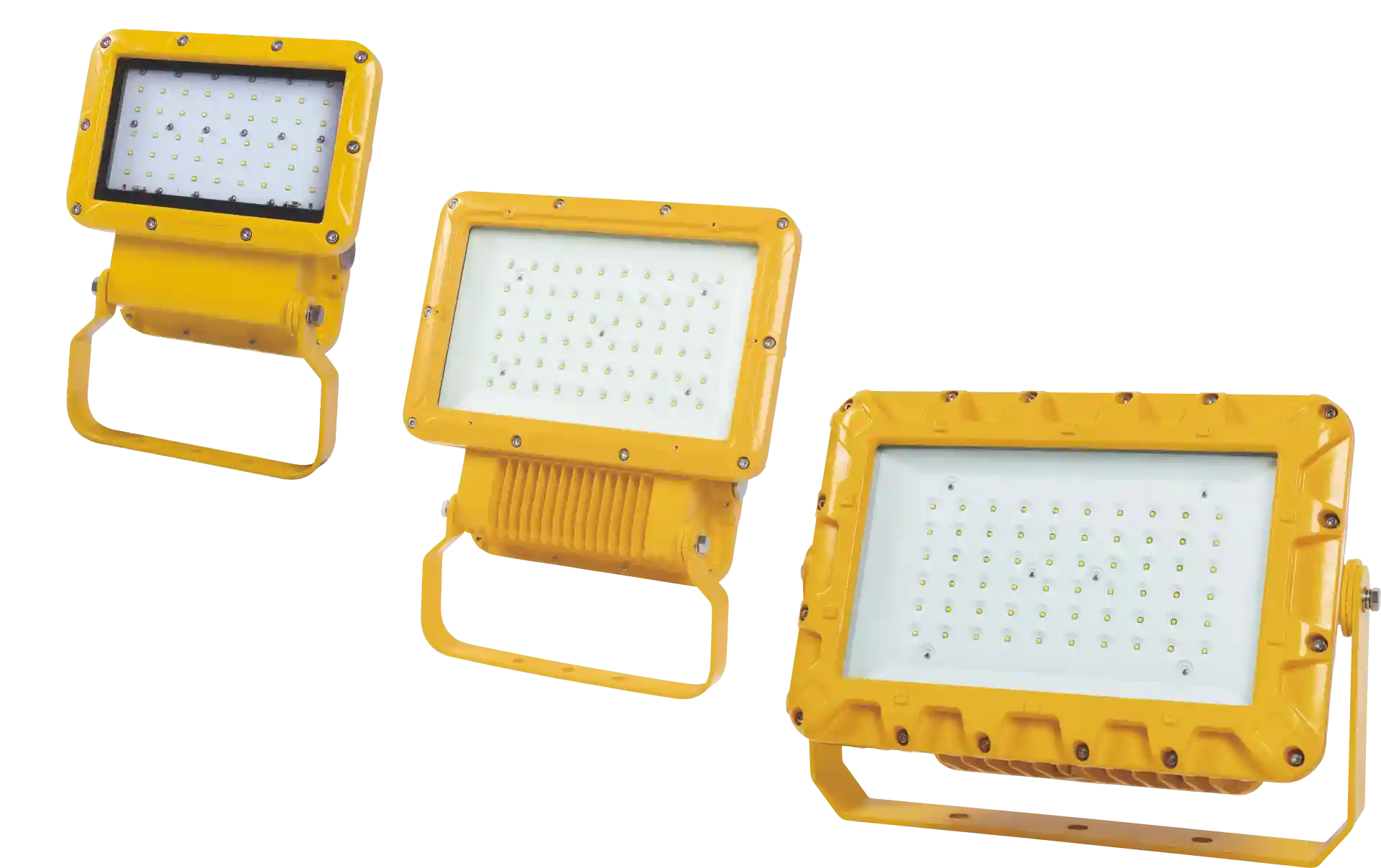
Floodlights carry the perimeter, loading bays and high structures. For these, the ambient range and the thermal design decide useful life, because a fitting mounted under a roof in a hot climate runs well above the shade temperature used in the catalogue. A family rated from -60 °C to +60 °C with a constant current driver and end-of-life protection covers sites where the standard -20 °C to +40 °C assumption fails.
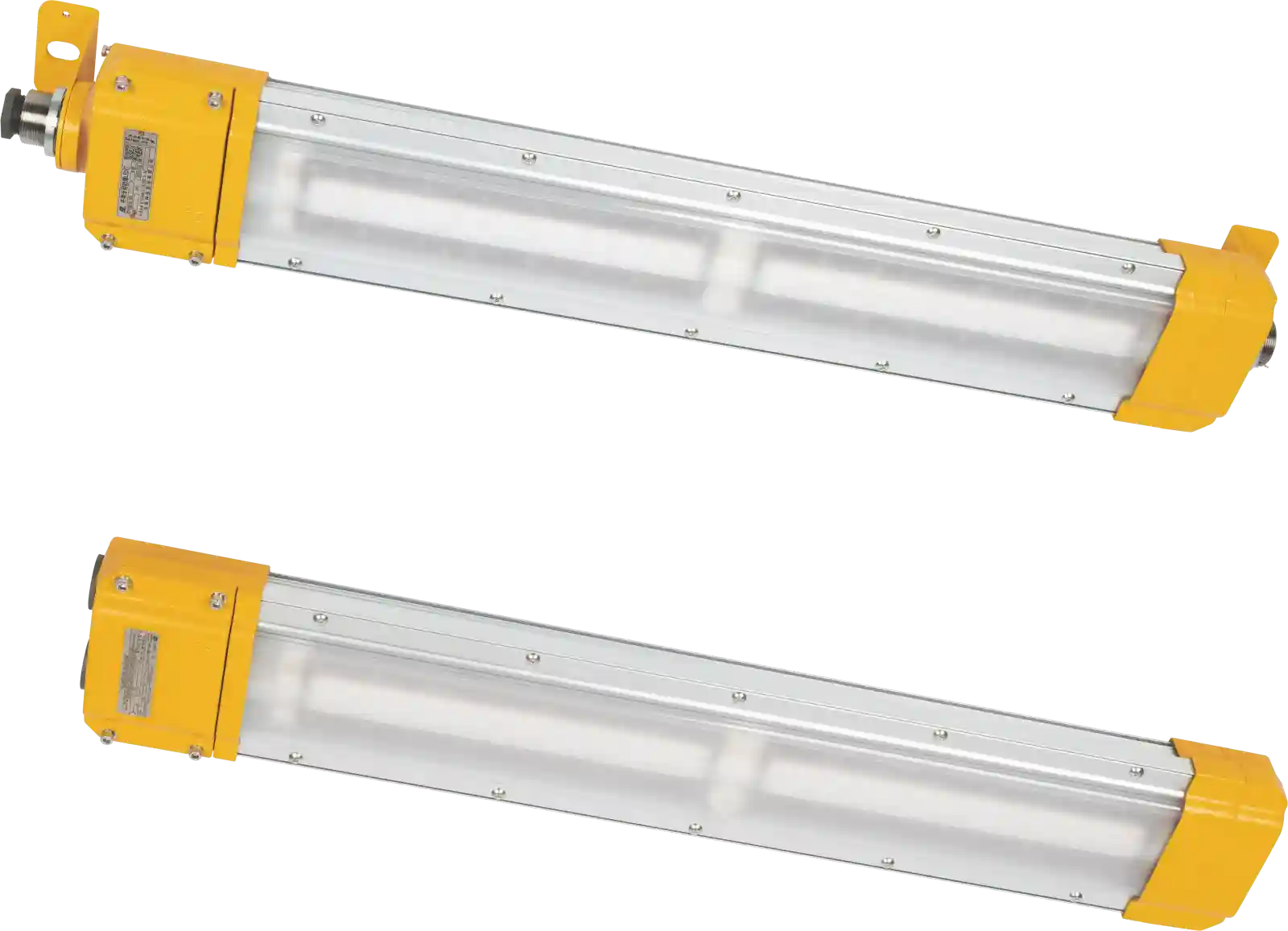
Linear fittings serve corridors, walkways and low mounting heights where light distribution matters more than raw output. Here the driver is the component to interrogate. A linear run concentrates failures in the same place, and a driver that can be replaced without altering the certified assembly keeps a maintenance team out of the flameproof enclosure.
Pendant fittings are specified where access for relamping is difficult, such as tank farms and tall process buildings. The details that decide whether they work are unglamorous: entry orientation, cable gland compatibility and whether the mounting bracket is part of the certified configuration.
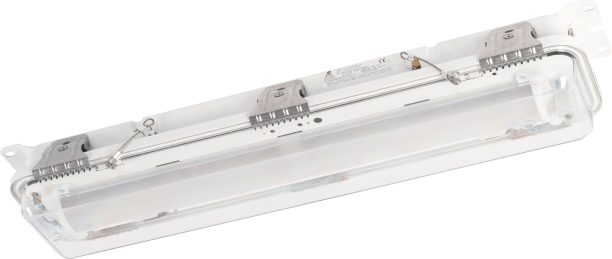
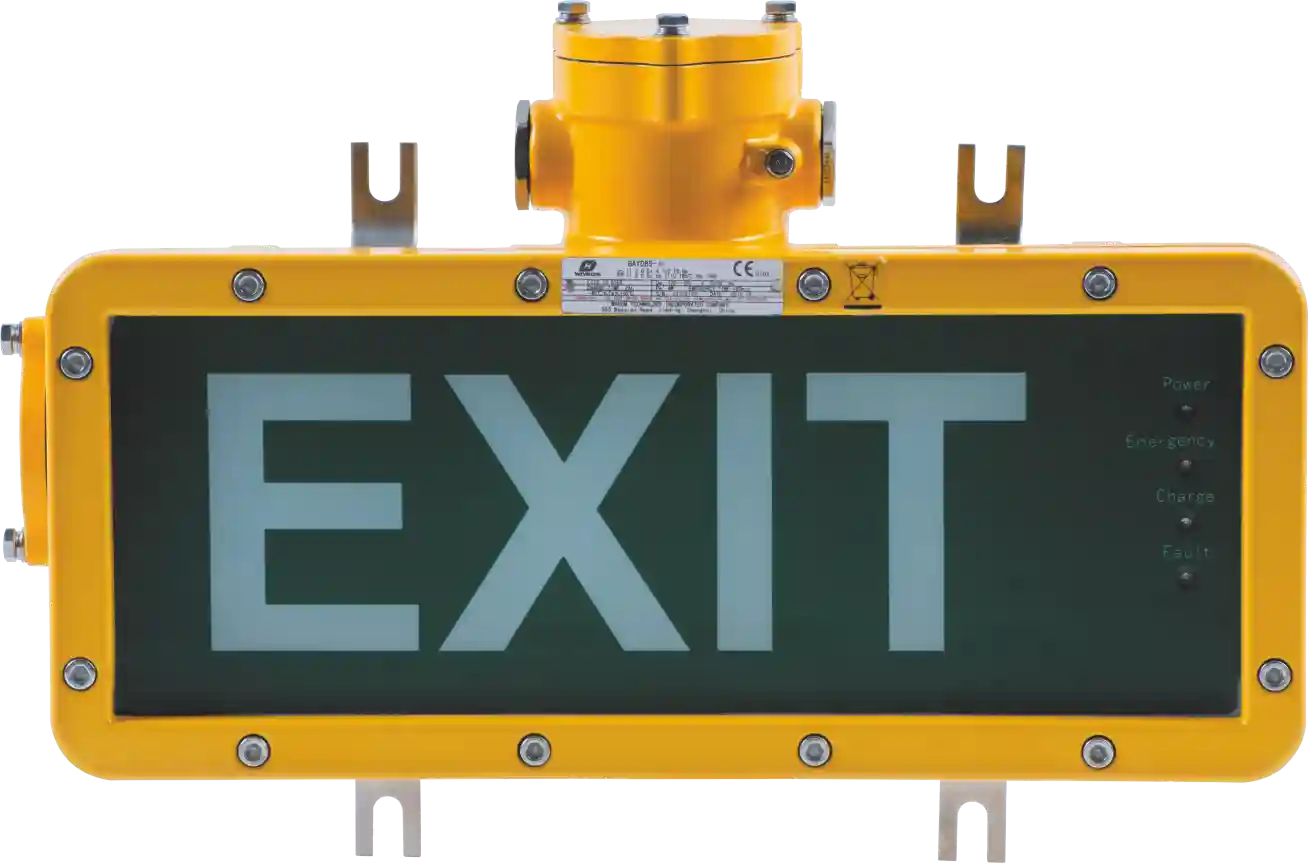
Emergency and escape lighting is often added late and bought badly. The emergency module sits inside the certified enclosure, so its battery, charging circuit and duration belong in the certificate and the instruction sheet, not only in the datasheet. Ask for the declared duration and the test method behind it.
Status and signal devices are the last group, and the one where configuration errors hide. Take an audio and visual caution unit: a flash rate of 150 to 160 times per minute, a sound pressure level of 110 to 120 dB at one metre and a 4 J impact rating on the cover are all declared values that belong in the same instruction set as the Ex marking. A number that appears only in a sales brochure has no place in an acceptance file.
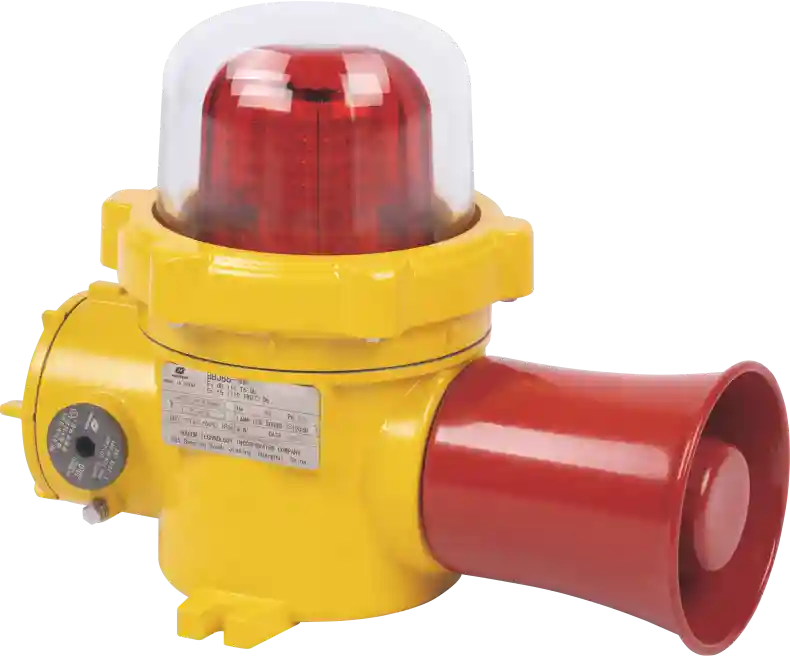
Local signalling devices are easy to specify loosely, and the gap shows up in service. <Local Caution Spotlights: Enhancing Safety in Hazardous Zones> covers local caution spotlight applications in hazardous zones.
A supplier that covers all five groups reduces the number of documents you have to verify and gives you one route for change notification. If the range is split between suppliers, assign a document owner per group and keep the acceptance criteria identical.
Which Technical Data Must Be Fixed Before You Compare Prices
Price comparisons fail when the specification is open. A quote for an IP66 floodlight at 100 W is not comparable with a quote for a T4 fitting at 45 °C ambient unless both documents state the same parameters, and the differences that matter are almost never in the price column.
Temperature class is the first. The class is a surface temperature limit, from T1 at 450 °C down to T6 at 85 °C [2], and the marked class holds only inside the marked ambient range. Raise the ambient and the same fitting runs hotter, so a T4 rating that was correct at 40 °C is no longer demonstrated at 55 °C. That is a design conversation, not a paperwork correction.
Ingress protection is the second, and it is routinely confused with explosion protection. IP66 to IEC 60529 means dust-tight and protected against powerful water jets [5]. It says nothing about ignition protection, and an Ex rating says nothing about water. Both belong in the specification, and both need a test basis rather than a claim.
The enclosure material and the corrosion category are the third. Coastal, chemical and marine sites shorten the life of any enclosure, and a corrosion category with no named test standard behind it is a marketing phrase. Ask which test the category refers to and whether the material certificate for the casting is available.
The fourth is the driver. It sits inside the certified assembly, and swapping it for a lower-cost unit after approval changes the electrical and thermal behaviour the certificate was based on. Ask for the driver brand, the input range, the power factor and the surge rating, and write into the order that a driver change requires notification and, where the certificate demands it, an amendment.
| Parameter | What the datasheet must state | How to check it |
|---|---|---|
| Gas or dust group | Zone, group IIA, IIB or IIC, or dust group IIIA, IIIB or IIIC | Compare with the area classification drawing, not with a similar project |
| Temperature class and ambient | Class at a stated ambient range, for example T4 at -40 °C to +55 °C | Read the certificate ambient first, then the nameplate |
| Ingress and impact | IP66 to IEC 60529, cover impact energy | Ask for the test report and the cover specification |
| Enclosure and corrosion | Alloy or GRP type, corrosion category, test standard | Material certificate and coating specification |
| Driver and electrical data | Brand, input range, power factor, surge rating, end-of-life protection | Driver datasheet plus the component listing on the certificate |
| Cable entries | Entry thread, count, certified gland and plug types | Nameplate photograph and the entry schedule in the instruction sheet |
What a Factory Audit Should Confirm on Site
A factory visit answers questions that documents cannot, provided you look at the production steps that create the protection rather than at the showroom.
Start with identity. The address you audit should be the address in the quality assessment report and on the nameplate. If a sales office arranges a visit to a different plant than the one named in the certificate, the trace is broken before the audit begins.
Flameproof construction depends on machining. The gap and length of a flameproof joint are the mechanism that cools an internal explosion before it reaches the atmosphere, and IEC 60079-1 sets the joint dimensions and the surface condition they must hold [6]. Ask how the gap is measured on the shop floor, which instrument is used, how often the result is recorded, and what happens to a casting that falls outside tolerance. Ask also how coating is kept off joint surfaces, because paint on a flame path changes the gap.
Then look for routine testing. Type testing proves a design; routine testing proves individual units or batches. Pressure testing of flameproof enclosures, ingress testing with water jets, ambient chamber runs and photometric measurement should each have a bench, a record format and a calibration certificate that is still valid. An expired calibration sticker tells you more about the quality system than any brochure.
For increased safety designs, the visible discipline is wiring: creepage and clearance distances, terminal torque and separation between circuits are what the protection concept depends on [7]. For dust applications, gasket compression and enclosure joints carry the protection [8]. In both cases, watch how a unit is assembled, not only how a finished unit looks.
Finally, ask about component supply. Castings, toughened glass and drivers are usually bought in, and the supplier’s control over those purchases decides whether next year’s batch matches this year’s certificate. An in-house foundry is convenient but not a requirement; a supplier that outsources castings can still be reliable if incoming inspection controls the alloy and the machined dimensions. What matters is the answer to one question: when a driver model is discontinued, who approves the substitute, and what evidence follows it?
Documents and Acceptance Points for Shipment Release
Release is a document event. The equipment may be correct and still fail acceptance because the paperwork does not let the buyer, the installer or an inspector confirm what was supplied.
The minimum set for a hazardous area lighting order: a declaration of conformity from the manufacturer, the EU-type examination certificate and the production quality notification or equivalent, the IECEx certificate, test report and quality assessment report where that scheme applies, a routine test record tied to each serial number, a nameplate drawing or photograph, a dimensional drawing showing cable entries and mounting, installation and maintenance instructions in the contract language, and the driver datasheet. The general requirements standard requires instructions to accompany the equipment, so a supplier treating them as optional is already outside the scheme [2].
Beyond the minimum, three items decide whether acceptance runs smoothly. The first is a first article approval, where one production unit is checked against the drawings and the certificate before the batch is released. The second is a factory acceptance test with agreed witness points, which is more useful than a final inspection because it catches a wrong driver or gland before packing. The third is a serial number list that matches the test records, so an inspector can trace a fitting on site back to a document rather than to a delivery note.
Packing and language deserve a line in the contract. Marine and tropical shipments need moisture protection that matches the route, and instructions in the wrong language are a common reason for a hold at customs or at site acceptance.
Projects that combine hazardous areas with environmental restrictions show why the document set matters. A package supplied for the Tilenga project in Uganda, where wellpads, a central processing facility and pipelines sit partly inside Murchison Falls National Park, had to satisfy hazardous area requirements and environmental conditions at the same time, which is the kind of scope where the acceptance file, not the datasheet, decides whether a delivery is complete.
The tradeoff is time. A full document set adds days before shipment. The alternative is discovering a variant mismatch after the fittings are on a vessel.
What a Certificate Cannot Prove About a Light Fitting
A certificate answers one question: was this design type examined against the standard and found to conform? Four other questions sit behind it, and each is answered by a different document.
The nameplate answers which configuration this unit is. The routine test record answers whether this unit passed production checks. The installation instructions answer what the assembly is permitted to contain. Site practice answers whether the flame path, gland or gasket survived installation. A buyer who treats the certificate as the answer to all five will eventually accept a unit that does not match its own paperwork.
| Record | What it was produced under | The claim it can support | What it cannot establish |
|---|---|---|---|
| EU-type examination certificate | Design examination by a Notified Body under the ATEX directive | The certified variant conforms at the stated ambient and gas group | That this shipment was produced under the quality system, or that the delivered variant is the certified one |
| IECEx certificate with test and quality reports | Testing by an accepted certification body plus a factory assessment | International conformity evidence for the model and assessed production | Approval for installation in a jurisdiction that requires its own listing |
| Routine pressure test record for a serial number | Production test at the factory | That this enclosure passed the production check | That a later field repair, gasket change or coating touch-up preserved the flame path |
| IP66 test report | Laboratory test on a sample to IEC 60529 | Ingress protection of the tested configuration | Dust or water integrity after uncertified glands are fitted or the cover is opened |
| Reference project list | Supplier declaration | That the supplier has delivered comparable scope | Delivery performance or failure rate on your site |
These records belong to the certification system and to the factory that produced the unit; they are evidence at defined stages, not a prediction of service life. The gap between them is where most disputes start, and it is closed by asking for the record that answers the specific question, not by asking for more certificates.
How to Write an RFQ That Produces Comparable Quotes
The fastest way to raise quote quality is to remove the choices a supplier would otherwise make for you. A loose request produces a loose quote, and the cheapest response usually wins a comparison it should not have entered.
Reject this line: “Please quote 100 sets of explosion proof LED floodlight, 100 W, IP66, ATEX, best price, delivery as soon as possible.”
Replace it with: “Zone 1, group IIC, T4 required at 45 °C maximum ambient and -5 °C minimum; ATEX EU-type certificate naming the exact model and wattage; IP66 to IEC 60529; enclosure alloy with material certificate; driver brand, input range, power factor and surge rating stated; 2 by M25 entries with certified plugs; routine test record per unit and serial number list; declaration of conformity and instructions in English; delivery week required.”
The second version takes ten minutes to write and removes the four assumptions that cause most post-award disputes: which variant is certified, which ambient the class holds at, which driver is inside, and which documents arrive with the crate.
| RFQ field | What to write | What it prevents |
|---|---|---|
| Area classification | Zone, gas or dust group, temperature class, maximum and minimum ambient, dust layer if relevant | A certified model that cannot be installed on the site |
| Certificate scope | Scheme, certificate number, holder name, exact model and wattage | Quotes priced against a certificate that does not cover the variant |
| Configuration | Wattage, colour temperature, beam, mounting, cable entries | Redesign and re-certification after the order is placed |
| Test evidence | Routine test record per unit, serial number list, factory acceptance points | Units that cannot be traced back to a record |
| Documentation | Declaration of conformity, instruction language, drawings, packing specification | Holds at customs, inspection or site acceptance |
| Lifecycle | Spare parts ratio, driver supply, written change notification | A product that becomes unsupportable in year three |
Comparing the responses then becomes a matter of normalising what is missing rather than reading the total. A quote that excludes spares, test records or a second language of instructions is not cheaper; it has moved the cost to a later stage of the project.
What to Send Before You Ask for a Price
Send five items: the area classification with zone, gas or dust group, temperature class and the maximum and minimum ambient; the fitting types and quantities; the certification schemes the project requires; the document set your client or inspector expects; and the delivery window. With those in hand, a manufacturer can answer with a certificate scope and a production plan instead of a price per unit, and you can compare answers on the basis that actually decides the order.
A price without that information is not a comparison, it is a guess with a currency symbol.
Warom Technology Incorporated Company answers these requests directly at gm*@***om.com, or by telephone on +86 21 39977076 and +86 21 39972657.
FAQ
Does an ATEX certificate allow installation in the United States
No. The United States uses its own classification system in Article 500 and a zone system in Article 505 of the National Electrical Code, and equipment is expected to be listed by a recognised testing laboratory to the applicable UL standard [4]. An ATEX or IECEx certificate is useful evidence of design quality and no help at the approval stage. Confirm the required scheme with the authority having jurisdiction before the order is placed, because a fitting can be well built and still not acceptable on that site.
How long does certificate verification take
One working session if the supplier provides certificate numbers with the quotation. The work is a database lookup, a comparison of the certificate holder and model designation against the quotation, a check of the marked ambient and temperature class against the area classification, and a check that the certificate is current on the shipping date. The slow part is usually the supplier rather than the database, because vague answers about which variant is certified delay the comparison more than any technical question.
Is a trading company always a problem
No, but the conditions change. A trader can be the right answer when the package spans several product categories that no single factory covers, and when the certificate holder is named, the producing factory is identified before shipment, and the warranty is passed through in writing. The risk rises when the factory behind the order is unnamed or can change between shipments, because the conformity decision then sits with a party that has no engineering stake in the product.
What if the site ambient is higher than the marked range
The marked temperature class is demonstrated inside the marked ambient range, so a fitting rated to +40 °C has no assured surface temperature limit at 50 °C. Ask for the certificate ambient first, then for thermal evidence at the site maximum. The options are a variant certified for the higher ambient, a lower wattage with thermal margin, or a mounting position with better air movement. A verbal assurance is not a substitute for a marked range.
Which document reveals the most about a supplier
A routine test record tied to a serial number, because it shows that production testing happens and that the result is traceable to a specific unit. The quality assessment report behind an IECEx certificate is the second, since it describes the factory the scheme assessed [3]. A supplier that can produce neither is describing a process rather than documenting one, and that gap rarely stays inside the paperwork.
References
[1] European Parliament and Council, “Directive 2014/34/EU on the harmonisation of the laws of the Member States relating to equipment and protective systems intended for use in potentially explosive atmospheres,” Off. J. Eur. Union, L 96, Mar. 2014.
[2] IEC 60079-0:2017, “Explosive atmospheres – Part 0: Equipment – General requirements,” International Electrotechnical Commission, Geneva, 2017.
[3] IECEx, “IECEx certificate system, online certificate and quality assessment database,” International Electrotechnical Commission. [Online]. Available: https://www.iecex.com
[4] NFPA 70, “National Electrical Code,” National Fire Protection Association, Quincy, MA, 2023.
[5] IEC 60529:1989+AMD1:1999+AMD2:2013, “Degrees of protection provided by enclosures (IP Code),” International Electrotechnical Commission, Geneva, 2013.
[6] IEC 60079-1:2014, “Explosive atmospheres – Part 1: Equipment protection by flameproof enclosures ‘d’,” International Electrotechnical Commission, Geneva, 2014.
[7] IEC 60079-7:2015, “Explosive atmospheres – Part 7: Equipment protection by increased safety ‘e’,” International Electrotechnical Commission, Geneva, 2015.
[8] IEC 60079-31:2013, “Explosive atmospheres – Part 31: Equipment dust ignition protection by enclosure ‘t’,” International Electrotechnical Commission, Geneva, 2013.
If you’re interested, check out these related articles:
OSHA Guide: Essential Construction Site Lighting Compliance
OEM Explosion Proof: When Custom Engineering Elevates Industrial Safety
The New Factory of WAROM MENA
With over a decade of experience, he is a seasoned Explosion-Proof Electrical Engineer specializing in the design and manufacture of safety and explosion-proof products. He possesses in-depth expertise across key areas including explosion-proof systems, nuclear power lighting, marine safety, fire protection, and intelligent control systems. At Warom Technology Incorporated Company, he holds dual leadership roles as Deputy Chief Engineer for International Business and Head of the International R&D Department, where he oversees R&D initiatives and ensures the precise delivery of design documentation for international projects. Committed to advancing global industrial safety, he focuses on translating complex technologies into practical solutions, helping clients implement safer, smarter, and more reliable control systems worldwide.
Qi Lingyi