
When a refinery maintenance manager looks at a stack of spent fluorescent tubes piled up after just 18 months in service, the cost difference between fluorescent and LED explosion-proof lights becomes painfully clear. The real question is not just rated lifespans on a datasheet, but what actually survives vibration, temperature swings, and corrosive atmospheres inside crude distillation units and hydrotreaters. Explosion proof LED light fittings have transformed refinery lighting economics over the last decade, not by incremental improvement but by eliminating the failure modes that kill fluorescent tubes early. Based on three decades of manufacturing explosion-proof electrical equipment for refineries worldwide, we can quantify the lifespan gap—and it is larger than most plant engineers assume.
What Shortens Lighting Lifespan Inside a Refinery
Datasheet lifetimes for any light source assume clean, dry, temperature-controlled conditions. A refinery gives you none of those. Three factors determine whether a fitting reaches its rated life—or fails catastrophically in two years.
Heat is the most aggressive killer. Process areas around crude heaters, reformers, and cokers routinely exceed 50°C ambient, and fixture internal temperatures run higher. Fluorescent ballasts are sensitive to thermal cycling; repeated expansion and contraction cracks solder joints and degrades capacitor electrolyte. We have seen ballast failures in fluorescent units operating at 45°C ambient after 12 to 18 months, well inside the warranty period.
Vibration from pumps, compressors, and overhead cranes weakens tube sockets and fractures filament connections in fluorescent lamps. A T8 tube may have a rated life of 20,000 hours on paper, but in a vibration-heavy zone above a reciprocating compressor, actual life can drop to under 8,000 hours. The tube itself becomes a consumable.
Corrosion adds a third dimension. Refineries along coastlines, or handling sour crude with hydrogen sulfide, accelerate metal corrosion inside fluorescent tube end caps and ballast housings. Even with an IP66 enclosure, moisture ingress through aging gaskets creates ground faults that trip branch circuits. This is not a theoretical edge case—on the Tilenga oil development in Uganda, where WAROM supplied explosion-proof LED lighting for wellpads and a central processing facility in a remote, humid national park, corrosion resistance was as critical as explosion protection for long-term reliability.
How Long Fluorescent Explosion Proof Lights Actually Last
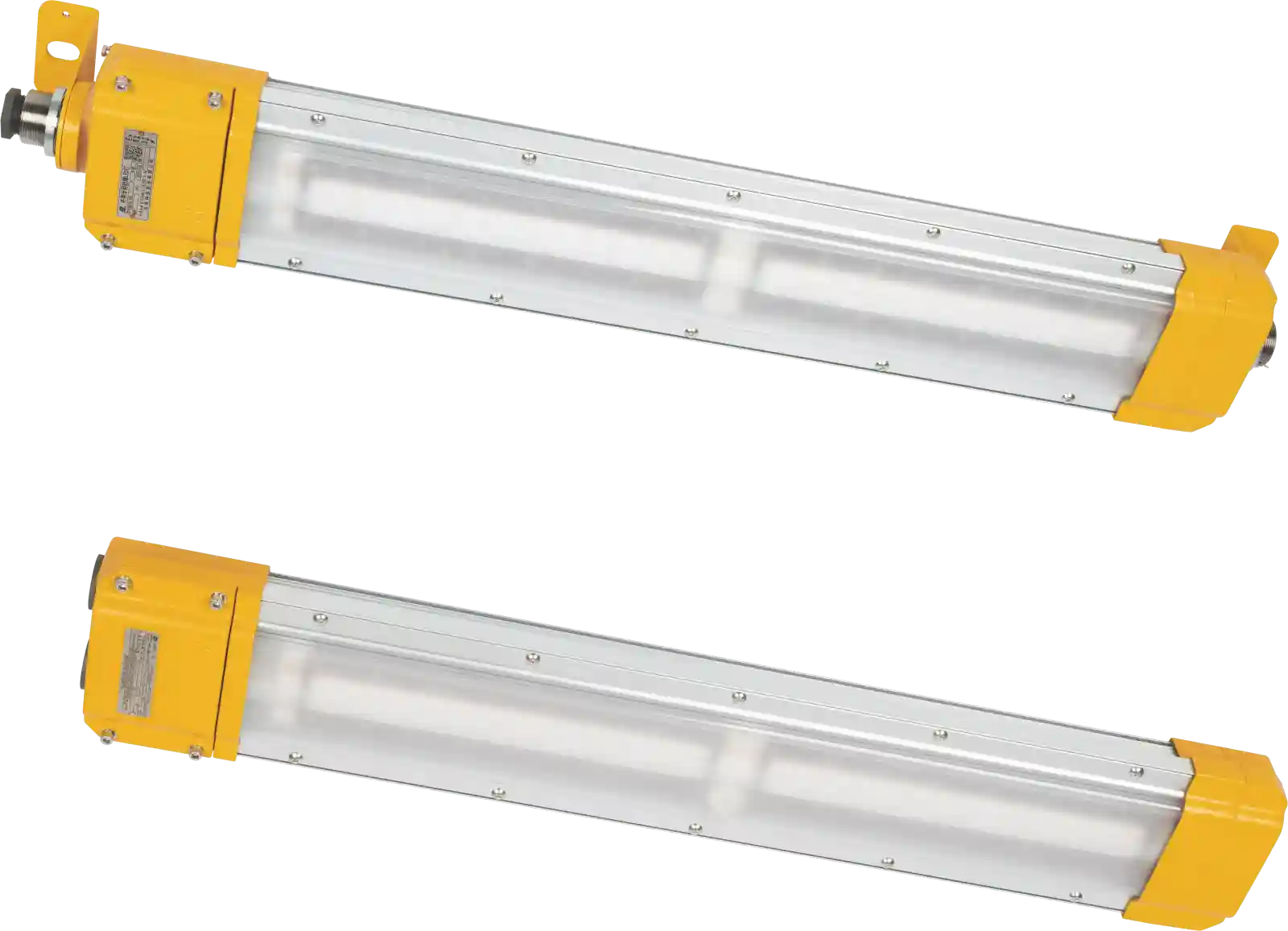
A fluorescent explosion-proof linear light like WAROM’s BAY51-Q uses replaceable T8 tubes rated for 15,000 to 20,000 hours under laboratory conditions. In a refinery, the tube itself lasts between 12 and 18 months before lumen output drops to the point where working illumination becomes inadequate—usually around 70% of initial lumens. Tube replacement is straightforward, but it is planned maintenance that never happens on schedule.
The real problem is the ballast. Magnetic ballasts generate heat and are sensitive to voltage fluctuations common on refinery switchgear. Electronic ballasts improve efficiency but are more vulnerable to transient spikes. When the ballast fails, the entire fitting is dark until an electrician replaces the control gear. The fitting itself must be opened in a potentially hazardous area, requiring gas testing and a safe work permit—a multi-hour interruption for a single light.
We still see some older installations with explosion-proof fluorescent fittings that have survived 10 years because they were in continuously air-conditioned control rooms. Those are the exceptions. In production areas, counting on more than four years before ballast replacement is optimistic, and tube changes every 18 months are normal.
LED Explosion Proof Lights: How the Failure Model Changes
LEDs do not have filaments to fracture or electrodes to sputter away. The light source itself in an explosion-proof LED fitting like WAROM’s HRNT95 series or the HRY97 linear LED is a solid-state emitter with a lumen maintenance life typically exceeding 60,000 hours to L70—the point where light output falls to 70% of initial. That translates to roughly 13 years of 12-hour daily operation. The LED modules themselves have no planned replacement interval.
The driver—the electronic current-control circuit—replaces the ballast and is the only element with a finite life. A properly designed LED driver with wide input voltage tolerance, surge protection, and adequate thermal management can operate 50,000 hours or longer in a well-designed enclosure. In the HRNT95, ambient temperature rating extends to 58°C with no derating, meaning the driver runs within spec even above most refinery process areas.
From our experience supplying LED fittings to offshore platforms and refineries, the failure pattern shifts from “replace tubes and ballasts regularly” to “the driver eventually ages, but usually after a decade.” This changes the maintenance model from reactive bulb changes to planned driver replacement integrated into turnaround cycles.
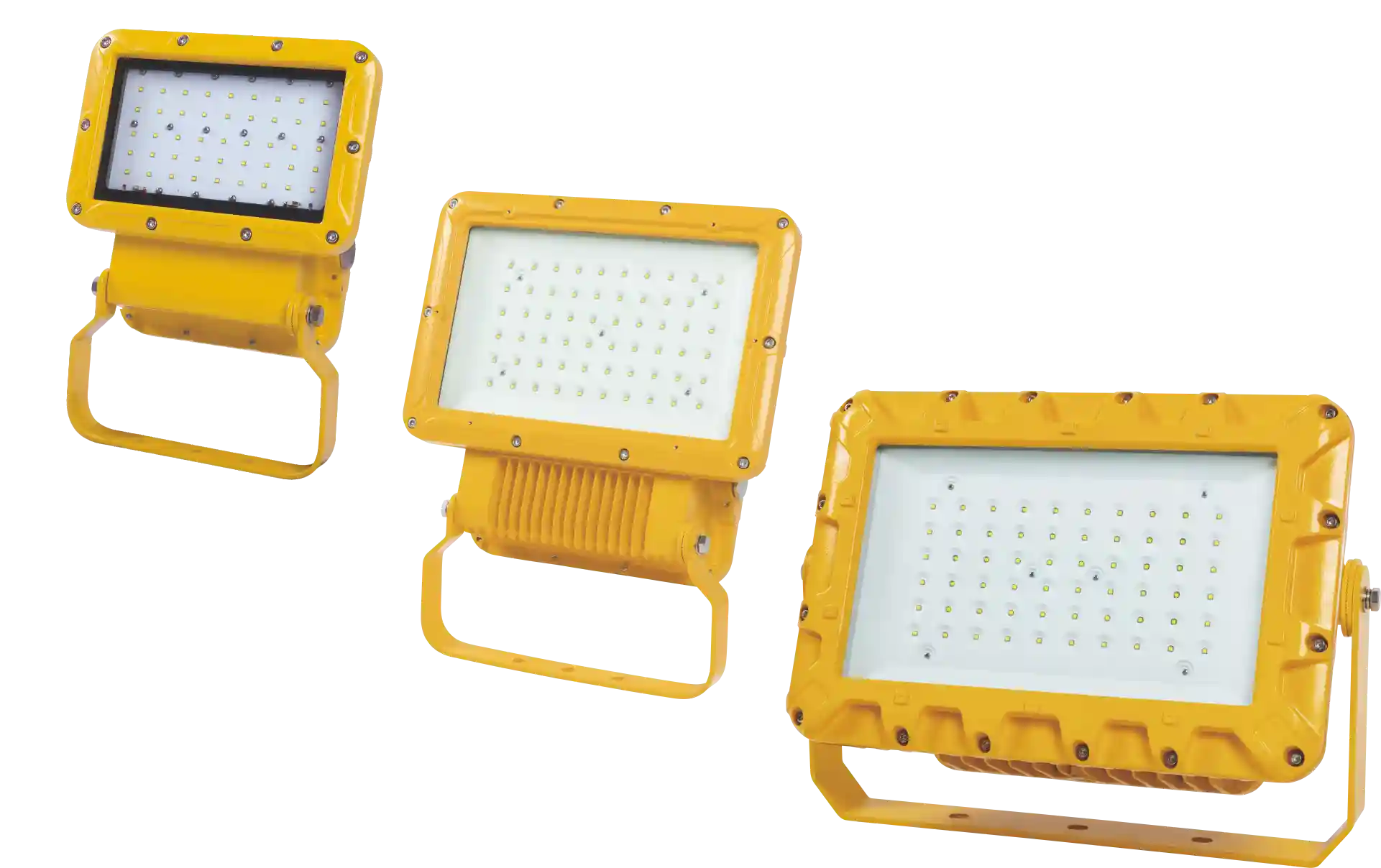
Total Cost of Ownership: Fluorescent vs LED Over a 5-Year Period
The purchase price of an explosion-proof fluorescent fitting is lower, but that position only holds for the first invoice.
| Cost Factor | Fluorescent (BAY51-Q with T8) | LED (HRY97 40W Equivalent) |
|---|---|---|
| Initial fixture cost | $150–$200 per unit | $250–$350 per unit |
| Tube/module replacement interval | 12–18 months (tube) | None (module) |
| Ballast/driver replacement interval | 3–5 years | 10+ years (driver) |
| Energy consumption (per 100 units, 12h/day) | ~35,000 kWh/year | ~17,500 kWh/year |
| Maintenance labor (access, permitting) | 2–4 hours per fixture per event | Near zero between turnarounds |
| 5-year total cost per fixture (material + labor + energy) | $600–$900 | $400–$550 |
The table assumes refinery labor at $80–120 per electrician hour, plus safe work permit delays. The LED cost advantage comes almost entirely from maintenance elimination, not energy savings. If your plant runs 24-hour shifts, the gap widens further.
If your refinery safety plan restricts live work in Zone 1 areas, the labor advantage for LED becomes decisive. Confirming LED driver compatibility with your specific ambient temperatures and supply voltage before finalizing the bill of materials avoids field surprises—send your operating conditions to gm*@***om.com and we can verify the correct specifications.
Where Fluorescent Lighting Still Has a Role
Acknowledging that no technology fits every application is part of professional honesty. Fluorescent explosion-proof fittings still make economic sense in three specific refinery scenarios.
The first is temporary enclosure lighting during turnarounds, where lights may be deployed for 3–6 months and then removed. The lower upfront cost outweighs the tubelife concern. The second is in air-conditioned electrical rooms and analyzer shelters, where ambient temperature stays under 25°C and vibration is zero. In those conditions, fluorescent tubes routinely reach their rated life, and the ballast longevity improves significantly. The third is for plants already standardized on fluorescent form factors with a large stock of spare tubes and ballasts in the warehouse—switching requires more than lights; it changes inventory.
Outside these cases, the economics of continuing to install new fluorescent light fittings in a modern refinery are difficult to justify.
What Determines an LED Driver’s Real Lifespan
The LED module will almost certainly outlast the driver, so the driver’s quality determines the fitting’s useful life. In an explosion-proof enclosure, the driver cannot exchange air with the outside atmosphere; all heat must conduct through potting compound to the enclosure body and then to ambient.
Two parameters matter most: electrolytic capacitor temperature rating and surge withstand capability. Capacitors rated 105°C under the driver’s thermal load will last orders of magnitude longer than 85°C-rated parts. We specify 105°C capacitors in drivers for refinery-grade LED fittings and have measured capacitor case temperatures under 80°C inside IP66 enclosures at 55°C ambient—a margin that translates directly into years of additional field life.
Surge protection matters because refinery power distribution is dirty. Large motor starts, VFD harmonics, and emergency generator switching create voltage transients that degrade unprotected driver input stages over time. A driver with at least 4 kV line-to-line surge protection, tested per IEC 61000-4-5, is not optional for refinery service.
Questions Refinery Electrical Engineers Ask About Lighting Lifespan
If we specified fluorescent lights five years ago, what is the retrofit liability?
In most cases, mounting hole patterns and cable entry positions are different between fluorescent and LED fittings. A retrofit requires new mounting brackets and possibly modification to conduit stub-ups. The labor to re-terminate is comparable to replacing the old fitting, so bundling the switch into a planned unit shutdown minimizes cost. We recommend ordering one sample LED fitting per area type, verifying the drop-in fit, then staging the bulk order.
Does the explosion protection method affect lifespan?
Ex d (flameproof) enclosures with thick aluminum bodies act as large heat sinks, which benefits LED driver cooling. Ex e (increased safety) fluorescent fittings rely on spark-proof construction rather than containment, but the enclosure design does not inherently promote heat dissipation. This gives flameproof LED fittings a slight thermal longevity advantage in high-ambient areas, independent of the light source technology.
How do we compare IECEx and ATEX rated fittings on lifespan?
The certification standard does not directly impact lifespan, but the testing rigor does influence component selection. Fittings tested to the full ambient temperature range and survival of thermal shock tests (required in IEC 60079) are less likely to have marginal components that fail early. When comparing quotes, ask for the temperature test report, not just the certificate.
What is the actual LED failure rate from your project records?
Across LED fittings we have shipped for refinery and offshore projects over the past eight years, the field failure rate for the LED modules themselves is under 0.2% over the first five years. Driver-related failures are also below 1% in that period, nearly all traceable to installation wiring faults or extreme surge events rather than component wear-out. If your operation is experiencing higher failure rates, the root cause is usually a mismatch between the ambient temperature rating and actual conditions—share your installation environments at gm*@***om.com and we can help diagnose the pattern.
For most refinery lighting systems, switching from fluorescent to LED explosion-proof fittings is the single most effective lever to reduce maintenance manhours and improve illuminated area uptime. The lifespan gap is not 1.5× or 2×—it is closer to 5× in real operating conditions, once you account for the invisible costs of safe-work permitting and electrical crew availability. If you are planning a new installation or a major upgrade, send your lighting schedule and zone classification to gm*@***om.com or call +86 21 39977076, and we will build a total cost-of-ownership comparison based on your actual operating profile.
If you’re interested, check out these related articles:
Technical Specification for Explosion Proof Cabinets: A Guide
WAROM Explosion-proof 2023 Summer Marketing Conference a Complete Success
Warom Technology “International explosion-proof technology Vietnam special Forum” was successfully held
WAROM With our partner in OGU
SOGCE 2025 is Underway
With over a decade of experience, he is a seasoned Explosion-Proof Electrical Engineer specializing in the design and manufacture of safety and explosion-proof products. He possesses in-depth expertise across key areas including explosion-proof systems, nuclear power lighting, marine safety, fire protection, and intelligent control systems. At Warom Technology Incorporated Company, he holds dual leadership roles as Deputy Chief Engineer for International Business and Head of the International R&D Department, where he oversees R&D initiatives and ensures the precise delivery of design documentation for international projects. Committed to advancing global industrial safety, he focuses on translating complex technologies into practical solutions, helping clients implement safer, smarter, and more reliable control systems worldwide.

Qi Lingyi