

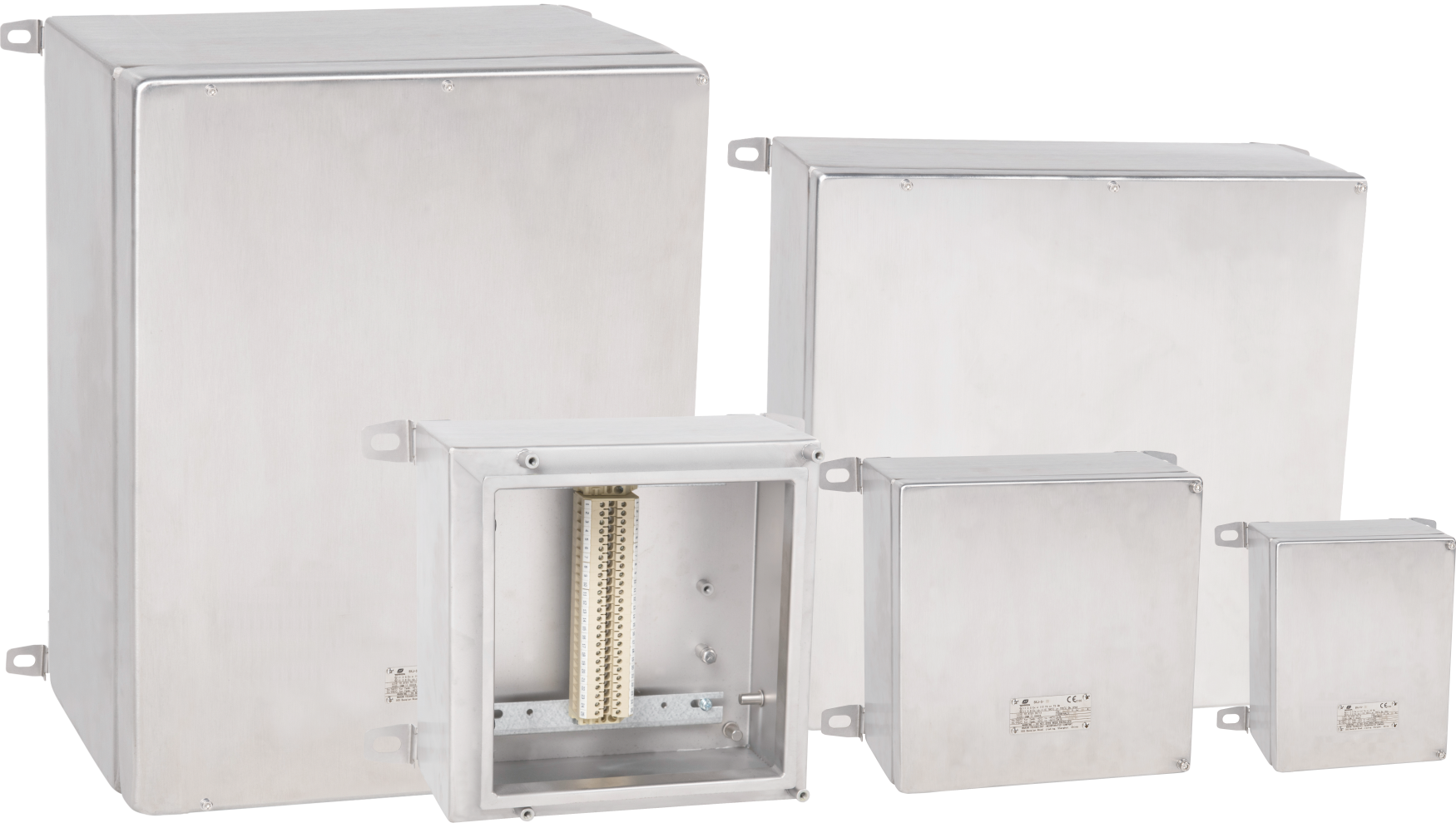
Stainless steel explosion-proof distribution cabinets protect electrical systems in marine hazardous environments where saltwater, humidity, and flammable atmospheres create constant risk. These enclosures meet ATEX and IECEx certification requirements while resisting the corrosion that destroys conventional materials within months of offshore deployment. On marine vessels and offshore platforms, they maintain power distribution reliability in conditions that would compromise standard electrical infrastructure.
Why Stainless Steel Outperforms Other Materials in Marine Hazardous Areas
Saltwater exposure, persistent humidity, and continuous vibration define the operating environment for electrical enclosures on offshore platforms and marine vessels. Conventional carbon steel corrodes rapidly under these conditions, losing structural integrity and compromising the seals that maintain ingress protection ratings. Aluminum alloys require protective coatings that degrade over time, creating maintenance cycles that interrupt operations.
Marine-grade stainless steel alloys resist these degradation mechanisms through their chromium content, which forms a passive oxide layer that regenerates when scratched or abraded. This self-healing property maintains corrosion resistance throughout the equipment’s operational life without requiring recoating or surface treatment. The mechanical strength of stainless steel also withstands the vibration loads common on vessels and platforms, where engine operation and wave action create constant stress on mounted equipment.
Material selection directly affects whether an enclosure maintains its IP rating over years of service. A stainless steel explosion-proof distribution cabinet that starts with IP66 protection typically retains that rating for its full service life, while aluminum or coated steel alternatives may lose seal integrity as corrosion progresses around gasket surfaces.
The Tilenga project in Uganda demonstrated this durability principle in practice. WAROM supplied explosion-proof lighting and electrical systems for wellpads and pipelines within Murchison Falls National Park, where equipment operated under extreme temperature variation and environmental exposure. The installation achieved zero safety incidents throughout the project phase, with maintenance requirements remaining minimal despite the demanding conditions.
| Material Type | Corrosion Resistance (Saltwater) | Mechanical Strength | Maintenance Needs | Cost (Relative) |
|---|---|---|---|---|
| Stainless Steel | Excellent | High | Low | Medium-High |
| Aluminum Alloys | Good (with coating) | Medium | Medium | Medium |
| Carbon Steel | Poor (without coating) | High | High | Low |
| Fiberglass (GRP) | Excellent | Medium | Low | Medium |
Which Certifications Actually Matter for Marine Explosion-Proof Distribution Cabinets
ATEX and IECEx certifications verify that explosion-proof distribution cabinets meet design and manufacturing standards for hazardous locations. ATEX applies within the European Union, covering equipment intended for potentially explosive atmospheres where flammable gases or combustible dust may be present. IECEx provides an international framework that facilitates equipment acceptance across multiple jurisdictions, reducing the certification burden for projects spanning different regulatory regions.
These certifications address different aspects of explosion protection. Zone classifications determine which protection methods are acceptable for specific hazardous area categories, while equipment group designations match enclosures to the gas or dust types present in the operating environment. A stainless steel explosion-proof distribution cabinet certified for Zone 1 gas atmospheres has passed testing that confirms it will not become an ignition source under the fault conditions specified in the relevant standards.
Marine classification society approvals add another layer of verification. DNV GL type approval and ABS certification confirm that equipment meets the specific requirements of maritime applications, including shock and vibration resistance, environmental sealing, and material compatibility with marine atmospheres. These approvals are typically required for equipment installed on vessels or offshore structures subject to classification society oversight.
The Fushilai Pharmaceutical project illustrated the practical application of these compliance requirements. Explosion-proof distribution boxes for workshops and tank farm areas met all applicable regulatory standards, creating a documented compliance chain that satisfied both regulatory authorities and the facility’s insurance requirements.
What specific certifications are essential for marine explosion-proof distribution cabinets?
Marine explosion-proof distribution cabinets require ATEX certification for European Union installations, IECEx certification for international acceptance, and marine classification society approvals from organizations such as DNV GL or ABS. The specific certifications needed depend on the installation location, the hazardous area classification of the operating environment, and the regulatory jurisdiction governing the project. Zone 1 and Zone 2 gas atmosphere ratings are common requirements for offshore oil and gas applications.
How to Specify Electrical Distribution Systems for Offshore Platform Requirements
Offshore electrical distribution systems integrate multiple component types within explosion-proof enclosures. Power control units manage load switching and motor control functions, while circuit breakers provide overcurrent protection for branch circuits. Terminal boxes and junction boxes create connection points for cable routing throughout the platform, and cable glands maintain the enclosure’s ingress protection rating where cables enter.
Electromagnetic compatibility becomes a design constraint when explosion-proof distribution cabinets operate near sensitive navigation or communication equipment. Proper shielding and grounding practices prevent the electrical noise generated by motor starters and variable frequency drives from interfering with other systems. This consideration affects both the enclosure design and the internal component arrangement.
Custom engineering addresses the specific requirements of individual projects. Standard catalog products rarely match the exact circuit configuration, physical dimensions, and mounting requirements of a particular installation. The General Paint project demonstrated this customization capability, where specific junction and distribution box configurations matched the facility’s process layout and electrical distribution architecture. If your project involves non-standard circuit arrangements or space constraints, discussing these requirements early in the specification process prevents costly modifications during installation.
What Explosion Protection Methods Work in Marine Atmospheres
Flameproof enclosures, designated Ex d, contain any internal explosion and prevent flame propagation to the surrounding atmosphere. The enclosure’s joints and openings are designed with specific gap dimensions and path lengths that cool escaping gases below the ignition temperature of the external atmosphere. This protection method suits applications where arcing or sparking components must operate in hazardous areas.
Intrinsic safety, designated Ex i, takes a different approach by limiting the electrical energy available in circuits to levels too low to ignite a hazardous atmosphere. This method applies to instrumentation and control circuits rather than power distribution, but intrinsically safe barrier modules often mount within explosion-proof distribution cabinets to provide the energy limitation function.
Pressurized enclosures maintain a positive internal pressure with clean air or inert gas, preventing the entry of hazardous atmospheres. This method allows the use of standard electrical components within the enclosure, reducing equipment costs for applications where the pressurization system can be reliably maintained.
Dust ignition protection methods address environments where combustible dust rather than gas creates the explosion hazard. These methods focus on preventing dust ingress and limiting surface temperatures to levels below the ignition temperature of the specific dust present.
Risk assessment identifies which protection methods are appropriate for specific locations within a facility. The Tilenga project’s zero-incident record reflected the effectiveness of matching protection methods to actual hazard conditions, with explosion-proof lighting and electrical systems performing without failure throughout the project duration.
Why Lifecycle Cost Calculations Favor Stainless Steel Explosion-Proof Distribution Cabinets
Initial purchase price represents only a fraction of the total cost of explosion-proof electrical equipment in marine service. Replacement costs, maintenance labor, and operational downtime accumulate over the equipment’s service life, often exceeding the original purchase price several times over.
Stainless steel explosion-proof distribution cabinets reduce these lifecycle costs through extended service life and reduced maintenance requirements. An enclosure that maintains its integrity for fifteen years without requiring seal replacement or surface treatment generates lower total costs than a less expensive alternative that needs refurbishment every five years. The labor cost of performing maintenance on offshore platforms, where technician time includes mobilization, accommodation, and safety supervision, amplifies the value of equipment that requires less frequent attention.
Energy efficiency contributes to lifecycle costs through the electrical losses in distribution equipment. Modern circuit breakers and contactors with lower contact resistance reduce heat generation within enclosures, extending component life and reducing cooling requirements. These efficiency gains compound over years of continuous operation.
The Tilenga project demonstrated the practical outcome of this lifecycle approach. Low maintenance requirements and high reliability throughout the project phase validated the equipment selection decisions made during the engineering phase.
How do stainless steel cabinets withstand extreme marine corrosion and environmental factors?
The chromium content in stainless steel forms a passive oxide layer on the surface that resists oxidation from saltwater and humidity. This layer regenerates when damaged, providing continuous protection without requiring external coatings. Environmental sealing through gaskets and cable glands prevents moisture ingress, while the material’s inherent UV resistance eliminates the degradation that affects painted or coated surfaces. Temperature cycling does not cause the differential expansion problems that can crack coatings on other materials.
What to Evaluate When Selecting a Supplier for Marine Explosion-Proof Equipment
Project execution capability matters as much as product quality when selecting explosion-proof electrical equipment for marine applications. A supplier’s ability to coordinate documentation, manage delivery schedules, and provide technical support during installation affects project outcomes beyond the equipment’s technical specifications.
The Tilenga project required coordination across multiple equipment categories, with explosion-proof lighting and electrical systems delivered to a remote location with limited infrastructure. Successful execution depended on documentation that satisfied regulatory requirements, packaging that protected equipment during extended transport, and technical support that addressed installation questions as they arose.
The General Paint project demonstrated custom engineering capability, where non-standard requirements drove the specification of junction and distribution boxes tailored to the facility’s specific needs. This type of project requires a supplier with engineering resources to develop custom solutions rather than simply selecting from catalog products.
The Fushilai Pharmaceutical project highlighted multi-party coordination, where explosion-proof distribution equipment integrated with systems from other suppliers within a larger facility construction program. Successful delivery required schedule coordination, documentation compatibility, and technical interface management.
What are the key considerations for selecting explosion-proof electrical equipment for offshore oil and gas projects?
Regulatory compliance verification confirms that equipment meets the certification requirements of the installation jurisdiction. Material durability assessment ensures that enclosure materials will withstand the specific corrosive conditions present at the installation location. Environmental resilience testing validates performance across the temperature range and humidity levels expected during operation. Supplier evaluation should include review of similar project experience, technical support availability, and spare parts supply capability for the equipment’s expected service life.
Discuss Your Marine Electrical Protection Requirements
To discuss stainless steel explosion-proof distribution cabinet requirements for your marine or offshore project, contact WAROM TECHNOLOGY INCORPORATED COMPANY. Tel: +86 21 39977076 Email: gm*@***om.com
Frequently Asked Questions About Marine Explosion Protection
Why is stainless steel specifically recommended for marine explosion-proof distribution cabinets over other metals?
Stainless steel resists the saltwater corrosion that degrades aluminum coatings and destroys carbon steel within months of marine exposure. The chromium oxide layer that forms on stainless steel surfaces regenerates after mechanical damage, maintaining corrosion protection throughout the equipment’s service life. This durability reduces maintenance frequency and extends replacement intervals, lowering total ownership costs despite higher initial purchase prices. For marine hazardous area applications, this material reliability directly supports the safety function of the enclosure.
How do marine explosion-proof cabinets ensure electrical safety in hazardous zones?
These cabinets employ protection methods matched to the specific hazard classification of the installation location. Flameproof enclosures (Ex d) contain internal explosions and prevent flame propagation through engineered joint designs. Intrinsic safety circuits (Ex i) limit energy to levels below ignition thresholds. Increased safety construction (Ex e) eliminates potential ignition sources through enhanced insulation and spacing. Each method undergoes testing and certification to ATEX and IECEx standards before equipment enters service.
What maintenance considerations are unique to explosion-proof electrical equipment on marine vessels?
Inspection schedules must verify that flameproof joints maintain their specified gap dimensions and surface condition, as corrosion or mechanical damage can compromise the flame path that prevents explosion propagation. Seal integrity checks confirm that gaskets and cable glands continue to provide the rated ingress protection. Personnel performing maintenance require training in hazardous area work practices to avoid creating ignition sources during servicing. Documentation of all maintenance activities supports ongoing compliance with classification society requirements. Contact our technical team if you need guidance on establishing maintenance programs for marine explosion-proof installations.
If you’re interested, you may want to read the following articles:
IP64 Rating Guide: Practical Device Protection Tests
Warom Technology “International IECEx explosion-proof technology Thailand special symposium” was successfully held
Explosion Proof LED Floodlights: Enhancing Safety and Efficiency
Warom Explosion-Proof Marketing Promotion Association 2024
With over a decade of experience, he is a seasoned Explosion-Proof Electrical Engineer specializing in the design and manufacture of safety and explosion-proof products. He possesses in-depth expertise across key areas including explosion-proof systems, nuclear power lighting, marine safety, fire protection, and intelligent control systems. At Warom Technology Incorporated Company, he holds dual leadership roles as Deputy Chief Engineer for International Business and Head of the International R&D Department, where he oversees R&D initiatives and ensures the precise delivery of design documentation for international projects. Committed to advancing global industrial safety, he focuses on translating complex technologies into practical solutions, helping clients implement safer, smarter, and more reliable control systems worldwide.

Qi Lingyi