

Explosion proof distribution cabinets look identical on a tender drawing whether they are factory built or assembled on site, but the certificate, test record, and commissioning risk sit on different sides of that choice. For most hazardous-area power distribution, factory built is the safer default unless the site has a very specific reason to assemble locally. The reason is not supplier preference. A factory built cabinet has frames drilled, glands installed, circuits terminated, and protection methods verified before it leaves a controlled production line. Site assembly moves part of that work into conditions that are harder to control. This comparison shows where each route succeeds and which specification details should drive the decision.
What Does Factory Built Mean for Explosion Proof Distribution Cabinets?
Factory built means the cabinet is not merely assembled in a workshop. The enclosure machining, component mounting, circuit wiring, terminal torquing, cable gland installation, and routine testing are done under the manufacturer’s quality plan before dispatch. For an Ex d flameproof enclosure, that includes checking flange gaps and tightening fasteners to the values recorded during type testing. For an Ex e increased safety section, it includes terminal torque, creepage and clearance verification, and confirmation that only certified components are fitted.
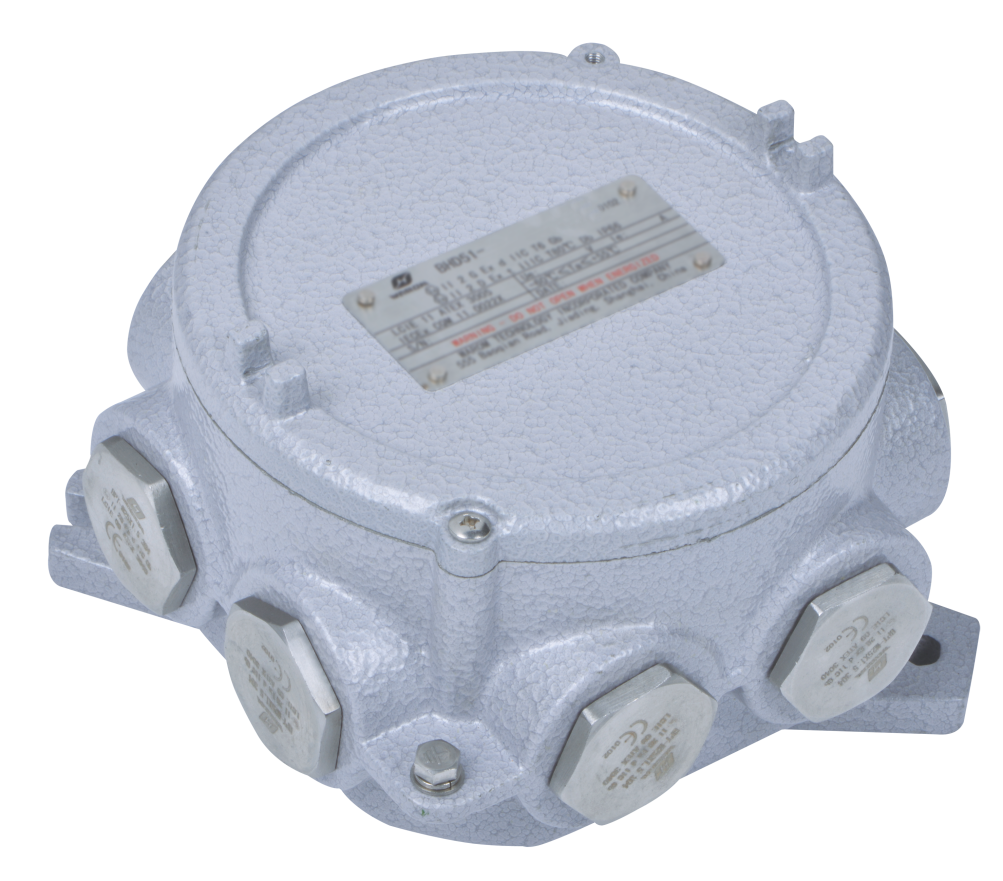
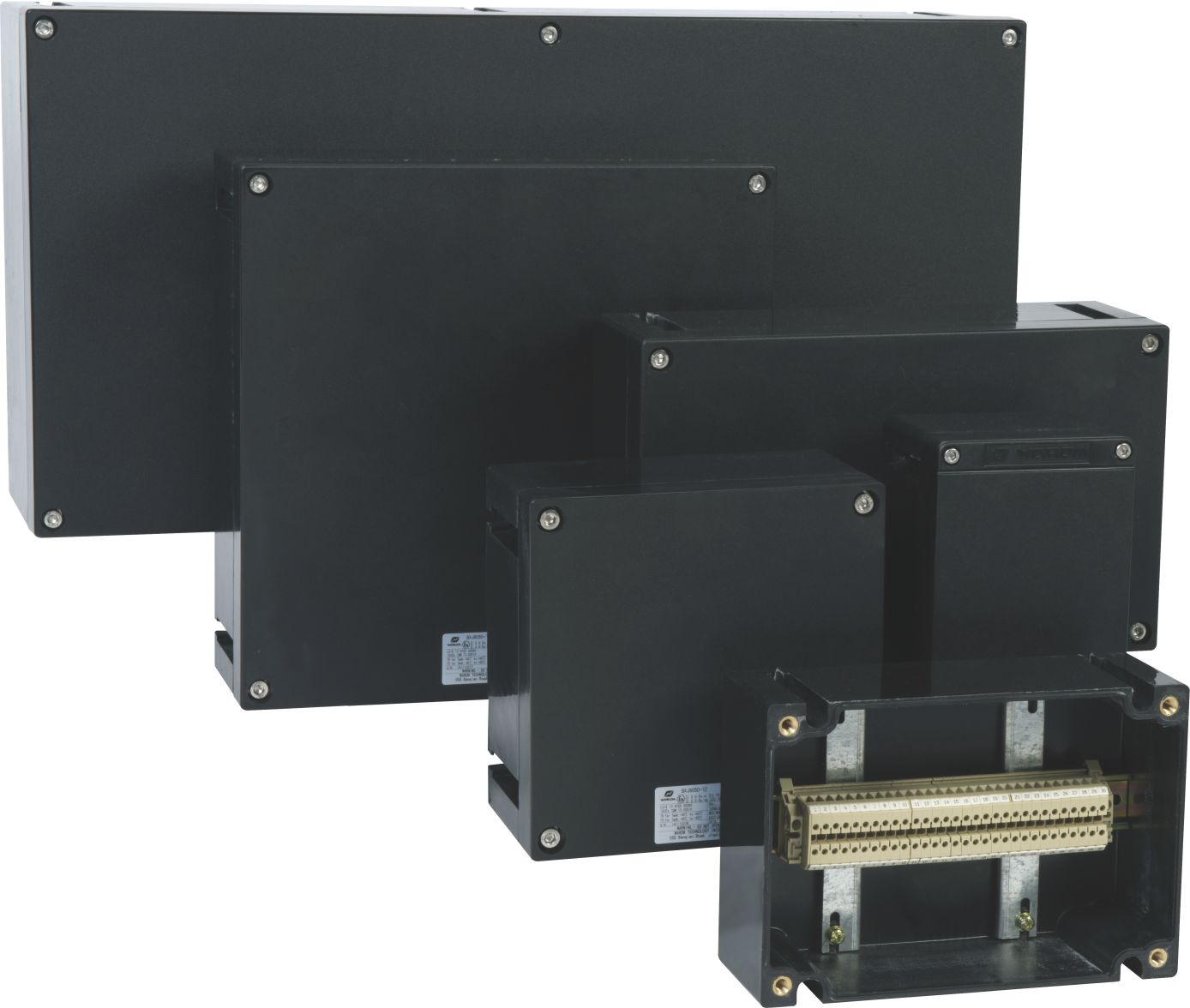
A practical example from the Warom range is the BXM(D)8050 distribution box, which combines Ex d and Ex e chambers, uses a GRP enclosure rated IP66, and operates at up to 690 V AC and 250 A. In factory build, the anti-static coating, anti-loosening fasteners, bottom cable entries, and modular circuit configuration are completed under one production process. The factory record shows who performed the work and what test result was accepted.
Factory build does not remove the need for site inspection. It narrows the variables. Instead of checking whether a contractor drilled an entry hole correctly, the inspector checks whether transport and installation damaged an already certified assembly.
For temporary construction power, the comparison changes because movable boxes get reconnected and exposed to different abuse loads. <Expert Guide: Selecting Temporary Power Distribution Boxes> covers how open-site conditions and frequent reconnection shift the inspection priorities.
Where Does Site Assembly Go Wrong in Explosion Proof Distribution Cabinets?
Site assembly usually fails at the cable interface, not at the enclosure. The enclosure may carry a valid certificate, but the final explosion protection depends on how the cables enter, how the glands are seated, and whether field modifications disturb a flamepath. I have inspected distribution cabinets where a contractor used a non-certified reducing adapter, omitted the sealing washer, or tightened a plastic gland beyond its rated range. Each fault changes the protection method in a way that is visible only during a detailed inspection.
Dust and gas zones make the problem worse. A field-drilled entry that leaves swarf inside the cabinet can damage terminal insulation. A gland that is not matched to the cable diameter can leave an unfilled annular gap. In increased safety equipment, one loose terminal can create heat at full load. These are not theoretical risks; they are the differences between a factory built cabinet and a site assembled cabinet.
During the General Paint assessment in Mexico, our team found existing distribution and junction boxes with entry modifications that had not been re-certified for the plant’s flammable gas and dust conditions. The remedial scope included replacing that site-assembled hardware with a configured explosion proof solution rather than extending the risk with further field changes.
How Does Certification Differ Between Factory Built and Site Assembled Cabinets?
A certificate is only as strong as the assembly it describes. When a cabinet is factory built, the ATEX or IECEx certificate, the type test data, and the production routine test results refer to the same completed configuration. If the manufacturer fits glands, terminals, and cable entries before dispatch, those components sit within the certified assembly.
Site assembly can break that link. The third-party certification body tested a specific gland type, torque range, cable entry arrangement, and enclosure condition. Once a site contractor changes the gland, drills an extra entry, or re-terminates a circuit, the assembly may no longer match the certified configuration. The site then needs an inspection by a qualified engineer, and in many cases a notified body or the project’s classification society must review the modification before energisation.
This is why factory built is not simply a preference. It keeps the certification chain intact through delivery.
How Should You Compare Factory Built and Site Assembled Costs?
The purchase price comparison is misleading. Site assembled cabinets appear cheaper at tender because the contractor carries the cost of installation labour and materials. The cost that matters is the cost after commissioning. Factory built shifts electrical assembly into a controlled production line, so the tender line item looks higher. Site assembly shifts it to a congested construction schedule where rework costs land after the quote.
| Factor | Factory built cabinet | Site assembled cabinet |
| Certification integrity | Assembly matches the certified configuration at dispatch. | Final configuration may fall outside the original certificate scope. |
| Gland and entry work | Completed and inspected under the manufacturer’s quality plan. | Depends on contractor skill and site conditions. |
| Fault discovery | Caught during factory routine testing. | Appears at loop check or first energisation. |
| Schedule impact | Lead time is longer before dispatch. | Site labour is later but rework can delay handover. |
| Best application | Fixed hazardous-area power distribution with multiple circuits. | A limited number of simple circuits with qualified site inspection. |
The real cost compares factory testing and lead time against the risk of field rework, delay, and re-certification. If the project has Zone 1 or Zone 2 gas atmospheres and multiple cable entries, confirm whether the supplier’s factory built certificate covers the final gland configuration before you freeze the bill of materials. Send the single-line diagram and entry schedule to gm*@***om.com and Warom will check which certificates and factory test records are available.
What Should You Confirm Before Choosing a Build Route?
The decision should not be made from a one-line quote. Before selecting, confirm five things. First, does the manufacturer’s certificate cover the final gland and entry configuration? Second, can the supplier produce routine test records for the exact assembled circuits? Third, does the enclosure material match the site environment, such as GRP for corrosion or 316 stainless steel for marine exposure? Fourth, is the temperature class and gas group matched to the hazardous area? Fifth, does the project have a qualified inspector available before site assembly begins?
If any of these cannot be confirmed, factory built is the safer route. If your project includes an unusual cable schedule, mixed Ex d and Ex e circuits, or a compressed commissioning window, send the specification and site classification to gm*@***om.com or call +86 21 39977076 before the purchase order is placed.
What Buyers Ask Before Choosing a Factory or Site Build?
Is site assembly allowed under ATEX/IECEx?
Site assembly can be compliant, but only when the responsible party controls gland installation, torque, and final inspection under the original certificate scope. The problem is that most construction sites do not have the same tooling, records, or trained inspectors as the factory. If the site route is unavoidable, the specification should name the inspector, the torque values, the gland types, and the final verification method before work begins.
Does site assembly affect warranty?
The assumption that a warranty automatically covers a site-assembled cabinet is wrong. Many suppliers warrant the factory built cabinet as delivered, but field modifications by a third party can shift responsibility to those who modified the equipment. If a contractor drills a new entry or changes a gland, the warranty on the flamepath and the cable entry often narrows or disappears. Buyers should request the warranty boundary in writing before deciding.
When does site assembly make sense?
It depends on what is being assembled on site. Site assembly can work for a small number of simple circuits, when the enclosure is already certified, the cable schedule is fixed, the installer is qualified, and an independent inspector checks the result before energisation. It becomes risky for multi-circuit distribution, mixed protection concepts, or tightly scheduled projects where the inspection step gets compressed.
Can a factory built cabinet be modified on site later?
The better question is not whether modification is possible, but whether the original certificate remains valid. A factory built cabinet can be modified on site if the modification is reviewed against the certificate, documented, and inspected. Routine field changes such as adding an unlisted hole or replacing a gland with a different type usually invalidate the certified configuration. Share the original nameplate details and the planned modification to gm*@***om.com and Warom will confirm what the certificate can still cover.
If you’re interested, check out these related articles:
Warom Explosion-Proof Supplier Conference 2024
OGI 2023, Indonesia
Ensuring Safety: The Indispensable Role of Explosion-Proof Fluorescent Lamps
Choosing IP68 Outdoor Junction Boxes: A Buyer’s Strategic Guide
With over a decade of experience, he is a seasoned Explosion-Proof Electrical Engineer specializing in the design and manufacture of safety and explosion-proof products. He possesses in-depth expertise across key areas including explosion-proof systems, nuclear power lighting, marine safety, fire protection, and intelligent control systems. At Warom Technology Incorporated Company, he holds dual leadership roles as Deputy Chief Engineer for International Business and Head of the International R&D Department, where he oversees R&D initiatives and ensures the precise delivery of design documentation for international projects. Committed to advancing global industrial safety, he focuses on translating complex technologies into practical solutions, helping clients implement safer, smarter, and more reliable control systems worldwide.

Qi Lingyi