
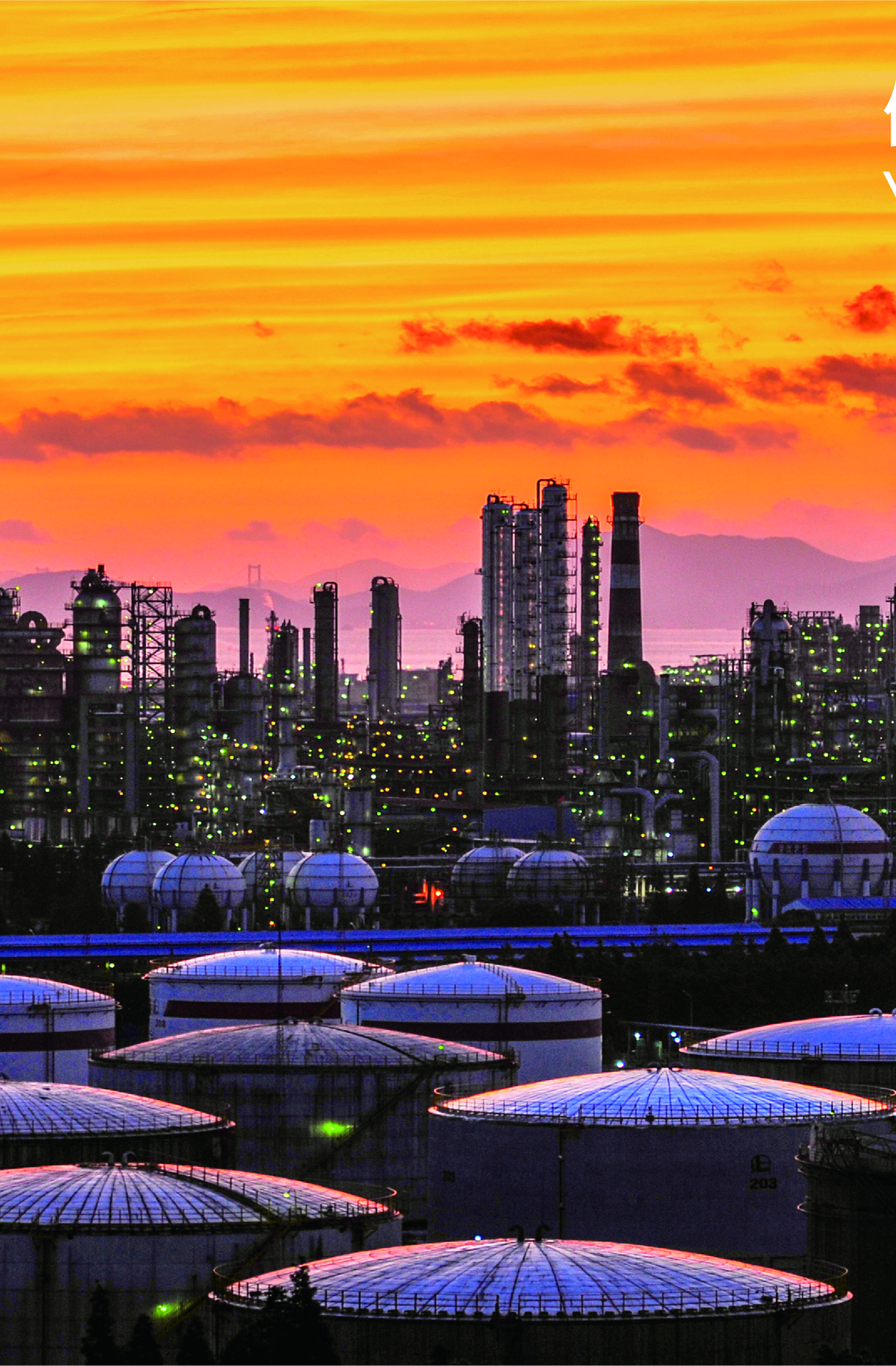
The explosion proof equipment at a methane drainage station is usually decided by two documents that never appear in the purchase order: the area classification drawing and the gas group ruling for the site. Once those are settled, the equipment list follows almost mechanically. When they are not, a station can end up with perfectly certified luminaires in the wrong group and junction boxes that cannot be sealed around the cable actually installed. Methane explains the sensitivity. It is lighter than air, so it collects at high points rather than in pits, and a drainage network running under negative pressure draws air inward through every imperfect joint instead of leaking gas outward. This guide covers the classification decision, the equipment set, the protection methods and the checks that decide acceptance.
What Makes a Methane Drainage Station a Hazardous Area
A drainage station is a small facility with an unusually concentrated set of release points. Gas from the boreholes arrives at a manifold, passes through a gas-water separator, then to vacuum pumps or compressors and on to a flare, a generator set or a sales meter. Every drain valve on the separator, every relief valve, every sampling point and every seal on the pump is an opening through which methane can reach the atmosphere. Those openings, not the length of the pipeline, define the hazardous area.
Negative pressure changes how that area behaves. In a positive pressure gas plant, a leaking flange releases gas outward and the zone around it is generous. In a drainage network the pump sits downstream, so the pipework runs below atmospheric pressure and a leaking joint draws air in. Release to atmosphere is mostly confined to deliberate openings, which is why the zone drawing for a station often covers the separator platform and the pump house rather than the whole pipe route. Classification follows IEC 60079-10-1 [1], and the inputs are the release source, its rate and the ventilation of the space around it.
Buoyancy matters for equipment and detector placement. Methane rises, so inside a pump house or a compressor shelter it reaches the roof long before it reaches a wall-mounted detector. Outdoors it disperses quickly, and the places that deserve attention are the sheltered ones: under a separator canopy, behind a compressor enclosure where air barely moves, and around the recessed sump where drainage water collects and gas can travel back up the drain line.
Coal dust is the second hazard. A station serving a coal mine sits inside a dust environment even when the drainage gas itself is clean, and Group I equipment is built to address firedamp and coal dust together. Dust also settles on horizontal surfaces, which raises a surface temperature question that the next section covers.
The practical check before any RFQ is straightforward. Ask for the zone drawing with every release source marked and the mounting elevation of each item noted. If the drawing shows a zone around the compressor house but none around the analyzer cabinet bolted to its wall, the classification and the layout disagree, and that disagreement belongs to the mine’s specialist rather than to the equipment supplier.
Group I or Group IIA and Why the Choice Comes First
IEC 60079-0 separates equipment into Group I, for mines susceptible to firedamp, and Group II for every other explosive gas atmosphere, with subgroups IIA, IIB and IIC ordered by the difficulty of the gas [2]. Methane belongs in Group IIA, the least demanding subgroup. That single fact creates most of the confusion around drainage stations, because a coal mine can legitimately classify its surface station in either system.
The case for Group I is administrative and practical. The drainage station is part of the mine’s firedamp control system, the mine’s inspectors work in Group I language, and a Group I spare will fit any other station on the same site. The case for Group IIA is that the station sits in open air, the release sources are known, and the classification study treats it like a surface gas plant. Both positions appear in real projects. The one that applies to a given station is the one written in the approved classification document or required by the regulator, and that ruling is worth obtaining before the RFQ rather than after delivery. Group I and Group II certificates are not interchangeable, and neither are the creepage, clearance and flame path details behind them. Projects working to US practice express the same decision in Class I Division language instead of zones, which changes the marking but not the underlying reasoning.
Temperature class is the next decision. Methane ignites above the 450 °C ceiling of class T1, so T1 is the theoretical minimum, and most certified luminaires and enclosures for this duty arrive marked T4, T5 or T6 [2]. For Group I equipment the binding limit is often dust rather than gas: 150 °C where a coal dust layer can form and 450 °C where it cannot [2]. A T4 marking or better satisfies both on paper. The real question is whether the surface temperature under a dust layer stays inside those limits at site ambient, which depends on driver derating and on how the enclosure is mounted.
Over-specifying the subgroup is an expensive habit. A IIB or IIC luminaire is not safer in a methane atmosphere than a IIA unit; it is built for a harder gas and costs more. Specify a higher subgroup only when the same equipment must serve another plant area with heavier gases, or when spares commonality genuinely justifies it. Write the exact marking string into the RFQ, for example Ex d I Mb or Ex d IIA T4 Gb, and require a nameplate photograph before shipment.
The Equipment Set a Drainage Station Actually Needs
A drainage station needs far less equipment than a refinery and far more than its size suggests, because it combines outdoor lighting, a small power distribution system, motor control for the pumps, gas detection and a monitoring and alarm layer. The table below sets out the functional list with the detail that usually decides the order.
| Function | Typical assembly | Protection | Selection note |
|---|---|---|---|
| Area lighting | LED floodlights for yards and separator platforms | Ex d or Ex e, IP66 | Beam angle and mounting height decide usefulness more than wattage |
| Emergency and exit lighting | Self-contained luminaires with integral battery | Ex d or Ex e | Declared duration and battery performance at the lowest site ambient both need stating |
| Power distribution | Modular illumination distribution boxes | Ex e or Ex de | Count spare ways at quoting stage, not after commissioning |
| Motor control | Starters for drainage pumps and compressors | Ex d or Ex de | Confirm where the variable speed drive is installed before fixing the starter type |
| Gas detection | Methane detectors on intrinsic safety circuits | Ex ia with associated apparatus | Detector height and calibration access decide whether it works |
| Monitoring and alarm | Cameras, sounders and beacons | Ex d, Ex e or Ex ia | The alarm has to be seen and heard before entry, not only in the control room |
Lighting is the item most often bought on price alone. At a station the useful number is not the wattage but the maintained illuminance on the separator platform and valve manifold, and the beam angle that reaches it without throwing glare into an operator’s eyes while he is reading a gauge. A narrow floodlight aimed at a walkway and a wide unit covering the manifold are different products, and quoting one for the other is a common source of retrofit work.
Distribution deserves the same discipline. Stations grow, and a spare way costs a fraction of a second enclosure. Where the same box has to carry switching devices and terminal blocks, the compound construction with a flameproof compartment and an increased safety compartment is common, but it only helps if the site knows which compartment is which at maintenance time.
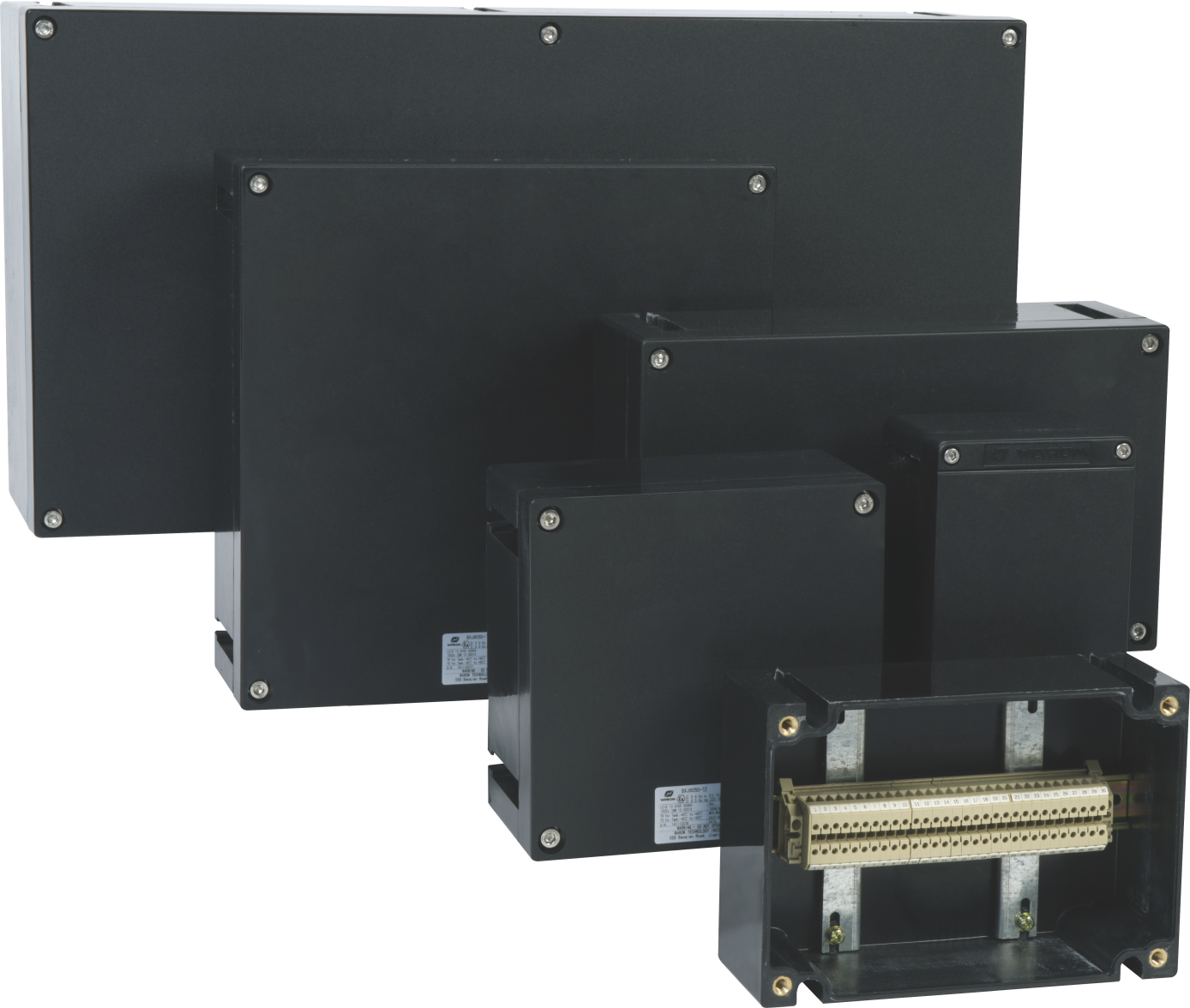
Instrument cabling has its own enclosure decision. Gas detectors, flow and pressure transmitters around a separator are usually wired through terminal boxes before the signal reaches the control room, and these boxes concentrate the most frequent installation error at the station: a certified enclosure entered through an uncertified or mismatched entry.
The other trap is the drive. A variable speed drive inside a flameproof enclosure is a heat problem first and a certification problem second, because the heat sink and the switching losses both sit inside a sealed volume. Most stations place the drive in a non-hazardous motor control room or in a pressurized cabinet and feed the motor through a flameproof starter. That choice changes the whole electrical layout, so it belongs in the first design meeting rather than in the electrical contractor’s scope.
Monitoring is where the station earns its operational value. Cameras aimed at the valve manifold, the compressor skid and the station entrance let the control room confirm a leak or a valve position before sending anyone into the compound. The camera specification has to match the environment, not the office: heated housings for winter, wiper or coating options for a dusty yard, and a bracket that keeps the sun out of the lens at midday.
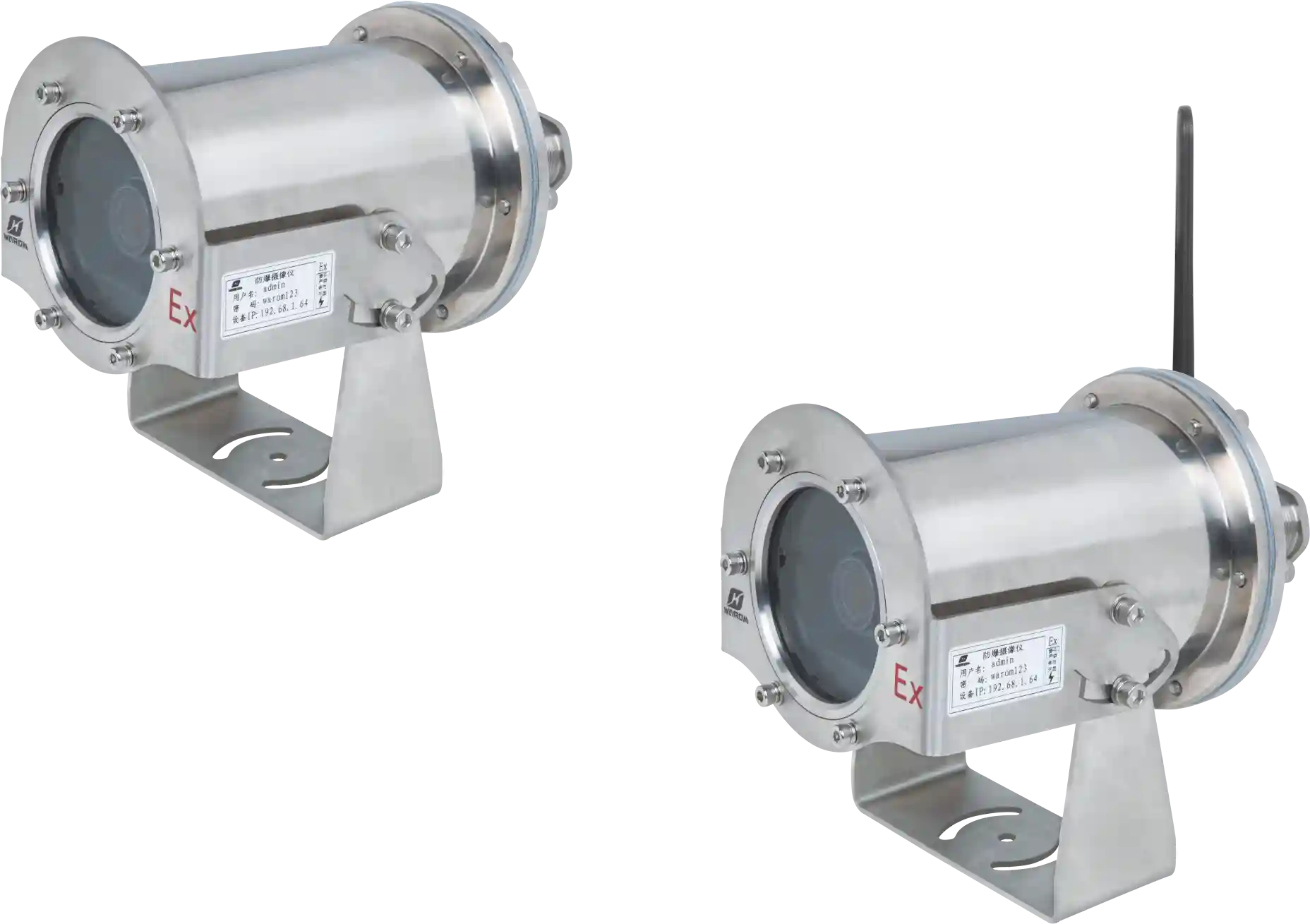
Monitoring rarely stops at the station fence. <Explosion-Proof CCTV for Zone 1: Hazardous Area Surveillance> covers camera specification for Zone 1 hazardous areas.
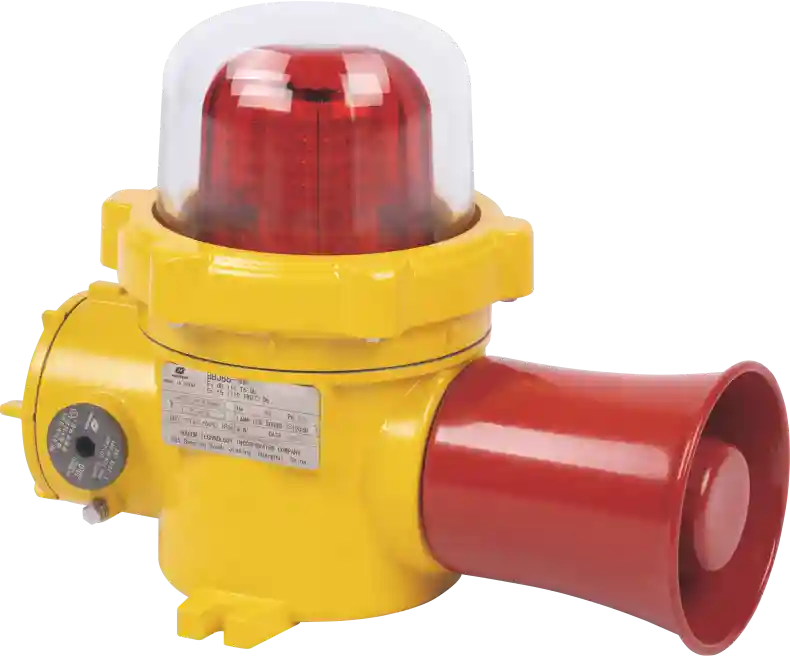
Alarm devices complete the layer. An audio-visual unit that combines a flashing beacon with a sounder in the 110 to 120 dB class is what makes a warning usable outdoors in daylight, where a lamp alone is invisible and a tone alone is unheard over a pump. Mount the unit where it is visible from the approach path, so the warning arrives before someone opens the door.
Matching Protection Methods to Each Location
Protection concepts are not grades of quality, and they are not ranked from good to better. Each one removes a different link in the ignition chain. Flameproof protection, increased safety and intrinsic safety are defined in IEC 60079-1, IEC 60079-7 and IEC 60079-11 respectively [3], [4], [5], and the choice between them follows the contents of the enclosure and the way the site is maintained.
| Method | How it works | Typical use at a station | Do not specify when |
|---|---|---|---|
| Ex d | Contains an internal explosion and cools the escaping flame through joints | Starters, control stations, luminaires in Zone 1 | Covers are opened often under load, or crews cannot maintain bolt torque and flame path condition |
| Ex e | Removes arcs and sparks and limits surface temperature | Terminal and junction boxes, distribution enclosures, luminaires | The enclosure contains any arcing or sparking contact |
| Ex i | Limits energy below the ignition level | Gas detectors, transmitters, communication circuits | Cable inductance and capacitance cannot be confirmed, or the circuit leaves the certified system |
| Ex de | Puts flameproof components inside an increased safety enclosure | Distribution boards and starter combinations with mixed contents | Nobody on site can tell which compartment carries which protection |
| Ex p | Holds positive pressure with clean air or inert gas | Analyzer houses, control cabins, large drive cabinets | The purge and alarm system cannot be monitored and maintained |
| Ex n | Non-sparking or energy limited design for Zone 2 | Zone 2 yards and peripheral equipment | The area is Zone 0 or Zone 1, or coal dust is present |
Cost ranking is not decision ranking. Increased safety is usually the cheapest per enclosure and the lightest to install, but it relies on the absence of any sparking contact, so it cannot hold a breaker or a contactor. Flameproof equipment is heavier, needs disciplined bolt torque and a flame path that nobody paints over, and is the right answer where switching or interruption happens inside the box. Intrinsic safety is the cheapest per measuring point and the easiest to add to later, provided the associated apparatus and the cable parameters are controlled as one system. Compound construction solves the mixed-contents problem but adds a maintenance risk if the two compartments look alike.
Maintenance capability should decide as much as the zone does. A station with two technicians and one annual shutdown should not carry four protection concepts when two will serve, because each concept brings its own inspection routine, its own spares and its own training need. Standardising on flameproof equipment for switching duties and increased safety for terminal and lighting duties keeps the training load manageable.
Where Drainage Station Equipment Fails First
Most failures at a drainage station are installation failures, and most of those start at the cable entry. An unused entry left open, a plastic plug where a certified stopping plug belongs, a gland of the wrong thread form, or a gland whose sealing range does not match the cable diameter all defeat the enclosure regardless of how good the certificate is. Every entry is part of the protection concept, and the entry schedule belongs in the purchase order rather than in the contractor’s memory.
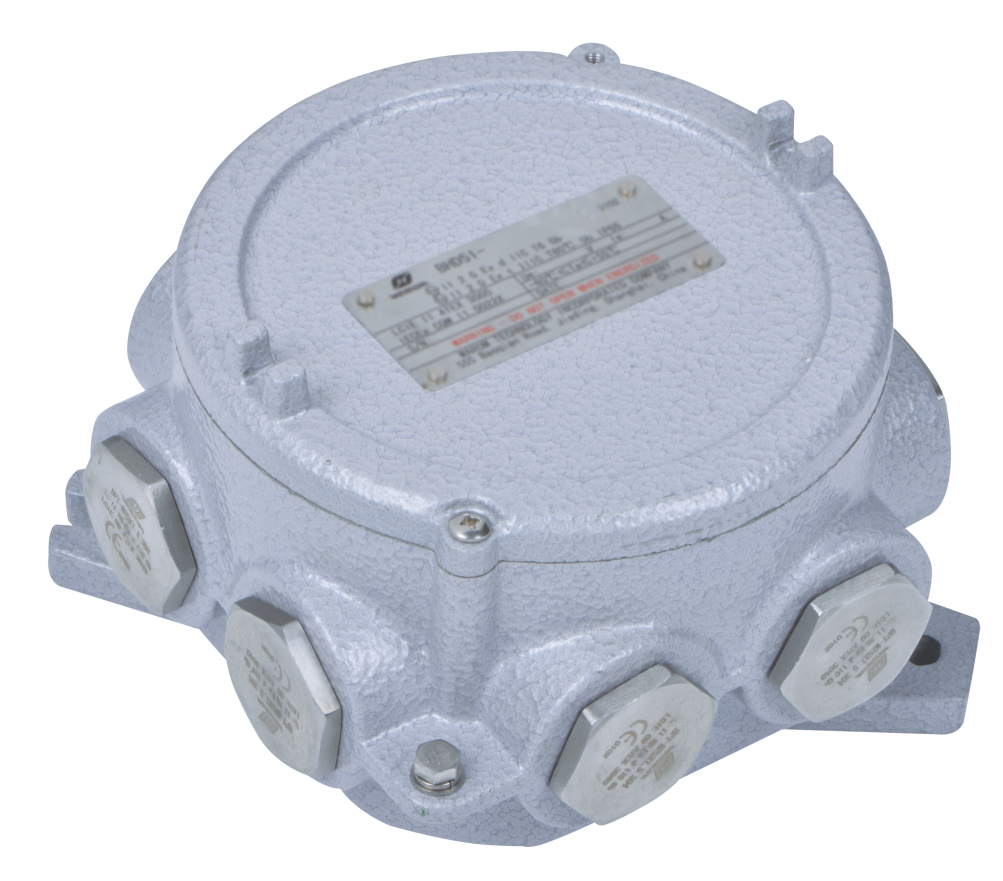
Flame paths fail slowly and quietly. Paint applied over joint faces during a repaint campaign changes the gap. A missing bolt replaced with a longer one from the site store changes the clamping. Corrosion on a flame path that nobody greased at commissioning changes both. none of these leaves a visible mark, which is why the flange condition is checked at every close inspection rather than at a glance.
Condensation is the failure mode that surprises operators. An enclosure that heats by day and cools at night pulls moisture inward through its breather, and if the breather and drain device are not fitted, or are fitted and never operated, water collects at the bottom of the box and finds the terminals. Coal mine drainage gas carries water vapour with it, and the surrounding atmosphere is often humid, so the drain schedule is a real maintenance item rather than a formality.
Earthing and torque finish the list. Internal and external earth points both need connection, gland plates need bonding to the enclosure, and pipework and structural steel need to sit at the same potential as the equipment. Terminal screws on increased safety equipment are torque-critical: a loose terminal runs hot, and a hot terminal inside a dust layer is exactly the condition the temperature class is meant to control. Re-tighten to the manufacturer’s figure after transport and again after the first month in service.
Inspection intervals come from the site’s own maintenance procedure, with IEC 60079-17 providing the framework for what a visual, close and detailed inspection each cover [6]. A station that only ever receives the visual check will keep passing audits while its entries and fasteners deteriorate, because nothing in a visual inspection opens a cover.
Maintenance work itself creates a temporary hazard. Repainting, flange work and separator cleaning all need light where no fixed luminaire reaches, and the temporary lighting must meet the same area classification as the fixed installation.
Maintenance work in a separator compound usually needs light where no fixed luminaire reaches. <Ultimate Guide to Portable Explosion Proof Lighting> covers portable lighting selection for hazardous areas.
Specifying for Cold, Heat, Coal Dust and Corrosion
The first distinction to fix in a specification is that IP and Ex answer different questions. An IP66 rating describes resistance to dust and water ingress. It says nothing about containing an internal explosion, limiting surface temperature or preventing a spark. An explosion proof enclosure is not automatically IP66 either, so outdoor locations need both ratings stated and both verified. Weatherproof enclosures for outdoor power and control have their own place on a station, but not inside a classified zone.
Cold is the constraint that catches northern sites. Equipment rated to -20 °C will be asked to work at -35 °C, and the parts that suffer are the elastomer seals in glands, the LCD displays on instruments and the batteries in emergency luminaires, whose usable capacity falls with temperature. A floodlight range rated from -60 °C to +60 °C, such as the BAT86 series, covers most of these sites, but the emergency lighting duration has to be confirmed at the site minimum rather than at 25 °C.
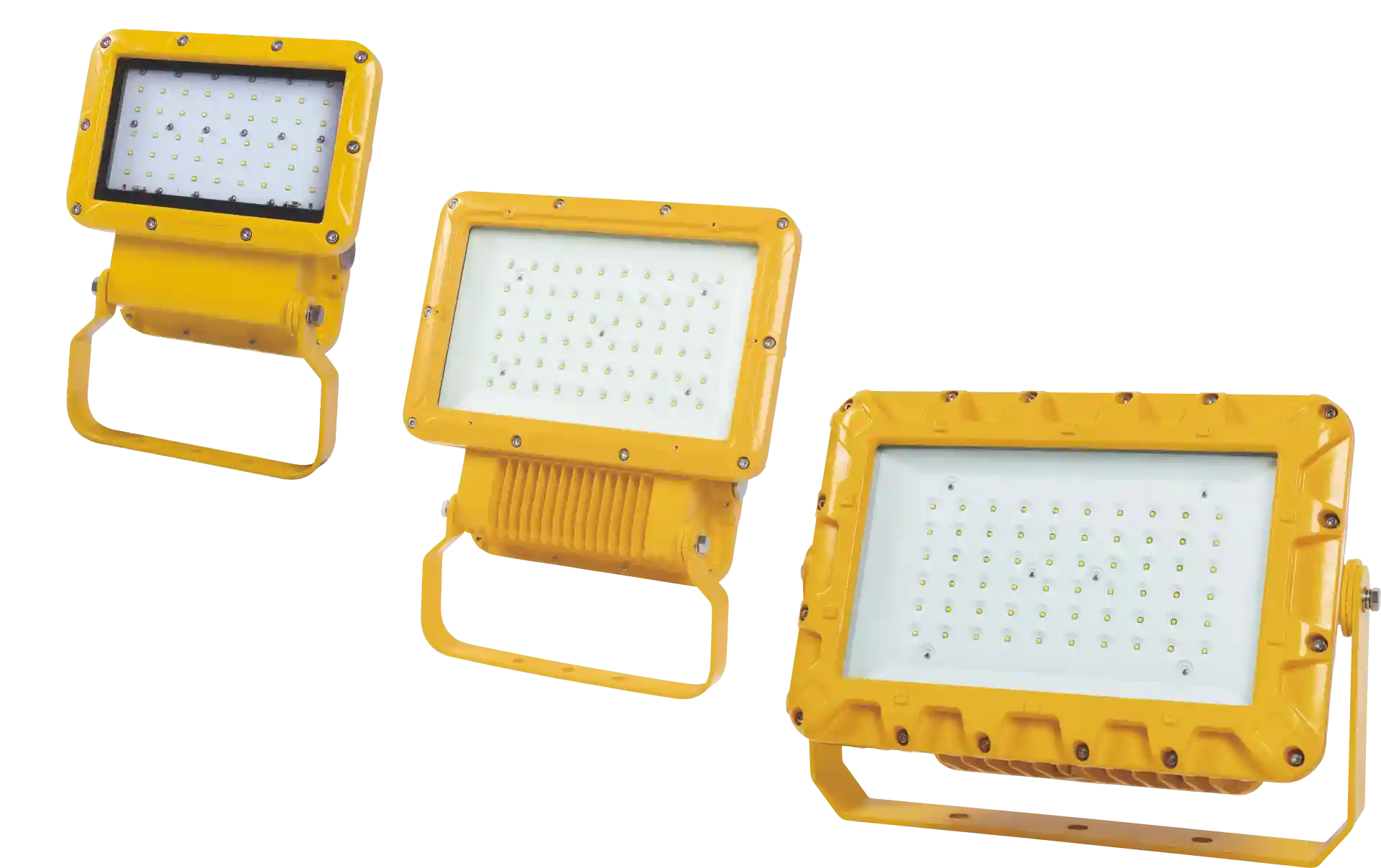
Heat works the other way and is easier to underestimate. A luminaire rated for +55 °C ambient is rated for the air around it, not for the inside of a driver compartment in direct sun on a dark enclosure. Solar gain, a dusty top surface and a mounting position under a canopy all push the driver temperature above ambient, and the declared temperature class has to survive that. Where a drive or a large luminaire sits in an enclosure, ask for the internal temperature rise rather than the ambient rating alone.
Corrosion and dust belong together because both are site-specific and both are usually understated in the quotation. Drainage water from a coal seam can be acidic, and coastal or offshore-adjacent sites add chloride. Corrosion grades such as WF2, GRP enclosures, 316 stainless steel fasteners and unpainted joint faces cover most cases, and the choice between aluminium, GRP and stainless is a cost and weight trade rather than a quality ranking. On the dust side, horizontal surfaces collect coal dust whatever the IP rating, so mounting orientation and a cleaning routine matter as much as the enclosure itself.
What to Check Before You Accept the Shipment
Documentation is where a technically correct order can still go wrong, because a certificate proves less than buyers assume. The table below separates what each document actually establishes from what it leaves to the receiving inspection.
| Record | Method context | Responsible use | Do not infer |
|---|---|---|---|
| Type examination certificate | Issued after type testing of a design for a stated group, temperature class and ambient range | The design passed the tests listed in the certificate | That the delivered unit was built to that design, or that the installed configuration with site cabling is safe |
| Nameplate marking | Applied to the individual unit | The unit’s declared protection, group, temperature class and certificate number | That the certificate covers the variant when the marking differs from the certificate schedule |
| IP66 test report | Sample tested for ingress protection | Ingress protection of the tested sample under test conditions | That an open entry or a mismatched gland leaves the enclosure at IP66 |
| Routine factory tests | Dielectric, insulation resistance and function tests before dispatch | Electrical integrity of the unit at the factory gate | That field terminations, torque and gland assembly are correct |
Read the certificate schedule, not only the number. A suffix letter after the certificate reference usually signals special conditions for safe use, and those conditions often concern exactly the details that decide whether the unit survives on site: a maximum ambient, a required cable type, a restriction on the entry position, or a mandatory breather. A unit ordered without reading that schedule can be fully certified and still misapplied.
Check the scheme as well as the certificate. EU projects route through Directive 2014/34/EU [7], international projects usually ask for IECEx, and Chinese coal mine projects add the coal mine product safety mark to the equipment that falls inside its scope. The schemes are not interchangeable paperwork, and a certificate in the wrong scheme can stop both customs clearance and commissioning. Confirm that the certificate holder matches the manufacturer named on the order, particularly when a trading company sits in the supply chain.
Then look at the physical package. Gaskets, breather elements, spare lamps, correct fasteners and the installation manual in the project language are all part of delivery, and a station missing one cover bolt is non-compliant from the day it is energised. Witness the routine tests if the order value justifies it, photograph the nameplate against the certificate, and count the entries against the approved drawing before the crates are opened on site.
An RFQ Field List You Can Reuse
Most slow quotations are not the supplier’s fault. The enquiry arrives without a classification, without cable data and without mounting information, so the supplier quotes a generic product and the comparison becomes meaningless. The field list below is the minimum that produces comparable offers.
| Field | What to send | Why it matters |
|---|---|---|
| Area classification | Drawing with zone, group, temperature class and release sources marked | Without it the supplier guesses the group and the quotes are not comparable |
| Equipment schedule | Tag, function, protection method, IP rating, material and mounting | Tags keep the right unit at the right location during installation |
| Circuit data | Voltage, current per way, number of ways and spare capacity | Under-counted ways are the most common change order on a distribution box |
| Cable and entry data | Cable type, armouring, outside diameter range and thread form | A gland that does not match the cable diameter cannot be made to seal |
| Site conditions | Ambient minimum and maximum, corrosion category, dust and solar exposure | A rating that fits the catalogue may not fit the site |
| Certification and documents | Required scheme, language, test witnessing and spare list | A certificate in the wrong scheme stops customs clearance and commissioning |
The difference between a vague line and a specifiable one is easy to see. Reject this RFQ line: “Explosion proof junction box, IP66, Zone 1, 12 terminals.” Replace it with: “Ex e IIC T6 Gb junction box, 12 terminals at 4 mm² rated 32 A, GRP enclosure, IP66, two M25 × 1.5 entries fitted with nickel plated brass Ex d glands for 12.5 to 20.5 mm armoured cable, internal and external earthing M5, ambient -40 to +55 °C, IECEx certificate and schedule with delivery, tag JB-104.” The second line can be quoted, compared and inspected. The first cannot.
Send the Classification Drawing Before the Equipment List Is Fixed
The fastest route to a comparable quotation is to send three documents together: the area classification drawing with release sources marked, the equipment schedule with tags and mounting locations, and the cable list with armouring and outside diameters. With those in hand, Warom Technology can confirm group, temperature class, protection method and entry configuration item by item, and flag the places where the drawing and the proposed layout disagree before anything is manufactured. Email gm*@***om.com or call +86 21 39977076 to start that review. If the classification document is still in draft, send it as it stands, because the gaps are usually easier to see against a proposed equipment list than in the abstract.
FAQ
Can weatherproof equipment replace explosion proof equipment at a drainage station?
No. The two ratings answer different questions. An IP66 rating describes resistance to dust and water ingress and says nothing about containing an internal explosion, limiting surface temperature or preventing a spark. A weatherproof box mounted where methane can reach it is an ignition risk with a good seal. The reverse also holds: an explosion proof enclosure is not automatically IP66, so outdoor locations need both ratings stated and both verified against the site conditions.
Is Group I or Group IIA equipment correct for a surface methane drainage station?
It depends on the approved classification document for that site, not on the gas itself. Methane sits in Group IIA, and a station classified as a surface gas plant will usually take Group IIA equipment. A mine that treats the drainage station as part of its firedamp system may require Group I instead. The two are not interchangeable, the certificates differ and spares cannot be swapped, so settle the ruling in writing before ordering and put the exact marking into the RFQ.
Which protection method suits lighting at a drainage station?
Both flameproof and increased safety luminaires are common. Flameproof units contain an internal fault and are the safer default where lamp or driver replacement happens on site. Increased safety units avoid sparks by design and limit surface temperature, which makes them lighter and easier to handle, but they must not contain arcing components. Zone 2 areas can use non-sparking types. The deciding factors are the zone, the maintenance routine and whether crews can keep flame paths and torque intact.
What temperature class does methane require?
Methane ignites above 450 °C, so T1 is the theoretical minimum and almost any certified equipment exceeds it. In practice the equipment arrives as T4, T5 or T6, and the question shifts to the real surface temperature under site conditions. A driver running near its limit inside an enclosure at 60 °C ambient can exceed its declared class even though the nameplate is correct, and where coal dust settles the Group I limit of 150 °C becomes the tighter constraint.
How often should equipment at a station be inspected?
The framework comes from IEC 60079-17, but the intervals belong to the site’s own maintenance procedure and its risk assessment for that station. What matters is that the schedule separates a visual check of enclosures, glands and labels from a close inspection that opens covers and checks flame paths, and from a detailed inspection that may require isolation. A station that only ever receives the visual check will keep passing audits while its entries and fasteners quietly deteriorate.
References
[1] IEC 60079-10-1:2020, “Explosive atmospheres – Part 10-1: Classification of areas – Explosive gas atmospheres,” International Electrotechnical Commission, 2020.
[2] IEC 60079-0:2017, “Explosive atmospheres – Part 0: Equipment – General requirements,” International Electrotechnical Commission, 2017.
[3] IEC 60079-1:2014, “Explosive atmospheres – Part 1: Equipment protection by flameproof enclosures ‘d’,” International Electrotechnical Commission, 2014.
[4] IEC 60079-7:2015, “Explosive atmospheres – Part 7: Equipment protection by increased safety ‘e’,” International Electrotechnical Commission, 2015.
[5] IEC 60079-11:2011, “Explosive atmospheres – Part 11: Equipment protection by intrinsic safety ‘i’,” International Electrotechnical Commission, 2011.
[6] IEC 60079-17:2013, “Explosive atmospheres – Part 17: Electrical installations inspection and maintenance,” International Electrotechnical Commission, 2013.
[7] Directive 2014/34/EU of the European Parliament and of the Council on the harmonisation of the laws of the Member States relating to equipment and protective systems intended for use in potentially explosive atmospheres, Official Journal of the European Union, 2014.
If you’re interested, check out these related articles:
Specifying Explosion-Proof Electricals for EPC Projects: Safety & Compliance
Warom at 40th ADIPEC 2024
Love And Respect For The Elderly, Warm Sunset Red
With over a decade of experience, he is a seasoned Explosion-Proof Electrical Engineer specializing in the design and manufacture of safety and explosion-proof products. He possesses in-depth expertise across key areas including explosion-proof systems, nuclear power lighting, marine safety, fire protection, and intelligent control systems. At Warom Technology Incorporated Company, he holds dual leadership roles as Deputy Chief Engineer for International Business and Head of the International R&D Department, where he oversees R&D initiatives and ensures the precise delivery of design documentation for international projects. Committed to advancing global industrial safety, he focuses on translating complex technologies into practical solutions, helping clients implement safer, smarter, and more reliable control systems worldwide.

Qi Lingyi