
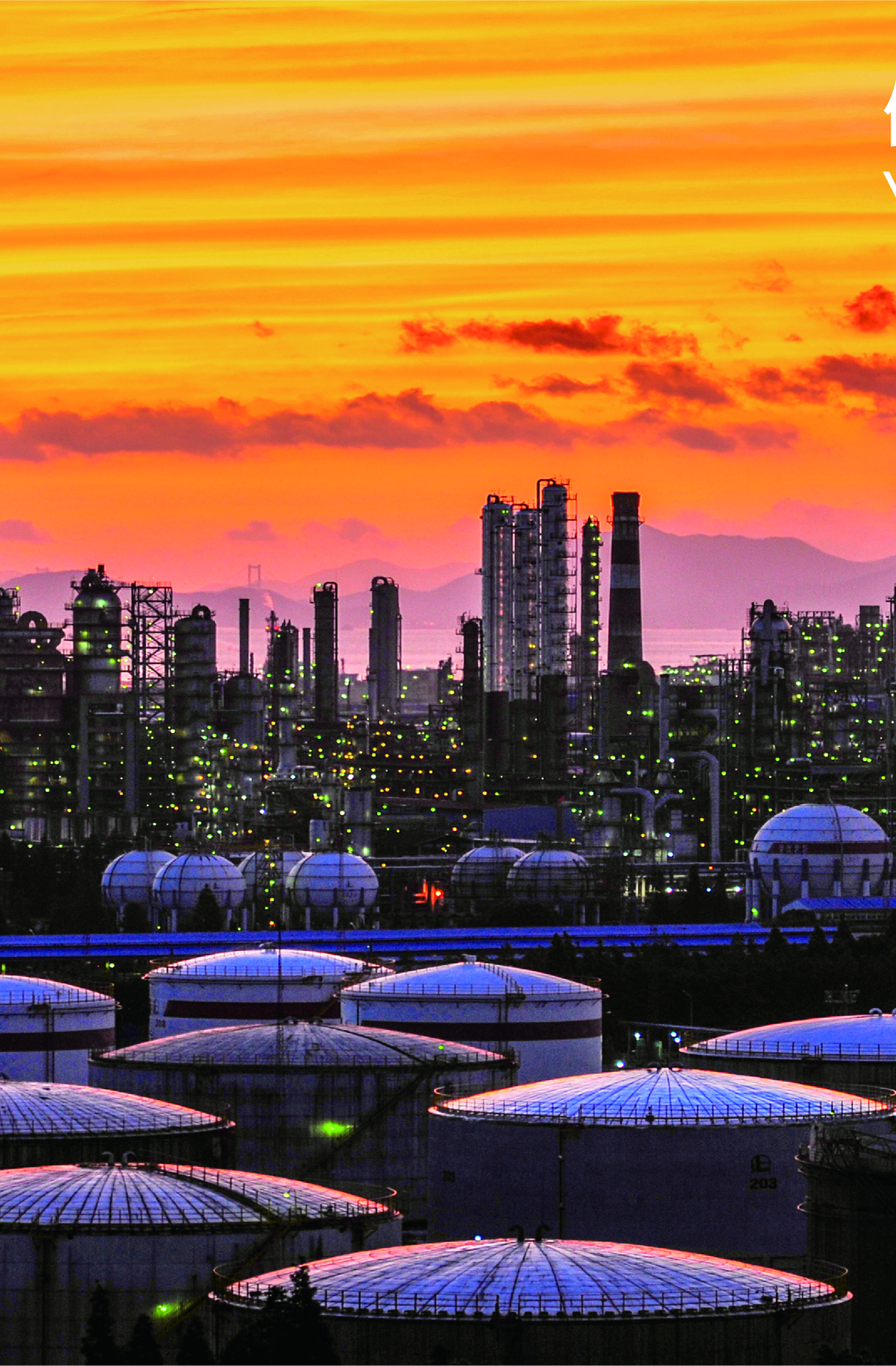
Explosion proof light fittings for paint booths are chosen from the booth’s area classification, not from a catalogue label. Two booths of the same size can need different equipment because the solvents differ, the ventilation behaves differently during a fault, and the surface temperature a fitting reaches in service depends on how much overspray has cured onto its lens. The order matters: classify the space, fix the gas group and temperature class, then settle the optical and mechanical details that let painters see defects and let maintenance keep the fitting inside its rating.
What the area classification has to tell you before you choose a fitting
In Europe, the employer classifies places where explosive atmospheres may occur into zones under Directive 1999/92/EC [1], and the technical method for deciding the extent of each zone is set out in IEC 60079-10-1 [2]. In the United States the same space is described as Class I Division 1 or Division 2 through NFPA 70 Article 516 [3], applied inside the fire safety framework for spray application in NFPA 33 [4]. The two systems use different words for comparable risk, and neither one lets a purchaser skip the drawing that defines the boundary.
The zone definitions are short. Zone 0 is a place where a flammable atmosphere is present continuously or for long periods. Zone 1 is a place where it is likely to occur in normal operation. Zone 2 is a place where it is not likely in normal operation and, if it does occur, only briefly. A solvent-borne spray booth usually has its interior and extraction path classified as Zone 1, with the space around the booth opening as Zone 2, but that pattern is a starting point for the classification study, not a substitute for it.
| Zone | Where it commonly falls in a booth installation | Equipment permitted under 2014/34/EU [5] |
|---|---|---|
| Zone 0 | Inside an enclosure where a flammable atmosphere is present continuously, which is unusual for a spray booth | Category 1G, EPL Ga |
| Zone 1 | Booth interior, extraction duct, immediate spray zone | Category 1G or 2G, EPL Ga or Gb |
| Zone 2 | Space around the booth opening and adjacent handling areas | Category 1G, 2G or 3G, EPL Ga, Gb or Gc |
A usable drawing states more than a zone. It gives the three-dimensional boundary, the gas group or a substance list, the required temperature class, the ambient temperature range at the mounting position, and any dust hazard from powder coating. If a tender document names only “Zone 1 lighting”, the temperature class and ambient are still missing, and a fitting can be correctly rated for the zone while remaining wrong for the solvent.
Matching gas group and temperature class to your coating solvents
Gas group describes how readily the atmosphere can be ignited and how much energy it takes. IEC 60079-0 divides Group II gases into IIA, IIB and IIC, with IIC the most demanding and covering gases such as hydrogen and acetylene [6]. Most solvent-borne coatings place a booth in group IIA, but the group belongs to the substances in the booth, not to the word “paint”, and thinners or cleaning solvents added later can change the list.
Temperature class works on a simpler relationship. Every class fixes a maximum surface temperature, and the equipment must stay below the autoignition temperature of the atmosphere it sits in. The boundaries below are the standard values in IEC 60079-0 [6].
| Temperature class | Maximum surface temperature |
|---|---|
| T1 | 450 °C |
| T2 | 300 °C |
| T3 | 200 °C |
| T4 | 135 °C |
| T5 | 100 °C |
| T6 | 85 °C |
Take a coating whose safety data sheet gives an autoignition temperature of 230 °C. T3, at 200 °C, stays below that figure, so T3 is the minimum class that works; a T2 fitting at 300 °C does not, even though it carries a full explosion proof certificate. This is the point where a general “explosion proof” description stops being useful. The marking has to be compared with the substance data, class by class.
| IEC group | Representative gas | Comparable NEC group |
|---|---|---|
| IIA | Propane | Group D |
| IIB | Ethylene | Group C |
| IIC | Hydrogen, acetylene | Groups A and B |
The comparison column is a cross-reference for reading drawings written in the other system, not a conversion rule. Where a substance sits close to a group boundary, the substance’s own data and the classification study decide.
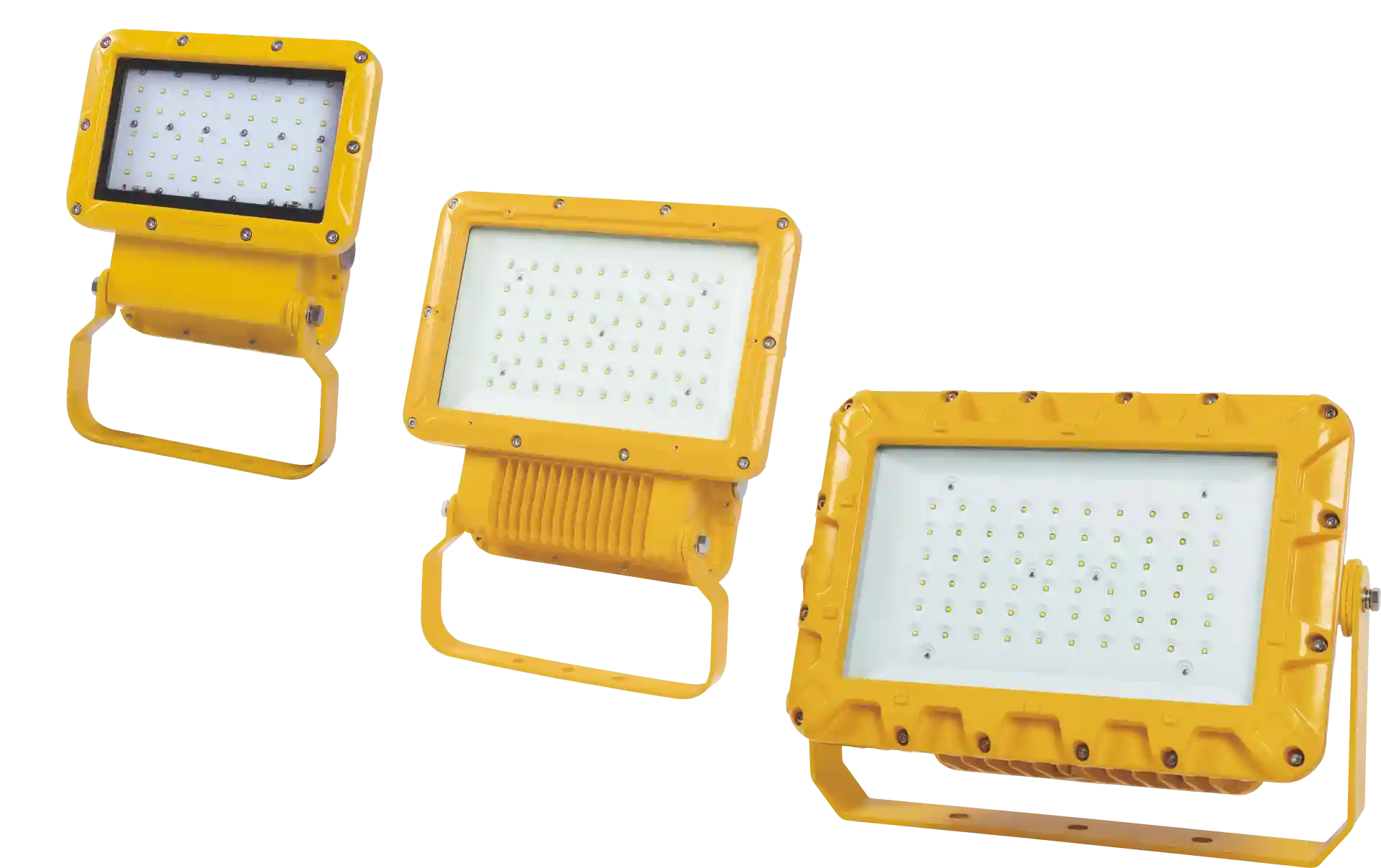
LED light sources do not remove this question. The hottest surface on a modern fitting is often the driver housing or the lens directly over the LED module, not the illuminated face, and the declared class applies at a rated ambient temperature. A fitting rated at 40 °C that must work at 55 °C near a drying tunnel needs the manufacturer’s derating data. Product data for this class of equipment shows how wide that range can be; the BAT86 floodlight in WAROM’s range is rated for ambient up to +60 °C, while other fittings in the same catalogue stop at +55 °C or +58 °C.
Reading the Ex marking on a light fitting
A marking string such as II 2 G Ex db eb IIC T6 Gb carries five separate decisions. “II” is the equipment group for surface industry, “2” is the ATEX category for Zone 1, “G” is the gas atmosphere, “db eb” are the protection concepts used for the enclosure and the increased-safety connection chamber, and “IIC T6 Gb” fixes the gas group, temperature class and equipment protection level. A quotation that mentions only the protection concept has not told you the temperature class, and the temperature class is the part the solvent cares about.
When the SDS and the drawing disagree
The classification drawing governs, because it is the document the site’s safety case rests on. If the drawing allows T3 and the coating data sheet points to T4, raise a query rather than ordering the cheaper fitting; the discrepancy is usually a missing solvent in the substance list. Keep that list current. Cleaning agents, gun wash and thinning solvents all enter the booth atmosphere, and a list that covers only the base coating is incomplete.
Light quality that lets painters see defects
A booth luminaire does two jobs, general illumination and inspection, and the second one is where most specifications are thin. For inspection, the size and angle of the light source matter more than lumen output. A long diffuse source mounted at a shallow angle across the wet film reveals orange peel, dry spray and sanding scratches through the small shadows each defect casts. A compact, bright source aimed square at the panel tends to wash those shadows out.
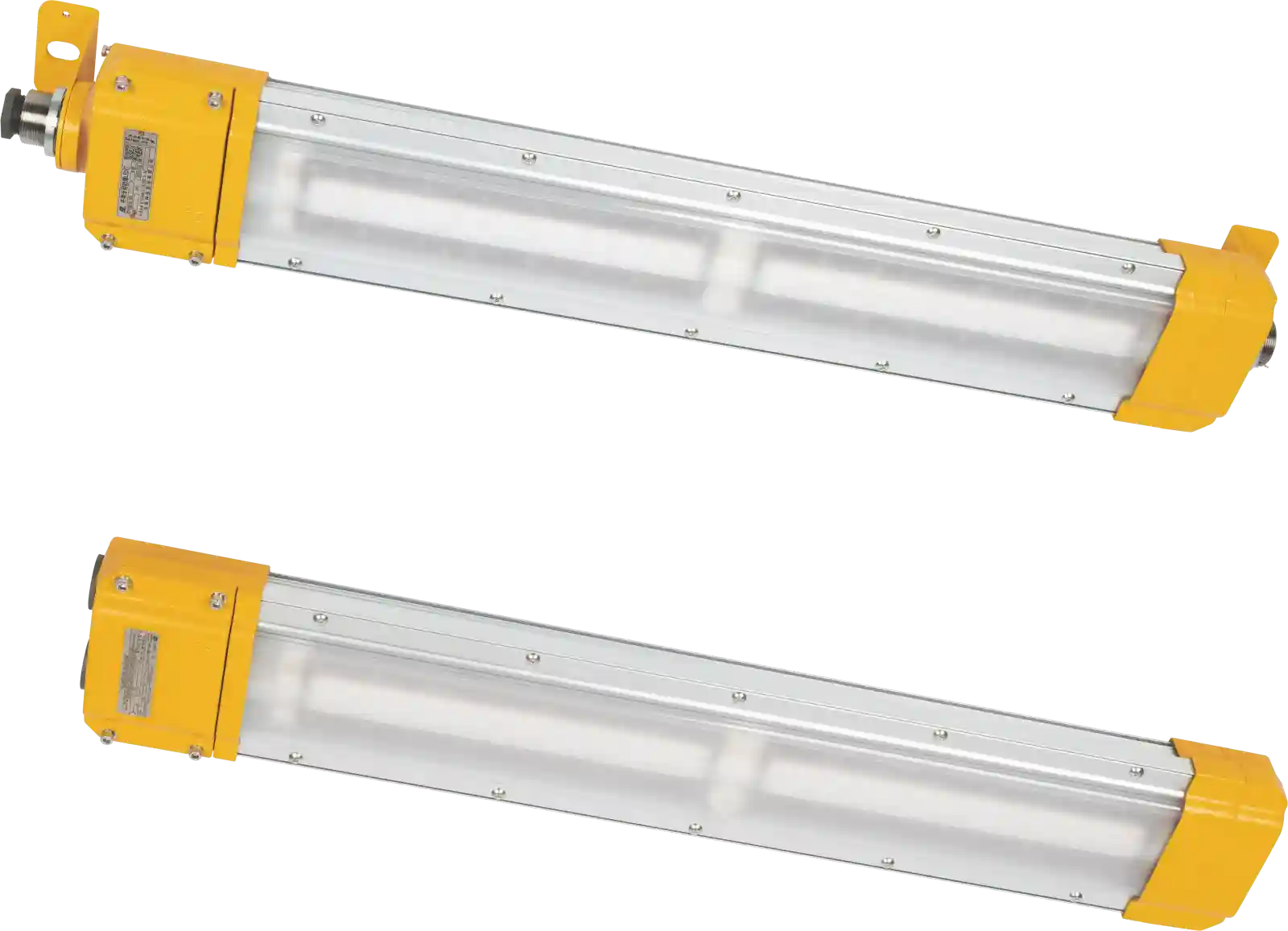
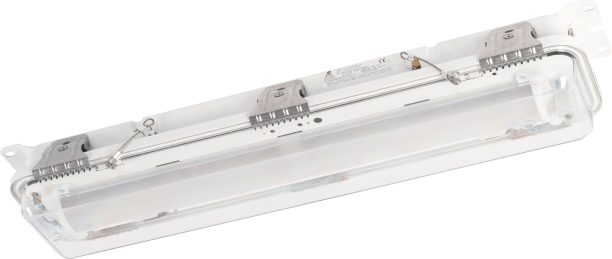
Linear fittings along the booth walls are the usual way to get that grazing light. Colour rendering matters next, because metallic and tinted colours are judged against a reference panel. A colour rendering index of 80 or higher is a practical minimum for inspection, and colour-matching work benefits from higher. Catalogue data in this product class typically quotes Ra ≥ 70 for a floodlight and Ra ≥ 80 for an inspection-grade linear or high-bay fitting, with colour temperatures around 5000 K to 5700 K, which is close to the daylight conditions under which most colour standards are written.
A local spotlight on a bracket still has a place for touch-up inspection, where the painter needs concentrated light on a small area and the general lighting would create reflections on the panel.
Uniformity is the last optical point, and it is usually lost to cost pressure. A single high-output fitting in the middle of a booth ceiling produces bright patches and shadowed corners, and a painter working in a shadow cannot judge a blend. Ask for a layout with calculated uniformity across the working plane, and treat a quotation without one as incomplete rather than as a saving.
IP rating, wash down and the surface temperature you did not plan for
The IP number and the explosion protection number answer different questions. IEC 60529 defines the IP code: the first digit covers solids and the second covers water, so IP66 means dust-tight and protected against powerful water jets, while IP65 covers jets at a lower intensity [7]. In a booth the fitting is cleaned with solvent and water between shifts, and the cover material decides how well it survives that routine. Toughened glass covers in this product class are commonly quoted at 4 J impact resistance, and polycarbonate covers are lighter but more sensitive to solvent attack and to stress cracking over time.
Ingress protection is often quoted as a number without the test behind it. <IP64 Rating Guide: Practical Device Protection Tests> covers how protection levels are tested and what the two digits do and do not demonstrate.
The maintenance point is where IP rating and temperature class meet. A film of cured overspray on the lens insulates the LED module and the driver, so the surface temperature rises above what the type test measured on a clean sample. That rise comes directly out of the margin between the marked temperature class and the solvent’s autoignition temperature. A solvent-wetted lens sitting on a hotter-than-expected surface is exactly the combination the classification is meant to prevent, which is why the cleaning interval in a booth is a safety interval rather than an appearance task.
The check is practical. After a full production shift, measure the lens and the driver housing with a contact probe or a thermal camera, at the ambient temperature the fitting is rated for, and compare the readings with the temperature class limit. Record the result with the date and the cleaning interval in force. If the margin is thin, shorten the cleaning interval, change the fitting, or reduce the ambient at the mounting position. An on-site reading is an operating check, not a type test, and it does not re-certify the fitting.
Installation details that decide whether the certification still applies
A certified fitting is certified as an assembly, with a defined number and size of cable entries, a defined gland type and a defined method of closing unused openings. Every one of those details can be undone on site within an afternoon.
Cable entries, glands and unused holes
The gland has to match the protection concept, the cable type and the entry thread. For a flameproof enclosure, a certified Ex d gland is the normal choice; the DQM-III in this product class carries Ex db IIC Gb, IP66 and an ambient range of -60 °C to +90 °C, which covers most booth and duct positions. Unused entries are closed with certified plugs, not tape or a plain blanking plug from the stores. An extra hole drilled on site for a second circuit removes the basis of the certificate, because the enclosure was never assessed with that opening in that position.
Interlocks and isolation
An interlock that switches the supply off when the diffuser is opened, as fitted to some linear and high-bay designs in this class, protects the person who opens the fitting for cleaning. It does not replace the isolation procedure. Opening a flameproof enclosure while the surrounding area is live and classified defeats the protection method for as long as the cover is off, whatever the interlock does.
Mounting, ambient and access
Mounting height decides whether the cleaning interval can actually be kept. A pendant fitting over a walkway that needs a scaffold to reach will be cleaned less often than the schedule says, and the thermal margin quietly erodes. Pendant and bracket-mounted designs suit different ceiling structures, and the ambient at the mounting point, not the ambient at the booth floor, is the figure that belongs in the specification.
Emergency lighting inside the booth area
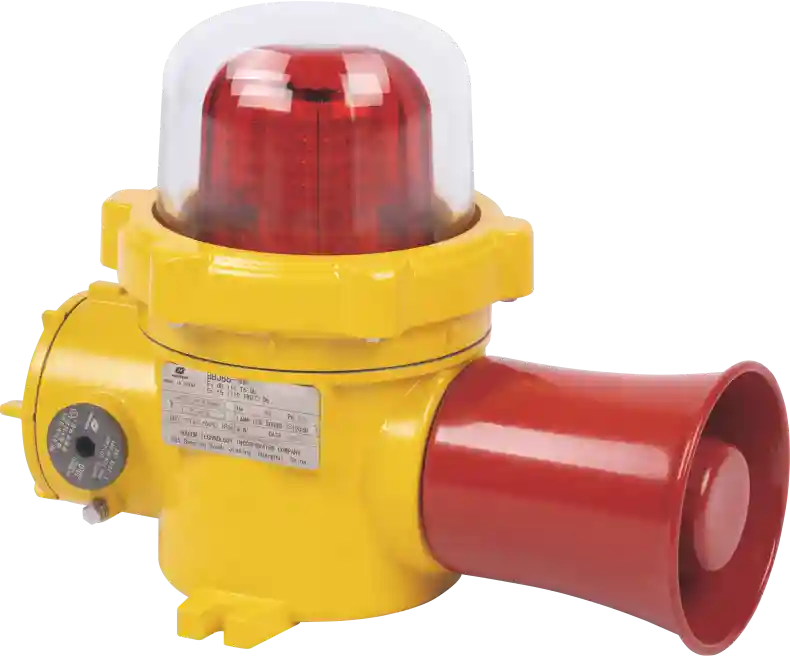
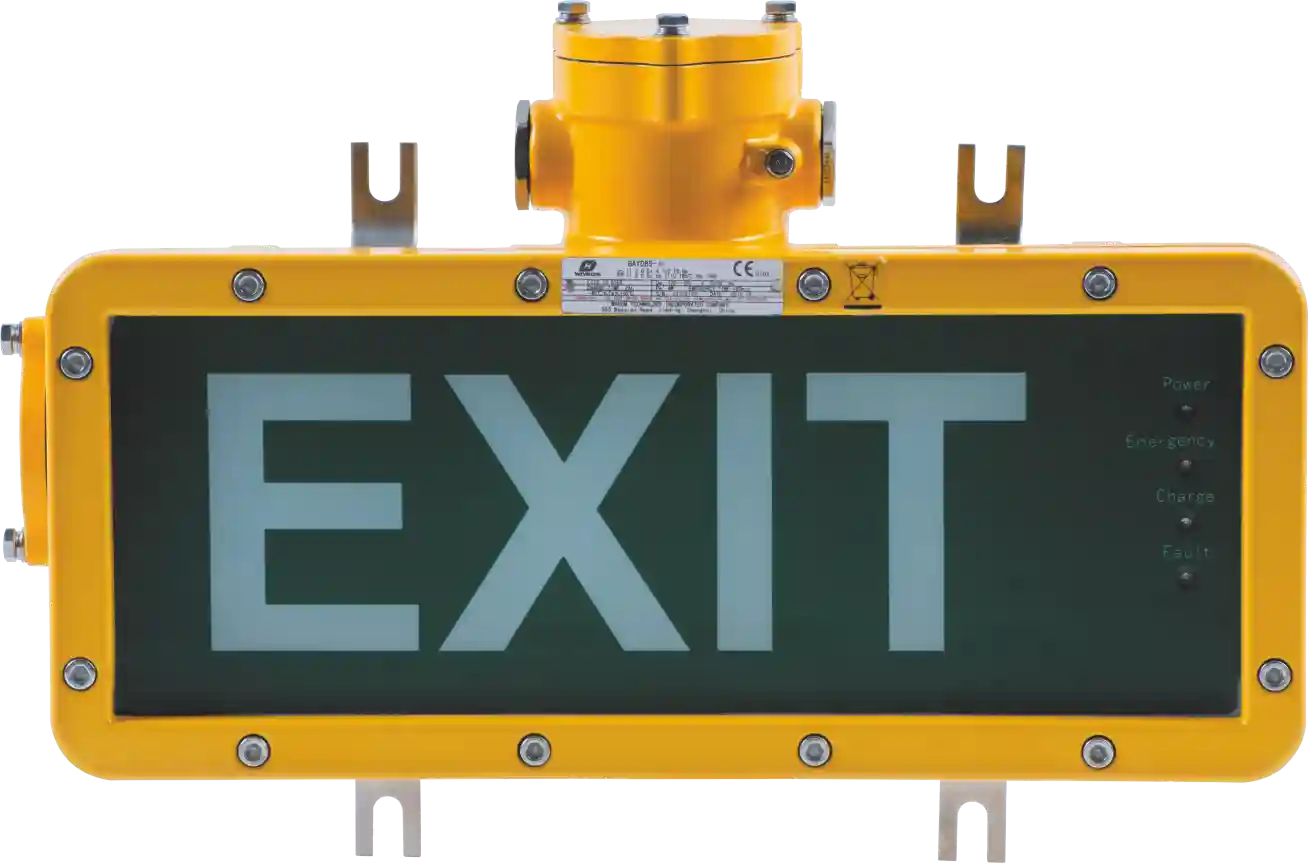
Egress lighting is part of a booth package, and it deserves its own circuit. If a fault takes out the booth lighting, the escape route should not go dark at the same moment. Exit luminaires and the general booth lighting are therefore kept on separate supplies, with the emergency units on a maintained or self-contained arrangement appropriate to the site. The specific duration and illumination levels come from the project’s fire and building codes, not from a luminaire datasheet.
What to put in the RFQ and what to reject
A quotation can only be as precise as the request behind it. The fields below cover the information a supplier needs in order to answer with a model, a marking string and a derating figure instead of a wattage.
| RFQ field | What to request | Why it matters |
|---|---|---|
| Area classification | Zone or Division with the boundary drawing reference, gas group, required temperature class | A zone label alone can hide a temperature class the solvent does not allow |
| Certificate and marking | Notified body certificate number and the full marking string for the exact model | Certificate scope must cover the model, the ambient range and the protection concept being quoted |
| Ambient at the mounting point | Highest air temperature measured or expected at the luminaire, plus the derating table | A declared temperature class applies at a rated ambient, not at any ambient |
| Optical requirement | CRI, colour temperature, light distribution, mounting angle, target uniformity | Defect visibility depends on source size and angle, not only on lumen output |
| Mechanical and cleaning | IP rating, cover material and impact rating, corrosion class, cable entry size and type | Solvent cleaning and overspray removal decide how long the rating survives in service |
| Maintenance and spares | Interlock or tool-free opening, spare lens and gasket availability, cleaning guidance | The cleaning interval is part of the thermal margin, so access and spares belong in the purchase |
A specification that fixes the marking, the ambient and the documentation in one place is easier for a supplier to answer and easier for an engineer to review. <Technical Specification for Explosion Proof Cabinets: A Guide> covers how a technical specification for explosion proof cabinets is organised, and the same document logic applies to a lighting package.
The gap between a vague line and a usable one is easy to see side by side.
Reject this line: Zone 1 explosion proof LED light, 150 W, IP66.
Replace it with: Zone 1 to drawing ABC-101, group IIA, temperature class T3, Category 2G, marking II 2 G Ex db eb IIA T3 Gb, ambient 55 °C at the mounting height, IP66 to IEC 60529, toughened glass cover, Ra 80 or higher, 5000 K, one M25 entry with an Ex d gland and a certified plug on the spare entry.
Documentation deserves the same scrutiny as the hardware, because each document proves a different thing.
| Record | Method context | Responsible use | Do not infer |
|---|---|---|---|
| Certificate of conformity (ATEX or IECEx) | Type examination of a model family at a stated ambient range | Proves the listed model met the standard under those conditions | That the installed unit still behaves the same with a coated lens, a long cable run or a higher ambient |
| Photometric test report | Laboratory measurement of output and distribution | Supports the light output and distribution claim | That installed illuminance will match, since dirt and overspray reduce it |
| Plant temperature reading | Contact or thermal camera measurement on lens and driver after a full shift | Shows the actual margin against the marked temperature class at this site | Nothing about other fittings, other coatings, or a fitting that has just been cleaned |
| Coating safety data sheet | Supplier-declared physical data including autoignition temperature | Fixes the required gas group and temperature class | That the sheet covers every solvent and cleaner used in the booth |
These records belong to the certificate holder and to the site. They are technical evidence with a defined scope, not a general assurance about a product family, and a supplier who cannot say which document supports which claim is asking to be trusted rather than checked.
Send the classification with your inquiry
The fastest way to get a usable answer is to send the inputs the selection actually depends on: the zone or Division description with its boundary drawing reference, the gas group and required temperature class, the highest ambient temperature at the mounting position, the mounting height and access method, the cleaning solvents used, and the optical requirement for inspection. WAROM Technology Incorporated Company reviews those inputs against its explosion proof light fitting range and replies with the model, the marking string and the derating data that match the stated conditions. Email gm*@***om.com or call +86 21 39977076 or +86 21 39972657 to start that review.
FAQ
Can a Zone 2 light fitting be used inside a Zone 1 booth?
No. Zone 2 equipment is certified for a place where a flammable atmosphere is unlikely and brief, and its Category 3G or EPL Gc design basis reflects that lower probability. Installing it in a Zone 1 area removes the protection basis the certificate provides, and the certificate itself will not cover the application. The reverse direction is allowed: Zone 1 equipment can serve a Zone 2 area.
Is a Class I Division 1 fitting the same as a Zone 1 fitting?
They describe comparable risk but they are not interchangeable paperwork. Division 1 covers conditions that the IEC system splits between Zone 0 and Zone 1, and the listing is issued through a national testing laboratory against NFPA 70 Article 516, while Zone equipment is certified under ATEX or IECEx. The fitting needs the marking that the authority for that site recognises.
Do LED fittings avoid the temperature class question?
No. Lower wattage does not by itself lower the hottest surface, because the driver housing or the lens over the LED module often runs hotter than the illuminated face. The class is declared at a rated ambient temperature, so a fitting installed near a drying tunnel or under a hot roof needs the manufacturer’s derating data for that ambient before the marking can be relied on.
Can an IP66 weatherproof fitting replace an explosion proof one?
No. IEC 60529 defines IP ratings to describe resistance to dust and water ingress, and the number says nothing about ignition risk. A weatherproof enclosure with a higher IP figure than a certified fitting is still not permitted in a classified area, because the two ratings answer separate questions and neither one substitutes for the other.
How often do booth light fittings need cleaning?
There is no universal interval. Overspray rate, coating type and shift pattern set it on each site, and what matters is the interval that keeps the measured lens temperature inside the temperature class margin. Start from the manufacturer’s cleaning guidance, then measure lens and driver temperatures after a full shift and shorten the interval if the margin is thin.
References
[1] Directive 1999/92/EC of the European Parliament and of the Council of 16 December 1999 on minimum requirements for improving the safety and health protection of workers potentially at risk from explosive atmospheres, Official Journal of the European Communities, L 23, 28.1.2000.
[2] IEC 60079-10-1:2020, Explosive atmospheres – Part 10-1: Classification of areas – Explosive gas atmospheres, International Electrotechnical Commission, Geneva, 2020.
[3] NFPA 70, National Electrical Code, Article 516, National Fire Protection Association, Quincy, MA, 2023.
[4] NFPA 33, Standard for Spray Application Using Flammable or Combustible Materials, National Fire Protection Association, Quincy, MA, 2024.
[5] Directive 2014/34/EU of the European Parliament and of the Council of 26 February 2014 on the harmonisation of the laws of the Member States relating to equipment and protective systems intended for use in potentially explosive atmospheres, Official Journal of the European Union, L 96, 29.3.2014.
[6] IEC 60079-0:2017, Explosive atmospheres – Part 0: Equipment – General requirements, International Electrotechnical Commission, Geneva, 2017.
[7] IEC 60529:1989+AMD1:2013, Degrees of protection provided by enclosures (IP Code), International Electrotechnical Commission, Geneva, 2013.
[8] IEC 60079-14:2013, Explosive atmospheres – Part 14: Electrical installations design, selection and erection, International Electrotechnical Commission, Geneva, 2013.
If you’re interested, check out these related articles:
Warom Technology Shines at 2025 ADIPEC: Empowering Global Energy Transformation with Innovative Technologies
Warom Technology attended the IECEx International Hydrogen Energy Conference in Singapore
Special Report Of Warom Explosion-Proof 2025 Supplier Conference
Day 1 Of IPA 2025
With over a decade of experience, he is a seasoned Explosion-Proof Electrical Engineer specializing in the design and manufacture of safety and explosion-proof products. He possesses in-depth expertise across key areas including explosion-proof systems, nuclear power lighting, marine safety, fire protection, and intelligent control systems. At Warom Technology Incorporated Company, he holds dual leadership roles as Deputy Chief Engineer for International Business and Head of the International R&D Department, where he oversees R&D initiatives and ensures the precise delivery of design documentation for international projects. Committed to advancing global industrial safety, he focuses on translating complex technologies into practical solutions, helping clients implement safer, smarter, and more reliable control systems worldwide.

Qi Lingyi