

Modular explosion proof distribution cabinets give EPC project teams a way to manage schedule risk, but only when the design freeze is disciplined. Most supplier content stops at enclosure material and Ex d versus Ex e selection. The harder question in an EPC package is whether the modular arrangement survives late load changes, cable entry revisions, and multi-discipline interface responsibilities. I see the same failure pattern on projects that treat the cabinet as a catalogue item instead of an engineered package. The cabinets themselves are predictable. The interface data around them is where schedule and cost erode. This article covers the specification, certification, and testing decisions that keep a modular package buildable.
Why Do EPC Projects Choose Modular Explosion Proof Distribution Cabinets?
A modular cabinet package splits an electrical distribution scope into repeatable enclosure arrangements instead of a unique custom panel for every area. For an EPC project this matters in three places. It cuts vendor engineering time, it makes phased delivery workable, and it gives the construction team a consistent termination layout across similar loads. The trade off is that modular flexibility only exists if the electrical interfaces stay stable long enough for the enclosures to be fabricated.
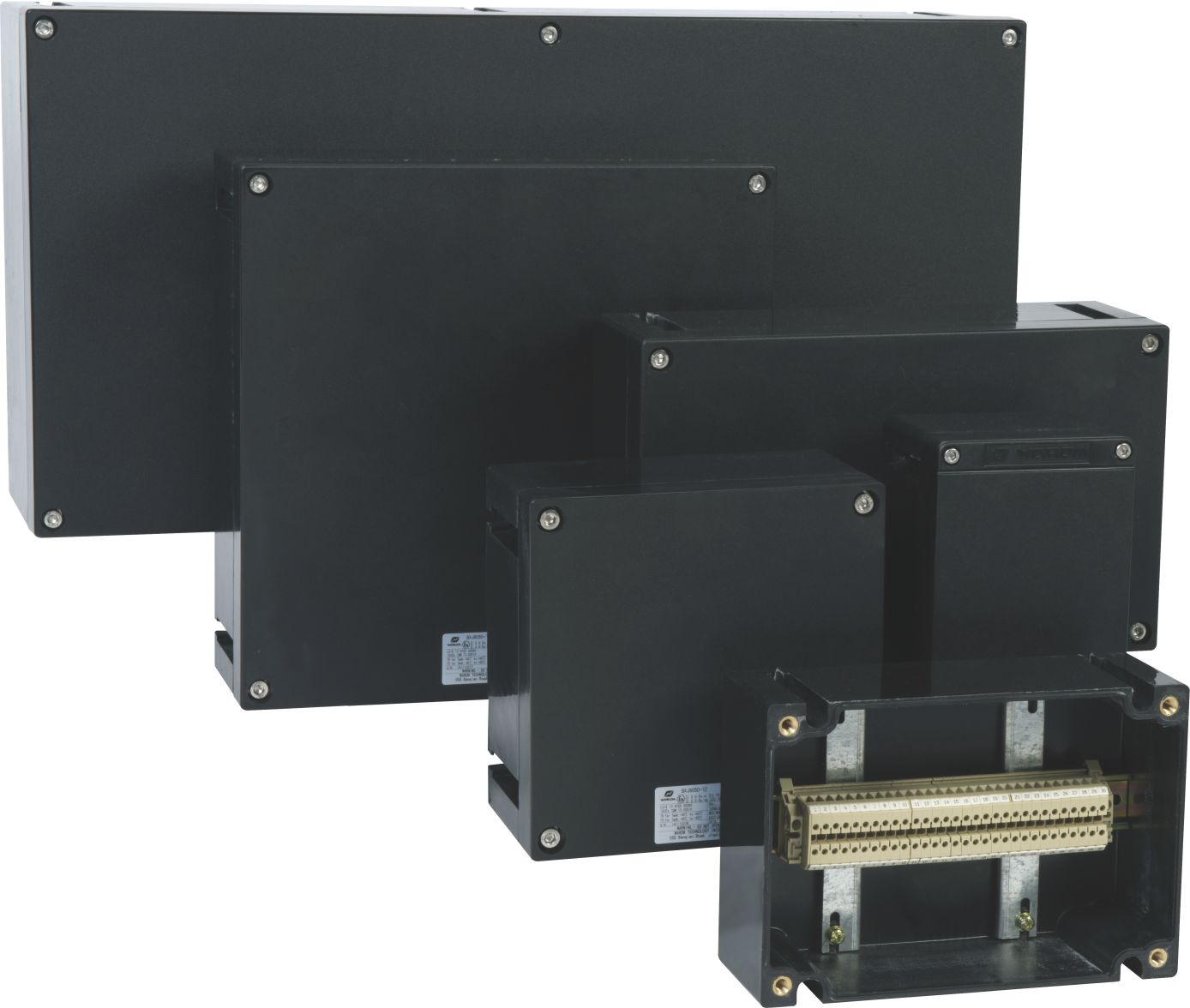
The typical arrangement uses a compound Ex d and Ex e design. The flameproof Ex d chamber holds switching or protection devices where arcs are possible. The increased safety Ex e chamber holds terminals and outgoing wiring where no arcing should occur in normal service. This separation keeps the flamepath volume small while giving the installation team enough room to terminate cables. A GRP distribution box in the BXM(D)8050 series, for example, is rated to 690 V AC, 250 A, IP66, with bottom entry and DQM-I Ex e glands recommended. A copper-free aluminium distribution panel in our HRMD range is also rated for IP66 service, with ambient capability from -60°C to +60°C and bottom entry as standard.
In a pharmaceutical API and intermediate manufacturing facility with 15 production lines, the explosion proof distribution box scope covered workshops, warehouses, tank farms, and pump controls. Early coordination with the promoter, the design institute, and the owner let the delivery run in phases that matched construction progress. The modular format made those phases possible without producing a different enclosure drawing for every release.
Which Design Freeze Decisions Affect Modular Cabinet Delivery?
The most common schedule killer is not the enclosure. It is a cable schedule that changes after enclosure fabrication has started. Each entry is machined or formed into the enclosure. A late change in cable diameter, armour type, or gland standard can create a new drilling requirement, a new gland approval, or a complete rework of the terminal chamber. I have seen a modular package lose more time from late cable data than from the production of the cabinets themselves.
Lock the cable entry schedule first
The entry schedule should be frozen before the enclosure drawing goes to production. For an Ex e terminal chamber, the terminal rating follows the conductor cross section. One common junction box design carries 2.5 mm2 terminals rated 24 A, 4 mm2 rated 32 A, and 6 mm2 rated 41 A. If a later revision adds larger incoming cables, the terminal arrangement may no longer be adequate. We ask the electrical designer to freeze external connections at the same review gate as the single-line diagram.
Confirm busbar and short circuit duties before cabinet assembly
A modular cabinet may be reconfigurable, but the busbar system and protective device ratings are not fully interchangeable after production. The specification should state the prospective short circuit current, the earth fault clearance time, and whether the cabinet supplies cascaded motor loads or lighting distribution only. If the short circuit duty is understated, the assembled cabinet can be underrated for the location. If it is overstated without a clear downstream assumption, the busbar and enclosure may be larger and more expensive than the project needs.
When a modular cabinet specification moves from single-line diagram to fabrication data, the terminal count, busbar rating, and entry arrangement are the usual failure points. <Technical Specification for Explosion Proof Cabinets: A Guide> covers how to structure the specification so the vendor receives a buildable set of electrical data rather than a catalogue description.
What Certification and Interface Points Should You Lock Early?
Certification is not a single line on a quotation. It is a set of interface points that define where the certified assembly begins and where the EPC contractor’s responsibility takes over. The cabinet marking must match the actual protection method, gas group, temperature class, ambient range, and cable entry arrangement. A cabinet marked Ex e IIB T5 for a +55°C ambient is not automatically valid for a IIC hydrogen atmosphere or for a -60°C site.
The table below shows the decisions that should be fixed before commercial release.
| Decision | What to lock | Why it matters |
|---|---|---|
| Enclosure material | Copper-free aluminium, GRP, or stainless steel | Drives corrosion life, cleaning suitability, and installed weight |
| Protection method | Ex d, Ex e, or compound Ex d and Ex e | Determines gland type, terminal access, and permitted internal devices |
| Gas group and temperature class | IIA, IIB, IIC, and T1 to T6 | Must match the process gas and the maximum surface temperature limit |
| Ambient temperature range | For example -60°C to +60°C | Changes seal material, derating, and certification validity |
| Cable entry thread | Metric or NPT | Thread mismatch breaks the interface with EPC cable packages |
| Certification body | IECEx, ATEX, or project scheme | Determines marking, documentation, and acceptance authority |
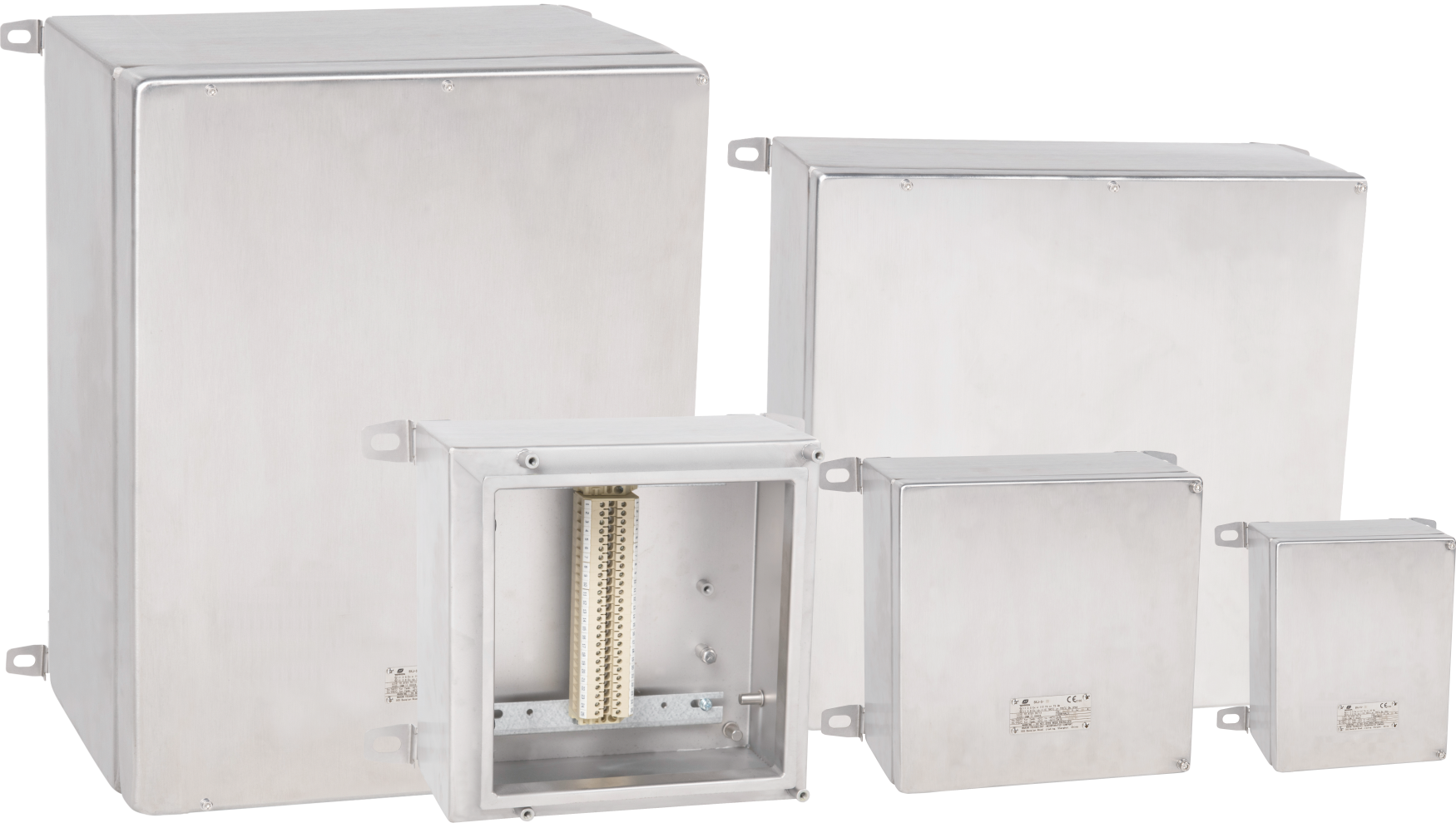
For a modular distribution cabinet, the compound chamber design splits the flamepath switching zone from the terminal wiring zone. The Ex d chamber keeps the flamepath volume small. The Ex e chamber gives the site team practical termination space. That division is what makes a modular cabinet maintainable, but it also means the gland plate and cable entries must be resolved before the Ex e chamber can be certified as an assembly. A cabinet that leaves the factory with blanked entries is fine. A cabinet that leaves with the wrong entry sizes is a schedule problem that cannot be fixed without returning the enclosure or recertifying the arrangement.
If your project includes mixed cable armouring or more than one gas group, it is worth confirming the gland plate and terminal rating before the enclosure order is released. Send the preliminary single-line diagram to gm*@***om.com and we will check the entry arrangement against the selected Ex e terminal rating.
How Does Factory Acceptance Testing Prevent Site Rework?
Factory acceptance testing is where the paper specification meets the physical cabinet. Before a modular distribution cabinet ships, the test should include insulation resistance, earth continuity, visual inspection of flamepath gaps, tightening checks on gland plates, and confirmation that the assembled layout matches the approved single-line diagram. For motor control cabinets, the interlock and emergency stop functions should be exercised at the factory rather than discovered during commissioning.
One of the most useful checks is comparing the physical cable entries against the final approved cable schedule. This takes less than an hour. It catches the errors that are expensive to repair on site: an undersized entry for an armoured cable, a gland plate prepared for the wrong thread form, or a terminal count that does not match the approved load list. When this check is done before packing, the site team can proceed with installation instead of opening a nonconformance notice.
For package based projects, interface alignment matters as much as enclosure rating. <Offshore Wind: Explosion Proof Electrical Safety Solutions> covers how offshore wind electrical packages manage installation sequence, environmental stress, and certification in one delivery plan.
In the Tilenga development in Uganda, part of the scope included wellpads, a central processing facility, and pipelines, some within Murchison Falls National Park. The electrical systems recorded zero safety incidents, met the environmental requirements, and delivered to schedule. That outcome depended on interface discipline and phased test documentation as much as on the equipment itself.
When Should You Confirm a Modular Distribution Cabinet Package?
The modular cabinet decision only pays off when the inquiry is specific. A request for an enclosure list without zone classification, load schedule, or cable entries produces long clarification cycles. We prefer to receive a preliminary single-line diagram, motor or lighting load list, and cable schedule at bid stage. With those, the enclosure arrangement, busbar size, terminal count, and gland plate layout can be checked before the commercial quote is issued.
If your EPC package includes mixed cable armour types, more than one hazardous area classification, or phased handover requirements, it is worth confirming the enclosure and gland interfaces before the bid is frozen. Send the preliminary load schedule and cable entry plan to gm*@***om.com or call +86 21 39977076, and we will confirm the cabinet arrangement, busbar rating, and certification documentation before your submission.
What Do Project Teams Ask About Modular Explosion Proof Distribution Cabinets?
Do modular explosion proof distribution cabinets carry individual certification?
Not always. The enclosure, devices, terminals, and glands are certified as a complete assembly, not as a loose set of certified parts. The manufacturer must hold the Ex certificate or conformity documentation for the assembled cabinet in its delivered configuration. Before accepting a quotation, ask for the assembly drawing with the certificate number and confirm the exact terminal count, gland type, and device rating match the order. A change in any of those items can move the assembly outside the certified arrangement.
Can a modular cabinet be reconfigured freely on site after delivery?
A common misconception is that modular construction means unlimited site reconfiguration. In practice, the Ex certification applies to the configuration assembled and tested at the factory. Opening the Ex d chamber to add an unlisted device or altering the gland plate without a certified modification can invalidate the assembly marking. If the site needs future capacity, specify spare ways or blanked entries in the original build. That approach keeps flexibility without creating a certification gap.
Should the enclosure be stainless steel or aluminium alloy?
It depends on the installation. For coastal, marine, or pharmaceutical washdown areas, stainless steel or GRP enclosures usually justify the higher material cost through longer corrosion life and easier cleaning. For inland process areas with moderate ambient conditions, copper-free aluminium alloy offers a practical balance of strength, weight, and cost. The decision should follow the atmosphere, ambient temperature, and cleaning regime, not the enclosure price alone.
What causes the most late changes in modular cabinet orders?
In projects we have supported, the final cable schedule causes the largest number of late changes. EPC teams often freeze motor lists and lighting circuits first, but cable diameter and armour type arrive later from the cable vendor. We ask for the cable schedule at the same review gate as the single-line diagram. When those two documents freeze together, the gland plate and terminal count stay stable through fabrication.
What information should be ready before ordering a modular distribution cabinet package?
The better question is what interface data is actually ready. Modular construction only reduces lead time when the load schedule, zone classification, cable entries, and ambient range are fixed. If those inputs are still open, the vendor will issue a drawing for approval rather than a production build. Send your load schedule and cable entry plan to gm*@***om.com and we will confirm the cabinet arrangement before you place the order.
If you’re interested, check out these related articles:
2023 Merry Christmas
Happy New Year
Warom at 40th ADIPEC 2024
With over a decade of experience, he is a seasoned Explosion-Proof Electrical Engineer specializing in the design and manufacture of safety and explosion-proof products. He possesses in-depth expertise across key areas including explosion-proof systems, nuclear power lighting, marine safety, fire protection, and intelligent control systems. At Warom Technology Incorporated Company, he holds dual leadership roles as Deputy Chief Engineer for International Business and Head of the International R&D Department, where he oversees R&D initiatives and ensures the precise delivery of design documentation for international projects. Committed to advancing global industrial safety, he focuses on translating complex technologies into practical solutions, helping clients implement safer, smarter, and more reliable control systems worldwide.

Qi Lingyi