
Most weatherproof enclosures for outdoor CCTV are chosen from a catalogue line, and the catalogue line leads with a single number, usually IP66. That number answers a narrow question about dust and water jets on a test sample. It says nothing about how the housing behaves after two summers of ultraviolet light, a winter of coastal salt, repeated day to night temperature swings, or a technician opening the lid for a firmware update. Enclosure suitability behaves more like a stack of independent ratings, covering ingress, impact, corrosion, thermal performance and, where the site requires it, hazardous area certification. Each layer has to be checked against the conditions at the mounting point.
What Weatherproof Enclosures for Outdoor CCTV Actually Have to Withstand
Rain is the threat everyone plans for and rarely the one that causes the failure. Water usually arrives as vapour carried on a temperature cycle, condenses on the coldest surface inside the housing, and only later appears as a fogged window or a corroded connector.
The loads that act on an outdoor housing at the same time:
- Water in three forms: driven rain, hose-down during cleaning, and standing water inside a pole or plinth.
- Dust, including cement, grain and coal dust that fills the gap between the housing and the camera body and settles on the window.
- Ultraviolet radiation, which yellows polycarbonate, hardens gaskets and fades coatings.
- Thermal cycling between a sun-loaded afternoon and a cold night, the engine behind most internal condensation.
- Chlorides, hydrogen sulphide, ammonia or chlorine in the local atmosphere, depending on the plant.
- Impact from vehicles, tools, wind-blown debris and deliberate tampering.
The security function adds a requirement that a lighting enclosure does not carry. The window has to stay clear enough for the camera to work, and the housing has to resist being opened or redirected without a tool. A housing that seals perfectly but hazes over after one season has failed the job.
Before any specification is written, walk the mounting point and record what is there: height and reachability, the direction of the prevailing weather, whether the position sits under an eave or fully exposed, the surface the bracket fixes to, the ambient range across the year, and the plant atmosphere. That record becomes the input to every rating decision that follows.
IP66 vs IP67 vs IP68 and What Each Rating Covers
The IP code is defined in IEC 60529 [1]. Two digits follow the letters: the first covers solids on a scale from 0 to 6, the second covers water on a scale from 0 to 9K. A first digit of 6 means dust-tight, verified in a dust chamber rather than by visual inspection. The second digit is where most outdoor projects are decided.
- The 5 and 6 water digits are jet tests at increasing pressure.
- The 7 digit is temporary immersion; the standard’s default condition is 30 minutes at 1 m below the surface, unless the manufacturer states otherwise.
- The 8 digit is continuous immersion, and the depth and duration are set by the manufacturer rather than by the standard.
- The 9K digit adds high-pressure, high-temperature wash.
That difference matters commercially. Because IP68 has no single test condition, two products carrying the same marking may have been tested to completely different depths for different durations. The marking says a test was passed; it does not say which one, so the test report has to be read before two IP68 housings are compared. IP66, by contrast, is a defined jet condition and is usually the appropriate target for a wall or gantry mounted camera with a visor.
Impact is a separate code, the IK rating in IEC 62262 [2], and no IP number implies it. Neither do IP digits say anything about corrosion resistance, ultraviolet stability, internal temperature performance or hazardous area suitability. A housing can be dust-tight and still lose its coating within a year.
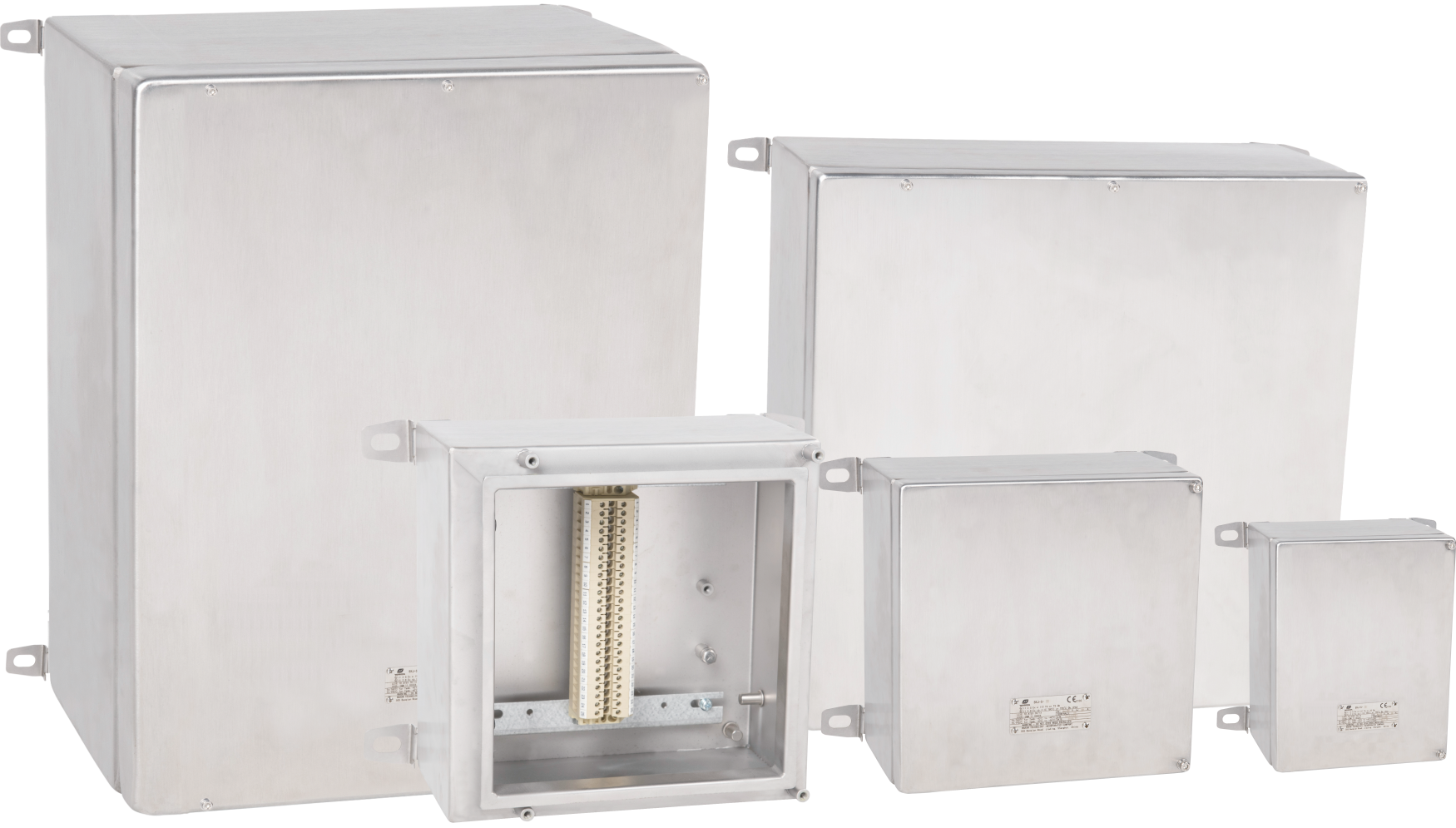
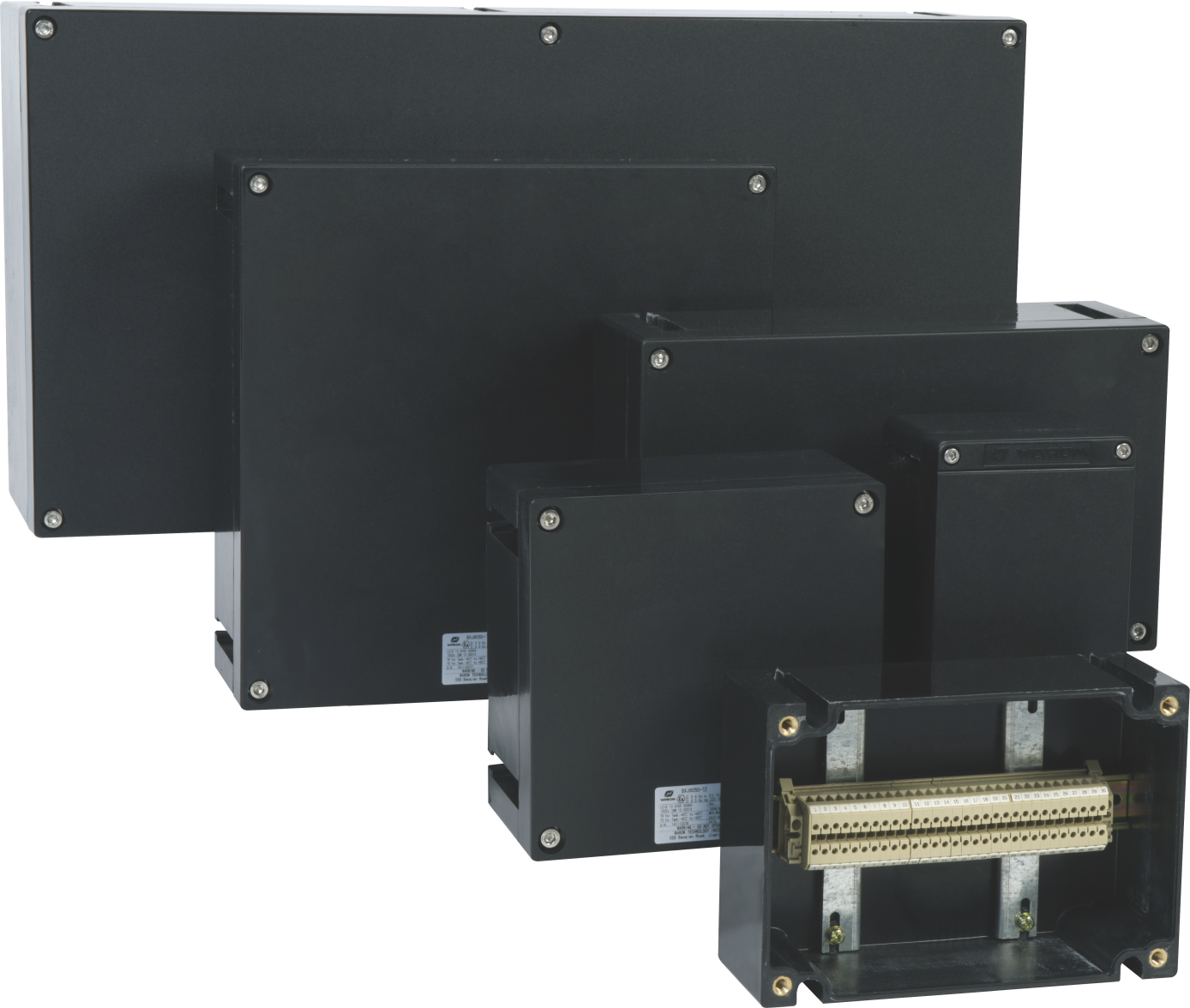
A rating applies to the assembly, not to the box alone. An IP66 enclosure fitted with a standard gland, an uncertified plug in an unused entry, or a lower-rated terminal box inside becomes an assembly at the weakest rating. The BXJ-S terminal box family, for example, is published at IP65, which makes it a component inside the protected boundary rather than the boundary itself.
| Rating | What the test adds | Where it fits on an outdoor CCTV site | What it does not cover |
|---|---|---|---|
| IP65 | Dust-tight, protected against water jets from a nozzle | Cameras under a canopy, inside a second barrier, on sheltered walls | Water driven upward, standing water, corrosion |
| IP66 | Dust-tight, protected against powerful water jets | Most wall, pole and gantry mounts with a visor | Immersion, salt, ultraviolet, impact |
| IP67 | Dust-tight, protected against temporary immersion, tested at 30 minutes and 1 m by default [1] | Plinths, pits, flood-prone culverts and wash areas | Longer or deeper immersion |
| IP68 | Dust-tight, protected against continuous immersion under conditions set by the manufacturer [1] | Sumps, below-grade vaults and splash zones | Cross-supplier comparison, because the conditions are supplier-defined |
| IP69K | Dust-tight, protected against high-pressure, high-temperature wash | Food, beverage and wash-down plants | Chemicals, solvents and ultraviolet |
Why a Weatherproof Enclosure Is Not Automatically Hazardous Area Equipment
Weatherproofing and explosion protection solve two different problems. Weatherproofing keeps the environment out of the equipment. Explosion protection keeps the equipment from igniting a flammable atmosphere, or contains an internal explosion so that it does not reach the outside. The standards are separate: IEC 60529 for ingress, and the IEC 60079 series for explosive atmospheres, starting with the general requirements in IEC 60079-0 [3] and including dust protection by enclosure in IEC 60079-31 [4].
A camera can easily land inside a classified area without anyone noticing. Tank farm perimeters, loading gantries, LPG storage, biogas digesters, grain silos, solvent stores and hydrogen refuelling stations all carry classified zones that extend beyond the visible equipment. A housing mounted on the boundary fence may be in fresh air, while the same housing on the loading platform is not.
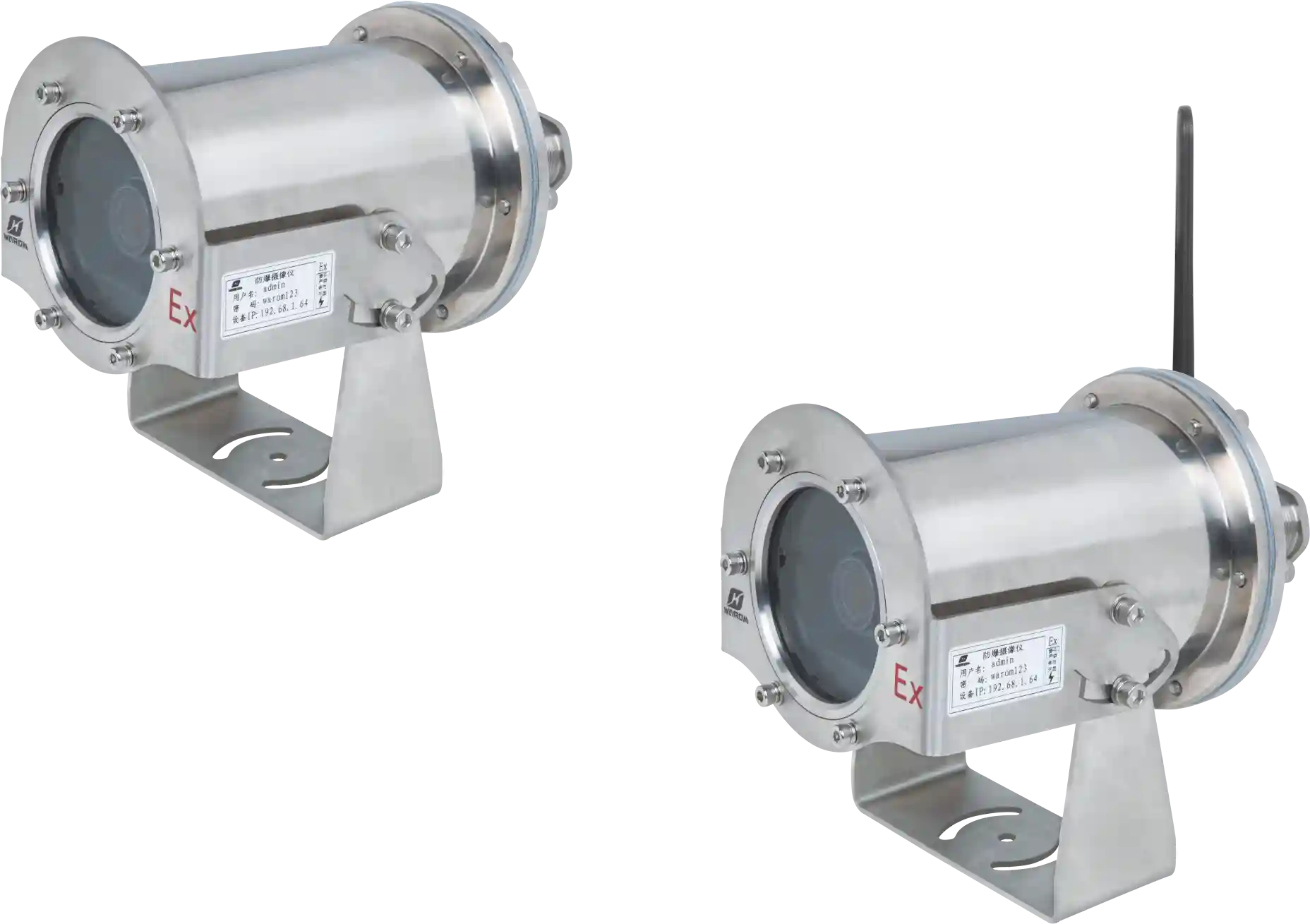
The marking tells you what the certification covers. A camera housing marked Ex db IIC T6 Gb and Ex tb IIIC T80 °C Db with an IP66 and IP68 rating has been assessed for flameproof gas protection, for dust protection by enclosure, for gas group IIC and for a surface temperature class of T6. Whether those categories match the site has to come from the area classification drawing, not from the supplier’s recommendation.
One limitation catches buyers regularly. A certificate covers a defined internal volume, a defined power dissipation and specified cable entries. Fitting a different camera, adding a higher-power heater or running an extra cable through an unlisted entry can take the installation outside the scope of the assessment. The question to put to the supplier is not only whether the housing is certified, but whether the certificate covers the exact equipment going inside it.
WAROM builds one example of that category in the BJK-S and BJK-SG camera housing, rated for Zone 1, Zone 2, Zone 21 and Zone 22 with an IP66 and IP68 enclosure. It illustrates the point that the housing, the camera and the entries are certified as a system rather than as three independent purchases.
Area classification decides the protection concept before any product is selected. <Explosion Proof LED Lights: Guide to Hazardous Area Safety> covers the safety requirements that apply to explosion proof lighting in hazardous areas.
Choosing the Enclosure Material for the Site
Material choice sets the maintenance bill more than the purchase price does. In a coastal or chemical environment, the enclosure body, fasteners, hinges, glands and mounting bracket form one corrosion system, and a mismatch inside that system fails faster than any single component would on its own.
| Material | Strengths outdoors | Where it fails | Cost and service note |
|---|---|---|---|
| Polycarbonate | Light, moulded, good impact behaviour, non-metallic | Ultraviolet yellowing and embrittlement, solvent attack, scratching | Lowest purchase cost, shortest inspection interval in strong sun |
| GRP | Good chloride resistance, moulded shapes, non-metallic | Gelcoat damage exposes fibres, static build-up, limited heat spreading | Mid cost, long life in coastal air when the gelcoat is intact |
| 304 stainless | Strong, weldable, familiar to fabricators | Pitting in chloride atmospheres, tea staining near the coast | Mid to high cost, 304 is the wrong default for a salt site |
| 316L stainless | Molybdenum content resists chlorides, good for wash areas | Weld heat tint and embedded iron still initiate pitting | High cost, best where salt or cleaning chemicals are constant |
| Coated die-cast aluminium | Light, good thermal path, easy to machine | Coating chips become pitting sites, galvanic couple with steel parts | Mid cost, needs careful coating specification and touch-up |
| Coated steel | Low cost, high stiffness, easy modification | Coating damage, cut edges and internal condensation | Low purchase cost, highest long-term maintenance |
Corrosion severity can be described rather than guessed at. ISO 12944-2 classifies atmospheric environments from C1 to C5 and CX [5], and a coastal or offshore security position normally sits in the upper categories. Salt spray testing to ISO 9227 gives a comparable number of hours [6], but the hours are a laboratory ranking, not a service life prediction. A 720-hour result does not promise 720 hours or ten years on a jetty; it tells you the coating system passed a defined exposure, and the maintenance schedule still decides how long it lasts.
Two practical rules follow. First, match the fastener to the body: A4 stainless into a chloride-resistant body avoids the galvanic couple that destroys an otherwise sound enclosure. Second, ask what happens at a damaged area. A scratched GRP panel and a chipped aluminium casting behave very differently over the following two years.
Managing Heat, Condensation and Sun Load Inside the Housing
Where the moisture comes from
An enclosure sealed in warm, humid air at commissioning carries that moisture for its whole service life. As the housing cools at night, the air inside contracts and draws more moisture through the seal path by vapour diffusion. Cables make this worse: water can travel along the strands of a cable core and arrive inside a housing that is otherwise perfectly sealed.
The usual countermeasures trade one problem for another. A desiccant sachet absorbs a fixed quantity of water and then stops working, so it needs a replacement schedule. A breather or drain valve equalises pressure and lets moisture escape, but it also creates a path for dust and insects unless it is filtered. A heater with a thermostat keeps the internal air above the dew point and is the most reliable of the three, at the cost of continuous power draw.
Heat, sun and the power budget
Internal temperature is not ambient temperature. A dark housing in direct summer sun absorbs solar gain, and every watt drawn by the camera, the lens heater, the wiper motor and the PoE conversion ends up as heat inside the same small volume. Power over Ethernet budgets climb steeply with pan, tilt and zoom motors, and a housing designed around a fixed camera may not carry a PTZ unit.
The camera’s own rated operating range is the limit that matters. If the datasheet states an upper ambient figure, it refers to the air around the camera, not the air around the pole. Mitigations are ordinary: a sunshield, a light-coloured finish, mounting away from flare tips, steam lines and hot pipework, and a passive vent or a cooling unit where solar gain cannot be designed out.
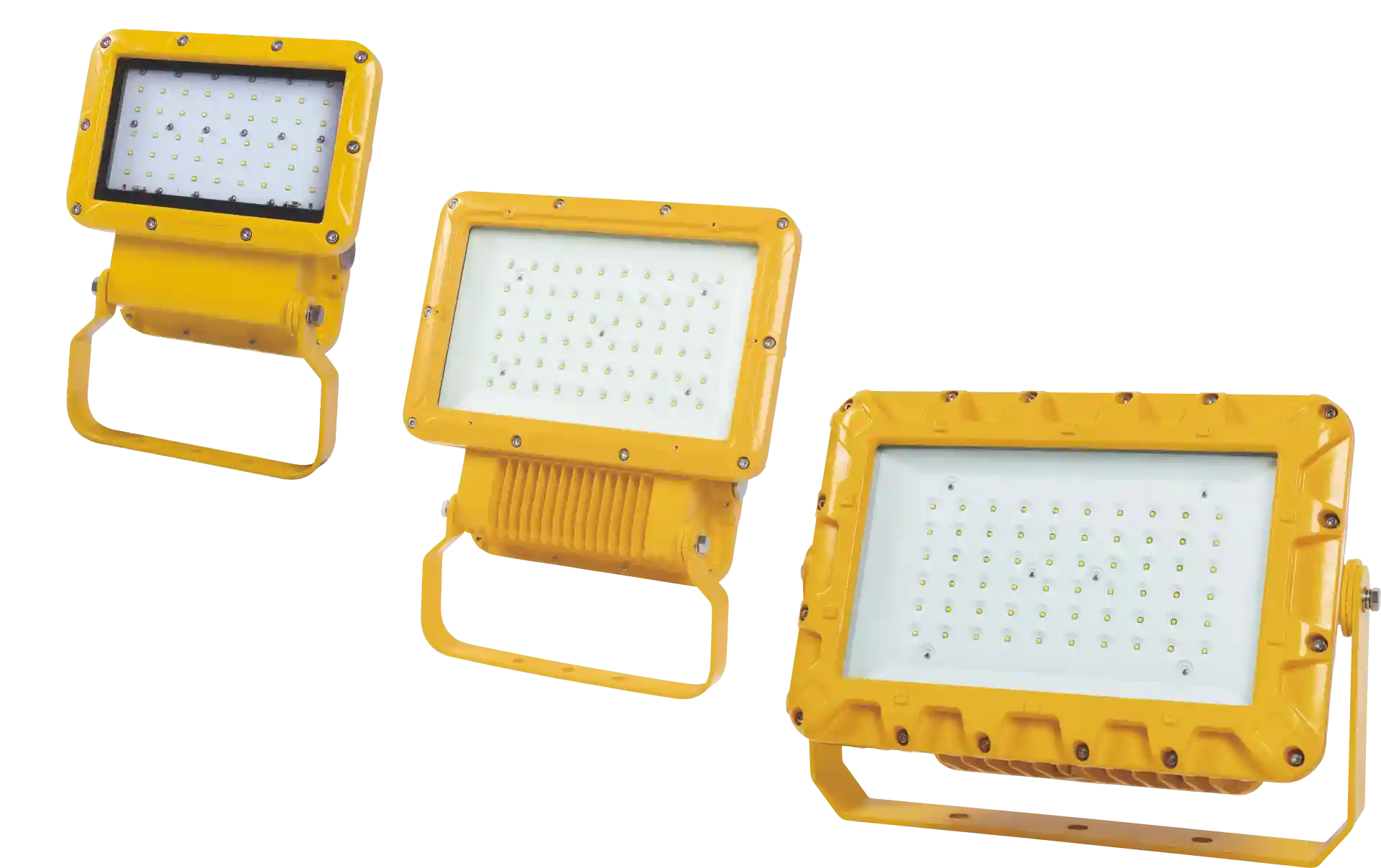
Cold end performance deserves the same attention. A heater sized to keep the camera above its minimum operating temperature is a different calculation from a heater sized to control condensation, and one thermostat rarely serves both. Sites that see both extremes should specify the two functions separately. Lighting on the same pole usually faces the same ambient window; the BAT86 floodlight family, for instance, is published for an ambient range extending from -60 °C to +60 °C depending on configuration.
The executable check is a temperature and humidity log. Record the internal conditions over at least 48 hours in the worst season, or ask the supplier to state the calculated internal temperature at the specified ambient, solar load and internal power. That number can be compared against the camera datasheet. A housing that has not been calculated at all cannot be compared against anything.
Fasteners, Glands and Seals Where Outdoor Enclosures Fail First
Cable entries set the real rating
Every cable entry is a hole in the protected boundary. The gland seals in two places, on the cable’s outer sheath and on the thread into the enclosure, and both seals have to be specified. A gland whose clamping range does not cover the actual cable diameter leaves a gap that no IP rating on the box can close. A sealing washer left off, a thread engaged by two turns instead of the full depth, or an unused entry closed with a plain plastic plug each break the same boundary.
Two habits prevent most of these failures. Route the cable so that it drops below the entry before rising into the gland, which stops water running along the sheath and into the thread. And close unused entries with certified plugs from the same rating family as the enclosure, not with whatever is in the van.
Gaskets, lids and maintenance wear
Gaskets fail by compression set rather than by tearing. Every opening of the lid resets the seal a little, and over-tightening distorts the gasket and creates the gap the fitter was trying to avoid. Torque values exist for a reason, and a lid closed with a powered driver at an arbitrary setting is the most common cause of a leak that appears two months after installation.
Gasket material matters outdoors. Silicone tolerates a wider temperature range and resists hardening better than neoprene, and ultraviolet exposure accelerates the difference. Where housings are opened frequently for lens cleaning, keep a spare gasket set in the maintenance store rather than waiting for a failure.
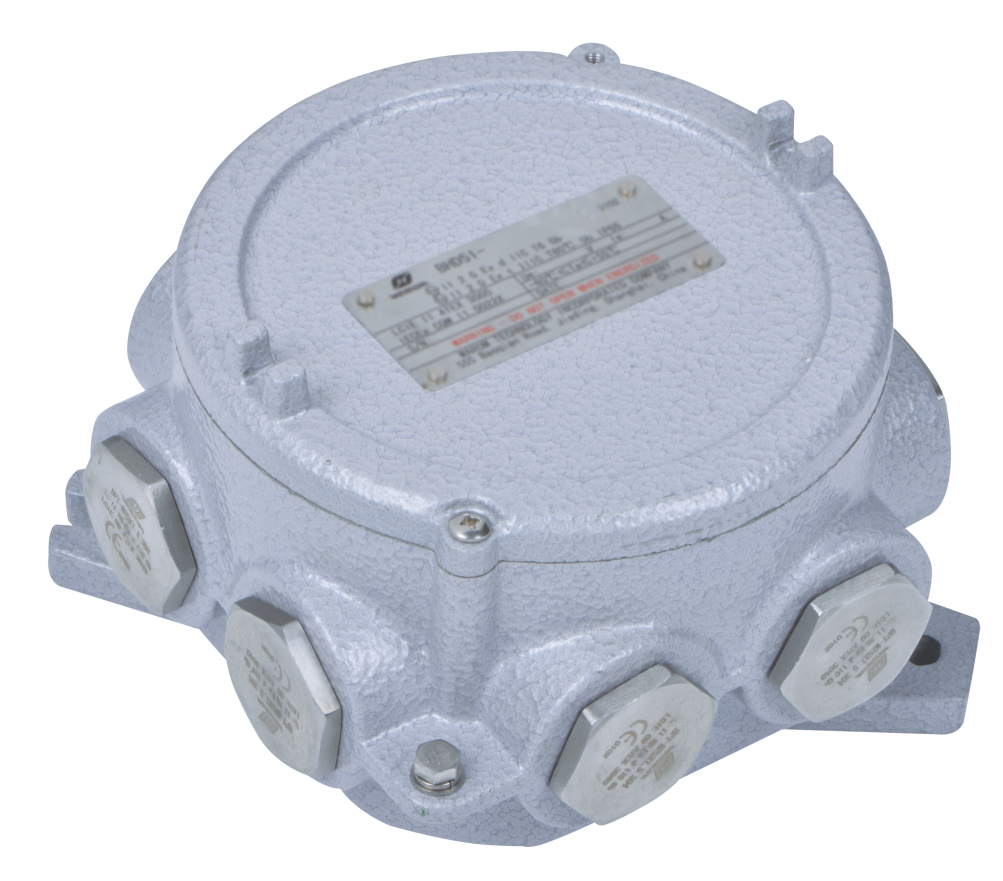
The BHD91 junction box family illustrates the component level of this discipline: an IP66 enclosure with an ambient range of -60 °C to +60 °C, M or NPT entries as standard, and glands specified separately because the gland, not the box, has to match the cable. A junction box that carries a rating the installed glands do not carry is a junction box with a lower rating.
An RFQ Checklist for Weatherproof CCTV Enclosures
A clear RFQ removes the ambiguity that suppliers resolve in their own favour. The six fields below change the answer, so they belong in the enquiry rather than in a later clarification.
| Field | What to state | Why it changes the answer |
|---|---|---|
| Mounting and exposure | Wall, pole, plinth or pit; sheltered or fully exposed; coastal, chemical or inland | Sets the IP target, the corrosion category and the bracket design |
| IP and IK target | The required IP digits and an IK figure, with the test standard named | Stops a supplier quoting a lower impact class because the IP number looked sufficient |
| Material system | Body, fastener, hinge, gland and bracket materials named together | Prevents a galvanic couple that fails two years after delivery |
| Internal load and ambient range | Camera model, PoE class, heater wattage, minimum and maximum ambient, hours of direct sun | Drives the thermal calculation, which is not visible from the outside |
| Cable entries and cable data | Number of entries, thread type, cable type and outside diameter range, glands included or excluded | The entry, not the wall, is where water gets in |
| Hazardous area data | Zone, gas or dust group, temperature class, and whether a certificate is required | Decides whether a weatherproof housing is even the right product category |
Compare two versions of the same request. A vague line invites a vague answer:
- Reject: “Weatherproof camera housing, stainless steel, IP66, with cable gland.”
- Replace with: “Camera housing for a coastal pole position, IP66 and IK10, 316L body with A4 stainless fasteners, sized for a specified camera and PoE class with a thermostatically controlled heater, two M25 entries for cable outside diameter 12 to 20 mm with glands supplied, rated from -25 °C to +55 °C in direct sun, supplied with the ingress test report and a corrosion statement for a coastal category under ISO 12944-2.”
The second version can be quoted accurately, inspected on delivery and rejected if it does not match. It also exposes the fields the buyer has not yet decided, which is usually the point at which a site survey is cheaper than a second order.
Evaluating a Supplier and the Documentation to Request
The documents behind the markings decide whether a specification survives contact with a site. Ask for the following before a purchase order, not after:
- The ingress test report or declaration of conformity referencing IEC 60529, with the tested configuration stated.
- The IK test result and the standard used, where impact is a stated requirement.
- Material certificates, including an EN 10204 3.1 certificate where stainless steel grade is a specified requirement.
- The corrosion test report with the standard, hours and coating system described.
- The Ex certificate and its schedule of limitations, where hazardous area equipment is involved.
- Dimensional drawings, torque values, gasket part numbers and the recommended inspection interval.
There is a hierarchy in that list. A declaration of conformity is often the manufacturer’s own statement, while a type test report from an independent laboratory carries more weight because the test was witnessed outside the factory. For explosion-protected equipment the certificate must come from an accredited certification body, and the schedule of limitations should be read as carefully as the certificate itself, because it defines the conditions under which the certification remains valid.
Two trade-offs are worth naming. Independent testing and a factory acceptance test on assembled enclosures add cost and lead time, and on a standard wall-mounted housing in a mild inland environment that cost may not be justified. On a coastal jetty with two hundred cameras, the same money buys a documented baseline that makes a warranty claim possible at all.
Certification claims are only as useful as the test evidence behind them. <Warom Technology “International IECEx explosion-proof technology Thailand special symposium” was successfully held> covers an IECEx technical exchange on explosion proof technology.
Turning Site Conditions Into an Enclosure Specification
The fastest route to an accurate answer is a complete first message. Tell us the mounting position and exposure, the IP and IK targets, the body and fastener materials you are considering, the camera model with its PoE class and any heater load, the cable types and outside diameters, the ambient range with the hours of direct sun, and the zone, gas or dust group and temperature class if the position is classified. We will confirm which parts of the enclosure chain meet the requirement as described and which need a different rating.
WAROM Technology Incorporated Company can be reached at gm*@***om.com, or by telephone on +86 21 39977076 and +86 21 39972657. One boundary is worth restating: a single IP number is not a specification. The site conditions, the material system and the entries decide whether the housing is still doing its job in the third year.
FAQ
Is IP66 enough for a camera mounted on a coastal pole?
IP66 addresses the water and dust side of that position and leaves the dominant risk untouched. On a coastal pole, housings usually fail through chloride attack on fasteners and gland threads, ultraviolet hardening of the gasket, or water standing inside the pole rather than through the enclosure wall. Specify a chloride-resistant body with A4 stainless fasteners, ask for a corrosion statement against the upper ISO 12944-2 categories, and set a 12-month inspection interval. If the pole can fill with water, an IP67 assembly at the lower entries is the more honest target.
Can I use a weatherproof enclosure in a Zone 2 area?
Only if the enclosure also holds the certification the zone requires. Zone 2 lowers the probability of a flammable atmosphere being present, but it does not remove the requirement for equipment assessed for that zone, gas group and temperature class, and a weatherproof housing without that assessment does not qualify. The same logic applies to dust zones, where protection by enclosure is assessed under the dust parts of the IEC 60079 series. Start from the area classification drawing, then select equipment that matches it.
Why does condensation form inside a sealed outdoor enclosure?
Because the enclosure was closed with humid air inside it and then cooled. As the internal air contracts overnight, the pressure difference draws more moisture through the seal path by vapour diffusion, and water can also travel along a cable core from a wet duct. The moisture then condenses on the coldest surface, which is often the window or the lens barrel. Solutions that work in practice are a thermostatically controlled heater holding the internal air above the dew point, a filtered breather, or sealing the housing on a cool, dry day.
Do I need a heater in a weatherproof camera housing?
It depends on two separate numbers. One is the camera’s minimum operating temperature, which sets the heating needed to keep the electronics inside their rated range. The other is the dew point margin, which sets the heating needed to stop condensation forming on the optics. These are different calculations, and a single small heater often satisfies only the second. If the site sees sub-zero nights and high daytime humidity, specify the heater wattage against both figures and confirm the power budget at the pole.
What IK rating should an outdoor camera enclosure have?
IK ratings run under IEC 62262 and express impact energy, so the sensible target follows the risk at the mounting height. A pole-mounted housing within reach of a person should generally be specified at IK08 (5 J) or better, and IK10 (20 J) where vehicles, tools or deliberate vandalism are plausible. Check the window and the mounting bracket as separate items, because a housing that survives the impact with a cracked window has still failed the security function.
References
[1] IEC 60529:1989/AMD2:2013, “Degrees of protection provided by enclosures (IP Code),” International Electrotechnical Commission, Geneva, Switzerland, 2013.
[2] IEC 62262:2002, “Degrees of protection provided by enclosures for electrical equipment against external mechanical impacts (IK code),” International Electrotechnical Commission, Geneva, Switzerland, 2002.
[3] IEC 60079-0:2017, “Explosive atmospheres — Part 0: Equipment — General requirements,” International Electrotechnical Commission, Geneva, Switzerland, 2017.
[4] IEC 60079-31:2013, “Explosive atmospheres — Part 31: Equipment dust ignition protection by enclosure ‘t’,” International Electrotechnical Commission, Geneva, Switzerland, 2013.
[5] ISO 12944-2:2017, “Paints and varnishes — Corrosion protection of steel structures by protective paint systems — Part 2: Classification of environments,” International Organization for Standardization, Geneva, Switzerland, 2017.
[6] ISO 9227:2017, “Corrosion tests in artificial atmospheres — Salt spray tests,” International Organization for Standardization, Geneva, Switzerland, 2017.
If you’re interested, check out these related articles:
Explosion Proof Marine Products for Offshore Wind Vessels
WAROM “INNOVATION” Unveils a New Era of Precision Medicine
Warom Successfully Passed the Partnering for Sustainability TFS Audit Certification
Explosion Proof Solutions for FPSO Vessel Safety
With over a decade of experience, he is a seasoned Explosion-Proof Electrical Engineer specializing in the design and manufacture of safety and explosion-proof products. He possesses in-depth expertise across key areas including explosion-proof systems, nuclear power lighting, marine safety, fire protection, and intelligent control systems. At Warom Technology Incorporated Company, he holds dual leadership roles as Deputy Chief Engineer for International Business and Head of the International R&D Department, where he oversees R&D initiatives and ensures the precise delivery of design documentation for international projects. Committed to advancing global industrial safety, he focuses on translating complex technologies into practical solutions, helping clients implement safer, smarter, and more reliable control systems worldwide.

Qi Lingyi