

A nameplate on explosion proof equipment records what the manufacturer certified the product to be, not what condition it is in today. Reading it correctly takes three separate checks: decode the marking string, confirm the certificate behind that string covers this exact variant, and match the declared ratings to the hazardous area and to the installation. Most misreadings come from treating the first step as the whole job. This guide covers what each field states, which fields are routinely misapplied, and where the plate stops being evidence of anything.
What the nameplate on explosion proof equipment actually declares
Every certified item installed in a hazardous area carries a plate that condenses years of type testing and quality control into a few lines. Under the ATEX directive, that marking is a legal obligation on the manufacturer and part of the technical documentation that must be retained [1]. The order of the symbols, the protection types, the equipment group, the temperature class, and the equipment protection level follow the marking rules of IEC 60079-0 [2].
What the plate does not do is describe the object in front of you. It describes a design that was type tested at a stated ambient temperature, with stated internal components, assembled in a stated way, and certified against a specific edition of a standard. Replace the driver with a different unit, add an entry, or operate it above the declared ambient, and the declaration no longer describes what is installed, even though the engraving is unchanged.
The vocabulary causes part of the confusion. “Explosion proof” is the North American term for a protection approach defined through UL 1203 and the National Electrical Code, while most other markets describe the same equipment by its type of protection, such as flameproof enclosure “d” or increased safety “e”. Two plates with no words in common can describe equivalent protection concepts, and two plates with similar words can describe different levels of protection.
The word on the plate and the word in the specification are not always the same term for the same concept. <Explosion Proof Definition: Essential 2025 Safety Facts> covers how the explosion proof definition is framed for safety teams working across regional standards.
A workable read therefore runs in sequence: decode the plate, verify the certificate, then match the declared ratings to the area classification and to the physical installation. Skipping the second or third step is how a correctly marked but wrongly applied device ends up in service with a paper trail that looks complete.
Decode the Ex marking string from left to right
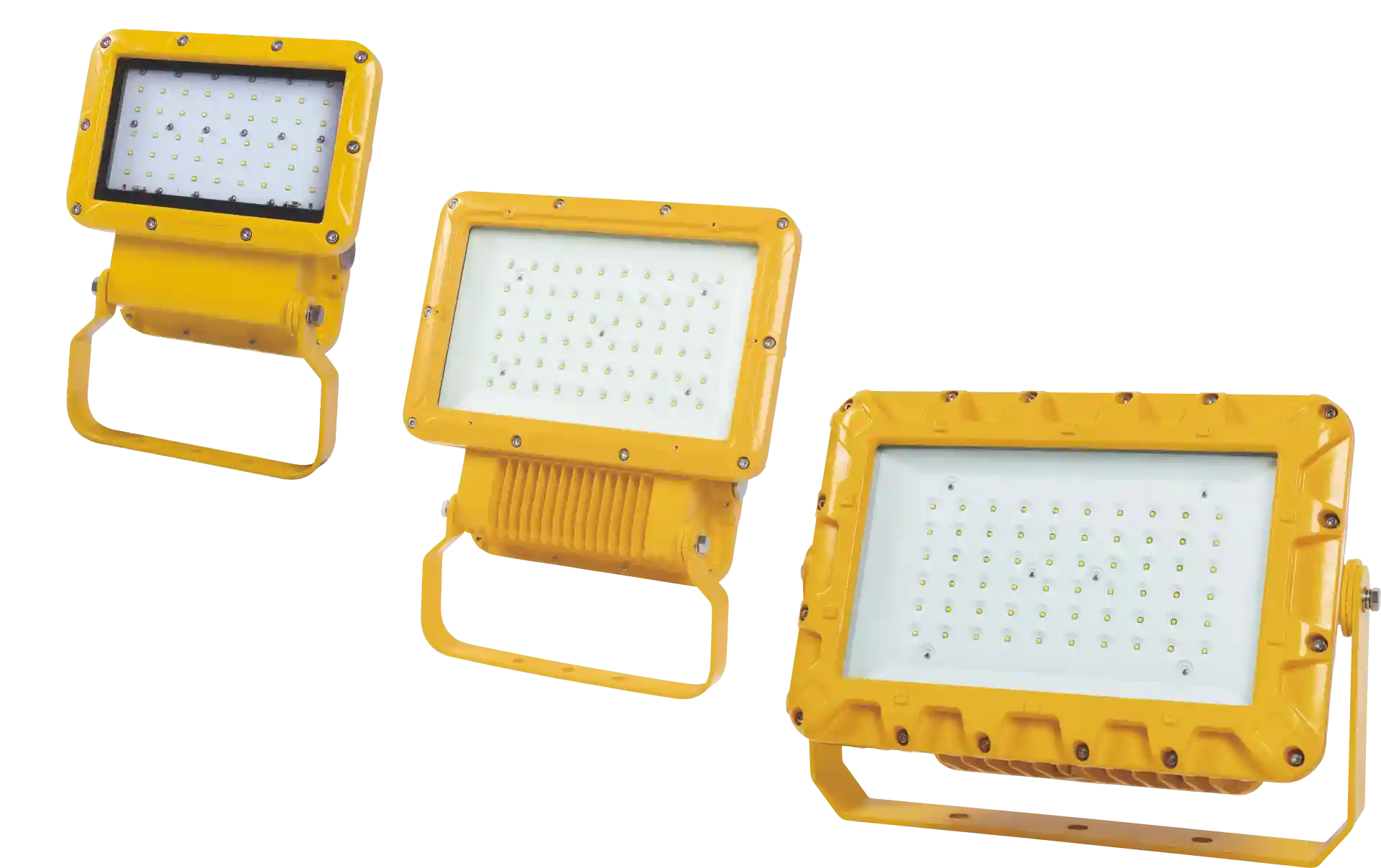
The marking string is written in a fixed order, and each block narrows the claim made by the one before it. Take a floodlight marked Ex db eb IIC T6 Gb. The enclosure is flameproof, the terminal chamber uses increased safety, the equipment is rated for the most severe gas subgroup, the maximum surface temperature is 85 °C, and the overall equipment protection level suits Zone 1.
| Block in the string | Example | What it states | Defined by |
|---|---|---|---|
| Ex symbol | Ex | The item is certified for explosive atmospheres | IEC 60079-0 marking rules [2] |
| Protection type | db, eb, tb | Flameproof enclosure, increased safety, or dust protection by enclosure | IEC 60079-1 [3], IEC 60079-7 [4], IEC 60079-31 [5] |
| Equipment group | I, II, III | Mining, surface gas, or surface dust application | IEC 60079-0 [2] |
| Subgroup | IIA, IIB, IIC, IIIA, IIIB, IIIC | The severity of atmosphere the enclosure was tested against | IEC 60079-0 [2] |
| Temperature | T1 to T6, or a value in °C | Maximum surface temperature under the declared conditions | IEC 60079-0 [2] |
| Protection level | Ga, Gb, Gc, Da, Db, Dc | The zone capability of the complete equipment | IEC 60079-0 [2] |
Two details trip people up. First, several protection types can be stacked in one string, which usually means a compound construction: a flameproof main chamber with an increased safety terminal compartment is a common arrangement on lighting and junction equipment, and each protection type has to be maintained separately during installation. Second, the letter attached to a protection type (the “b” in db or eb) reflects the protection level that technique achieves, while the final letters in the string state the level for the assembly as a whole. When the two differ, the lower one governs the application.
Earlier editions of IEC 60079-0 did not require the protection level letters, so older equipment may show only Ex d IIB T4 with no EPL. That equipment is not automatically unusable, but it has to be assessed against the current zone requirement rather than assumed equivalent to a modern Gb marking.
Find the certificate number and read the letters after it
The certificate number is the most photographed and least checked part of the plate. Its structure tells you where to look. A number such as IECEx TUR 22.0035X identifies the scheme, the issuing certification body, the year of issue, a sequence number, and a suffix. An ATEX number follows a different pattern, for example TÜV 22 ATEX 8855X, because it is issued under European legislation rather than an international scheme.
The suffix is not decoration. An X means the certificate carries specific conditions for safe use, which are written in the certificate schedule and are binding on the installer. A U means the item is an Ex component rather than complete equipment, so it cannot be placed in a hazardous area on its own; it is intended to be built into something else that holds the final certification. Both letters appear on real equipment and both change what you can do with it.
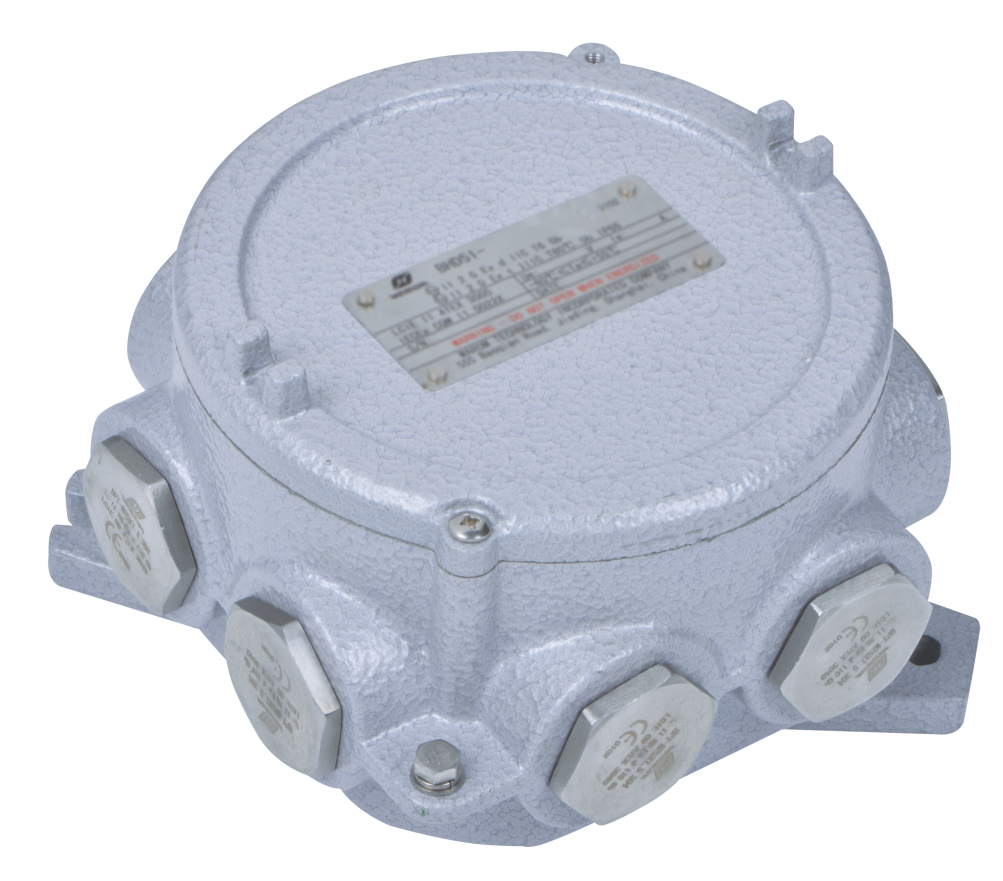
Many products hold certification under more than one system, and the plate may show only the one relevant to the market it was built for. One cable gland range in the WAROM catalogue carries IECEx TUR 22.0035X and TÜV 22 ATEX 8855X, with a declared ambient range of -60 °C to +90 °C and IP66. Seeing a single number on a delivered unit is not a defect; it tells you which market the unit was certified for and which schedule of conditions you must read.
Verification means opening the issuing scheme’s public certificate register, entering the number, and reading the schedule rather than the cover page. The schedule lists the variants covered, the ambient range, the entry options, and any condition attached to the X. A certificate covering a family does not automatically cover the variant with the larger enclosure, the extra terminal count, or the alternative entry thread.
Certificates are also revised. A number copied into a project file five years ago may now sit at a later issue with changed conditions, so the plate and the current issue should be checked together rather than in isolation.
Match the marking to the area classification before you accept the plate
The area classification is produced by the site assessment, not by the equipment supplier. Under the worker protection directive, the employer classifies places where explosive atmospheres may occur into zones according to the likelihood and duration of the hazard [5], and the equipment selection then follows from those zones and from the properties of the gas or dust present [6]. The plate is tested against that conclusion; it does not establish it.
Zone and equipment protection level
The zone sets the minimum protection level. Zone 0 requires Ga, Zone 1 requires Gb or Ga, and Zone 2 accepts Gc, Gb, or Ga. The dust equivalents run Zone 20 with Da, Zone 21 with Db, and Zone 22 with Dc. A plate showing Gc in a Zone 1 location is a mismatch regardless of how robust the enclosure feels, because the protection level states the probability of the equipment becoming a source of ignition, not its mechanical strength.
Gas group and temperature class
Subgroups are cumulative in one direction only. Equipment marked IIC can serve an IIA or IIB application, but equipment marked IIB cannot serve an IIC requirement, and the same logic applies to IIIA, IIIB, and IIIC for dust. The subgroup reflects testing against a representative gas or dust, so the site classification has to name the subgroup before the plate can be judged.
Temperature classes are fixed values: T1 is 450 °C, T2 is 300 °C, T3 is 200 °C, T4 is 135 °C, T5 is 100 °C, and T6 is 85 °C [2]. The class must keep the surface temperature below the ignition temperature of the atmosphere involved, with the margin set by the assessment. A higher class number is not a general safety upgrade: T6 equipment is often derated on ambient temperature or output, so specifying T6 where T4 is sufficient can cost light output or require a larger fixture count.
Ambient range at the installation
If the plate does not state an ambient range, the default assumption is -20 °C to +40 °C [2]. Equipment marked for a wider range, such as -60 °C to +60 °C on a marine-grade junction box, is only compliant within that range. Enclosure interiors run hotter than the surrounding air when a lamp or a driver sits inside, and solar gain on a painted enclosure in direct sun can push the internal ambient well past the shade temperature. Compare the plate range with the measured or calculated enclosure ambient, not with the weather forecast.
| Parameter | What the plate must show | Reject the match if |
|---|---|---|
| Gas zone | Ga for Zone 0, Gb for Zone 1, Gc for Zone 2 | Plate shows Gc only and the location is Zone 1 |
| Dust zone | Da for Zone 20, Db for Zone 21, Dc for Zone 22 | Plate carries only a gas protection type in a dust-classified area |
| Subgroup | Equal to or more severe than the classified gas or dust | Plate shows IIB against a hydrogen or acetylene classification |
| Temperature class | Class whose limit sits below the atmosphere ignition temperature | Plate class permits a surface temperature above that ignition temperature |
| Ambient | Range covering the calculated enclosure minimum and maximum | Plate upper limit is below the enclosure ambient measured in service |
| Dust surface temperature | A value in °C with the dust layer condition stated | Plate gives a T class only, with no dust surface temperature |
IP rating, supply data and terminal fields buyers skip
The IP code is a separate declaration from the Ex marking and follows IEC 60529 [8]. The first digit covers solids and the second covers water, so IP66 means dust tight plus protection against powerful water jets. IP68 involves continuous submersion, but the depth and duration are set by agreement between manufacturer and user rather than fixed by the code, so an IP68 claim means nothing until you read the stated conditions. None of this makes an enclosure suitable for a hazardous area; a weatherproof enclosure with an impressive IP number can still be entirely uncertified for explosive atmospheres.
Below the marking string sit the electrical and mechanical fields that determine whether the equipment can actually be installed. Rated voltage and frequency, wattage for luminaires, terminal cross-section and current, terminal count, entry thread type and size, and the cable diameter range accepted by the recommended gland all constrain the job. A plate on a junction box in the BHD91 range, for instance, states 2.5 mm² terminals rated 24 A with twelve terminals, a maximum rated voltage of 500 V AC, IP66, an ambient range of -60 °C to +60 °C, and M-thread entries with NPT available on request.
The useful question is not whether those values look adequate in isolation but whether they match what is being connected. A 6 mm² conductor will not land in a 2.5 mm² terminal, an M25 entry will not accept a gland sized for a 10 mm cable, and a luminaire rated for a 100 to 277 V AC supply will not behave as marked on a 480 V feed. Checking the plate against the cable schedule and the gland schedule catches more installation errors than checking the Ex string alone.
ATEX, IECEx and NEC plates show the same product differently
The three main systems answer the same engineering question in different legal frameworks, and the plate reflects the framework rather than the physics.
| System | Legal status | Typical plate text | What to verify |
|---|---|---|---|
| ATEX | Mandatory for equipment sold in the EU and EEA under 2014/34/EU [1] | CE, four-digit notified body number, II 2 G, then the Ex string and level | Notified body number and category match the zone and the equipment type |
| IECEx | International certification scheme, required where the project or country adopts it | Ex string with level, plus an IECEx certificate number | Certificate is current, and the schedule covers this variant |
| NEC and UL | The installation code and listing system used in the United States [9] | Class I Division 1 Groups C and D T4, or Class I Zone 1 AEx db IIC T6 Gb | Division or zone system used on site, and the correct product standard |
The practical consequence is that a single unit may carry more than one plate, or one plate with several markings, if it was certified for several markets. A CE mark on its own proves nothing about explosion protection, since ordinary industrial products carry it too; only the Ex string and its certificate do that work.
Other markets add their own layers: UKCA for Great Britain, EAC for the Eurasian Economic Union, and CNEX certification against GB/T 3836 for China. None of these is interchangeable with another by default. A project specification that requires IECEx is not satisfied by an ATEX certificate alone, even when the protection concept and the certificate holder are identical, because the acceptance criterion is the scheme named in the specification.
Where the nameplate stops being evidence
The plate answers a narrow documentation question very well and several practical questions not at all. Knowing where the line falls prevents the most common audit finding, which is a file full of correct certificates attached to equipment that no longer matches them.
- Condition. The plate states what the enclosure was designed for, not whether the flame path is within tolerance, whether the gasket has hardened, or whether corrosion has opened a path into the terminal chamber.
- Installation quality. Gland selection, cable diameter, tightening torque, unused entry plugs, and earthing continuity are installation facts. A correctly marked enclosure with a mismatched gland is non-compliant.
- Variant coverage. Certificate schedules list what is covered. An added terminal chamber, a different lens, or a substituted driver may sit outside the listed variants even though the model number looks familiar.
- Repair and modification. An enclosure repaired outside the manufacturer’s procedure, or fitted with a non-approved component, no longer holds the certification basis, whatever the plate says.
- Genuine marking. Cloned plates exist. The certificate number is only evidence when it is checked with the issuing body and the details match the unit in hand.
- Legibility. A plate that cannot be read cannot be verified. Re-stamping or re-engraving by the user is not a substitute for the original marking, and a lost plate is a non-conformance until identity and certification are recovered from the manufacturer’s records.
The area classification sits outside this list entirely. A plate can be correct, current, and genuine while the classification it is being matched against is wrong, which is why selection is a joint exercise between the plate, the certificate, and the assessment document, not a reading of the plate alone.
A nameplate check you can run before energizing
The sequence below works for lighting, junction boxes, control stations, and distribution equipment. Items marked required affect compliance; the last item is planning rather than conformity.
- Photograph and transcribe the full string. Record every line on the plate, including the certificate number and the ambient range, before the equipment is mounted where the plate cannot be read.
- Decode the protection types and the equipment protection level. Identify each protection type in the string and note whether the level matches the zone.
- Verify the certificate number and any suffix. Open the register, read the schedule, and confirm the conditions attached to an X or the component status implied by a U.
- Compare subgroup and temperature class with the classification document. Check the direction of the subgroup rule and confirm the class limit sits below the ignition temperature with the required margin.
- Check the ambient range against the calculated enclosure temperature. Include internal heat gain and solar exposure, not just air temperature.
- Match supply and mechanical data to the installation. Voltage, frequency, wattage, terminal capacity, terminal count, entry thread, and gland cable range all have to fit the cable schedule.
- Inspect what the plate cannot describe. Flame path condition, gland fit, plugging of unused entries, torque marks, and earthing continuity are inspection items, not documentation items.
- Record serial number and year for spares planning (optional). Age and revision data help predict obsolescence and confirm that a replacement matches the installed variant.
Send us the marking string and we will check it against the certificate
If a delivered unit, a tender document, or an existing installation has a plate you are not certain about, send the photograph and the full marking string to gm*@***om.com along with the area classification for the location. We will check the protection types, the equipment protection level, the subgroup, and the temperature class against the certificate, and tell you which fields do not match or which variant of the same family carries the marking your classification requires. Phone +86 21 39977076 or +86 21 39972657.
A plate review resolves a documentation question. It does not replace the inspection of the installed equipment, and it cannot confirm the condition of a flame path or the fit of a gland that nobody has looked at. WAROM Technology Incorporated Company, gm*@***om.com, +86 21 39977076, +86 21 39972657.
FAQ
What does the X at the end of an Ex certificate number mean?
An X means the certificate carries specific conditions for safe use, which are written in the certificate schedule rather than on the plate. The conditions are usually practical: a maximum ambient range, a required entry type, a restriction on the cable diameter, or a limitation on the enclosure mounting. The equipment is certified, but only when those conditions are met. Read the schedule before installation, and treat an X-suffixed certificate as a set of instructions rather than a simple approval.
Does a T6 marking mean the equipment is safer than T4?
Not in general terms. T6 limits the maximum surface temperature to 85 °C, which allows use in atmospheres with lower ignition temperatures, but equipment designed to that limit often carries a narrower ambient range or reduced output because the thermal margin is tighter. T4 at 135 °C is sufficient for many hydrocarbon atmospheres. The right class is the one that sits below the ignition temperature of the gas present with the margin the assessment requires, not the highest number available.
Can I replace a lamp or driver with any certified part of the same wattage?
No. The certification covers the assembly as tested, including the light source, the driver, and the thermal behaviour of the combination. A certified part from a different family changes the tested configuration, even at the same wattage, because the heat path and the internal temperature rise will differ. Use the spare part specified by the manufacturer for that model, and treat an unlisted substitution as a modification that places the certification at risk.
Is ATEX certification accepted where the specification requires IECEx?
Usually not automatically. ATEX is the legal route for the European Union and EEA, while IECEx is an international certification scheme, and a specification that names one scheme is stating which evidence it will accept. Some projects accept either, some accept both, and some require a local mark such as UKCA, EAC, or CNEX. Check the project specification and the national authority requirement rather than assuming equivalence from a similar protection code.
What should I do if the nameplate is missing or unreadable?
Treat the item as unverified until its identity and certification are recovered from the manufacturer’s records or the delivery documentation. Do not re-engrave, stamp, or attach a replacement plate yourself, because that creates a marking that no certificate supports. Isolate or replace the equipment according to site procedure, then confirm the model, variant, and certificate number with the supplier before any return to service.
References
[1] Directive 2014/34/EU of the European Parliament and of the Council of 26 February 2014 on the harmonisation of the laws of the Member States relating to equipment and protective systems intended for use in potentially explosive atmospheres, Official Journal of the European Union, L 96, Mar. 2014.
[2] IEC 60079-0:2017, Explosive atmospheres, Part 0: Equipment, General requirements, International Electrotechnical Commission, Geneva, 2017.
[3] IEC 60079-1:2014, Explosive atmospheres, Part 1: Equipment protection by flameproof enclosures “d”, International Electrotechnical Commission, Geneva, 2014.
[4] IEC 60079-7:2015, Explosive atmospheres, Part 7: Equipment protection by increased safety “e”, International Electrotechnical Commission, Geneva, 2015.
[5] IEC 60079-31:2013, Explosive atmospheres, Part 31: Equipment dust ignition protection by enclosure “t”, International Electrotechnical Commission, Geneva, 2013.
[6] Directive 1999/92/EC of the European Parliament and of the Council of 16 December 1999 on minimum requirements for improving the safety and health protection of workers potentially at risk from explosive atmospheres, Official Journal of the European Communities, L 23, Jan. 2000.
[7] IEC 60079-14:2013, Explosive atmospheres, Part 14: Electrical installations design, selection and erection, International Electrotechnical Commission, Geneva, 2013.
[8] IEC 60529:1989, Degrees of protection provided by enclosures (IP Code), International Electrotechnical Commission, Geneva, 1989.
[9] NFPA 70, National Electrical Code, National Fire Protection Association, Quincy, MA, 2023.
If you’re interested, check out these related articles:
2023 Merry Christmas
APPEA 2024
Explosion Proof Solutions for FPSO Vessel Safety
With over a decade of experience, he is a seasoned Explosion-Proof Electrical Engineer specializing in the design and manufacture of safety and explosion-proof products. He possesses in-depth expertise across key areas including explosion-proof systems, nuclear power lighting, marine safety, fire protection, and intelligent control systems. At Warom Technology Incorporated Company, he holds dual leadership roles as Deputy Chief Engineer for International Business and Head of the International R&D Department, where he oversees R&D initiatives and ensures the precise delivery of design documentation for international projects. Committed to advancing global industrial safety, he focuses on translating complex technologies into practical solutions, helping clients implement safer, smarter, and more reliable control systems worldwide.

Qi Lingyi