

Marine explosion proof distribution boxes in stainless steel are not land based enclosures with a higher IP rating. The saltwater environment changes what fails first: the enclosure surface, the gland plate, the flame path, and the external fasteners corrode at different rates. After specifying these boxes for offshore platforms, docks, and below deck areas, I now put material grade and certification scope ahead of circuit count in the first review. For long service in marine atmospheres, 316L stainless steel with an Ex d or compound Ex d and Ex e construction is the baseline I recommend, but the approval path and cable entry details still decide whether the box stays safe after installation.
Material Selection for Marine Explosion Proof Distribution Boxes
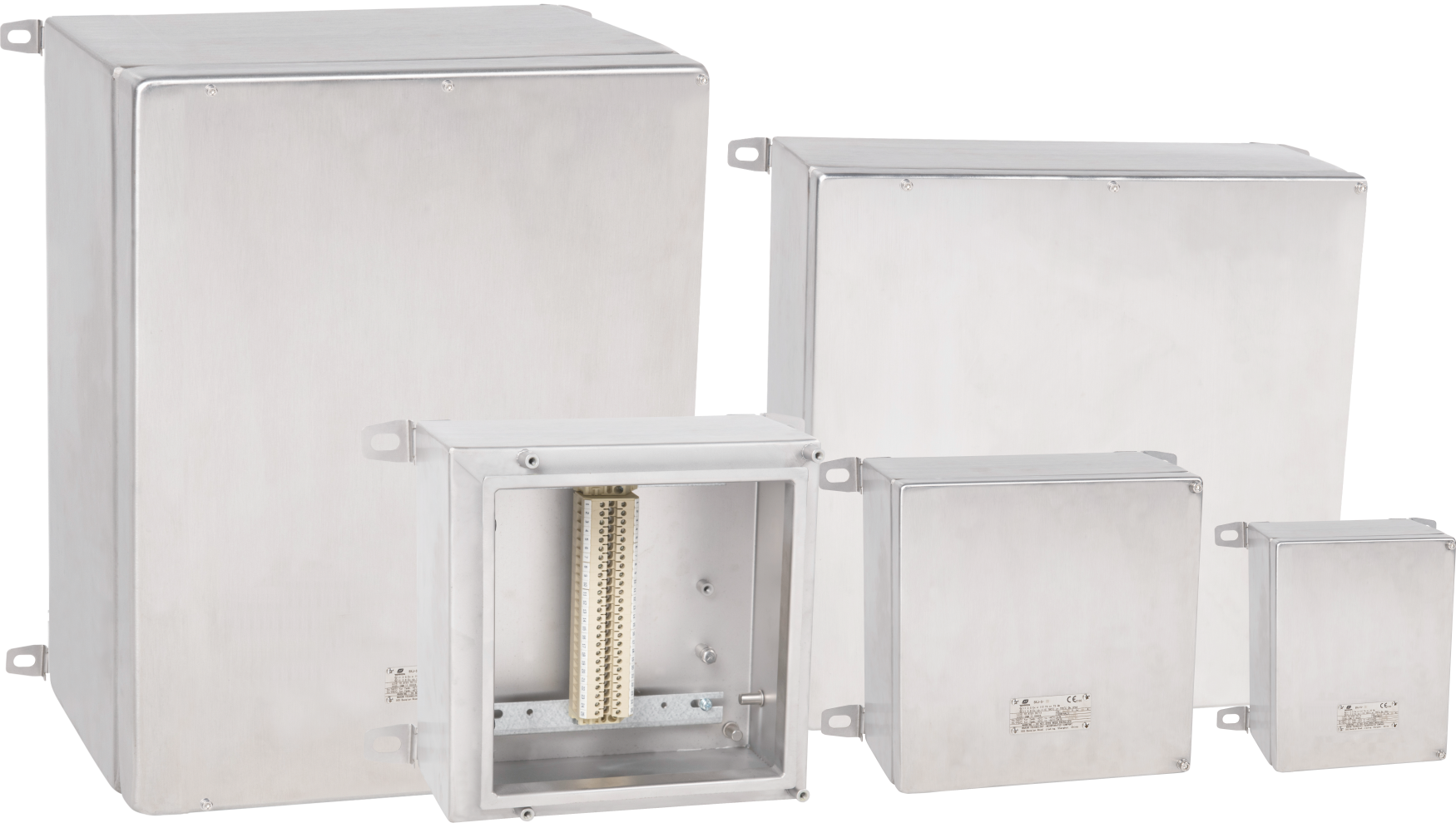
Marine salt spray penetrates threaded entries and mounting interfaces long before it floods an enclosure. A copper-free aluminum body with a powder coat can last for years in a chemical plant, but once a deck brace wears through the coating, corrosion starts at the scratch. Stainless steel removes that failure mode because there is no coating layer to breach. The practical difference is less about the box looking new and more about the machined flame path surfaces staying smooth year after year.
For marine service I specify 316L rather than 304. The molybdenum in 316L resists chloride pitting better, and the low carbon content keeps welded corners from becoming sensitized. 304 can work in a sheltered engine room with routine washdowns, but it is the wrong default for an open deck or a cargo pump room. External fasteners matter just as much as the shell, so specify stainless steel fasteners instead of mixing grades that create a galvanic couple.
| Enclosure Material | Marine Saltwater Behavior | Best Fit |
|---|---|---|
| 316L stainless steel | Resists chloride pitting after welding; no coating to fail | Open decks, cargo pump rooms, direct salt spray |
| 304 stainless steel | Acceptable only in sheltered or washed down spaces | Air conditioned control rooms, occasional washdown |
| Copper-free aluminum alloy | Good strength but coating damage starts surface corrosion | Zone 2 interiors with low salt exposure |
| GRP fiberglass | Strong chemical resistance but limited for flameproof service | Weatherproof and increased safety designs |
Enclosure choice starts with the corrosion mechanism, not just the IP rating. <GRP Fiberglass Enclosures: Ultimate Corrosion Protection> covers where molded GRP performs well in aggressive exterior conditions and where flameproof service pushes the decision back toward 316L stainless steel.
Certification and Type Testing for Marine Distribution Boxes
Approval starts with the protection concept, not with the material. A stainless steel box that carries only an IP66 rating is weatherproof, not explosion proof. The marine environment does not reduce the hazard; a vessel pump room or an FPSO topside may be Zone 1 or Zone 2 with a IIB or IIC gas group. I check three documents before accepting any quotation. The first is the IECEx or ATEX certificate for the enclosure or the complete fitted box. The second is the classification society approval, usually CCS, BV, DNV, or ABS, covering the marine environmental tests. The third is the manufacturer’s declaration for material grade, fastener grade, and cable gland compatibility.
A common mistake is to accept a land based certificate and assume the box behaves the same at sea. Salt mist testing, vibration, and motion loads belong to the marine approval package. On projects with long cable runs, the gland plate is often drilled on site, yet the flameproof certificate may only cover the original hole pattern. If the plate is machined after dispatch, confirm that the modification stays within the certified design. For stainless steel enclosures, I also check that the certificate relates to the actual welded shell, not a cast aluminum equivalent with a different wall thickness.
Flame Path and Gland Plate Design in Stainless Steel Boxes
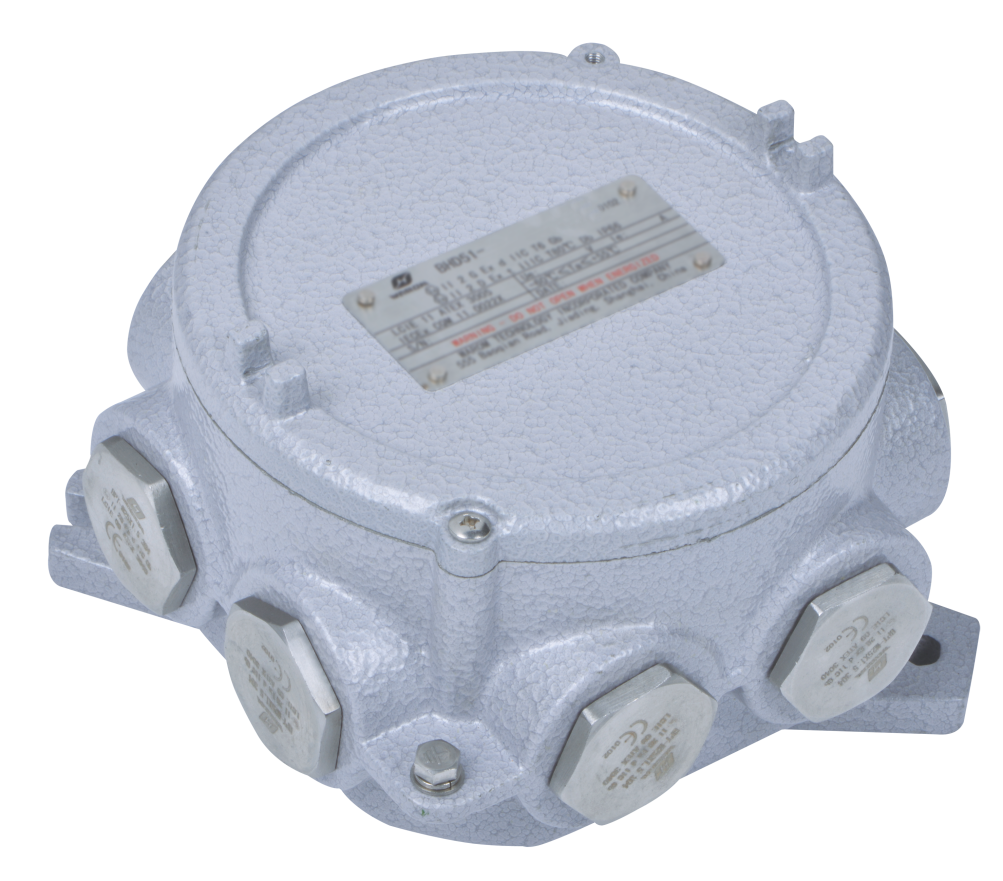
In a flameproof enclosure, the cover and body do more than seal. They form a controlled flame path. When an internal ignition occurs, hot gases escape through the gap between the cover and body but cool below the ignition temperature of the surrounding gas before they reach the outside. That depends on gap width, length, and surface finish. Salt corrosion, pitting, or mechanical damage on the flame path can invalidate the certification even if the box still closes. Stainless steel holds this dimension better than coated aluminum in aggressive marine service because there is no coating to erode and the material surface is harder.
Removable gland plates need the same attention. On marine distribution boxes I prefer a stainless steel gland plate drilled at the factory, not on site, so the hole layout matches the certified drawing. The material left between adjacent entries has to keep enough strength for the explosion pressure. In practice, overpacking a gland plate with four large entries and then asking for one more hole is where many projects go wrong. The plate bends, the flame path opens, and the box no longer matches its type test.
On the increased safety side, terminals and busbars must keep the creepage and clearance distances defined by the Ex e design. Salt deposits and condensation can bridge these paths, so I look for terminals with solid barriers and a drain point where the mounting plane allows. The earthing arrangement matters in the same way. A stainless steel shell with an external stud and an internal earthing rail gives the surveyor a clear connection point, but the protective conductor path must still be checked against the maximum prospective fault current.
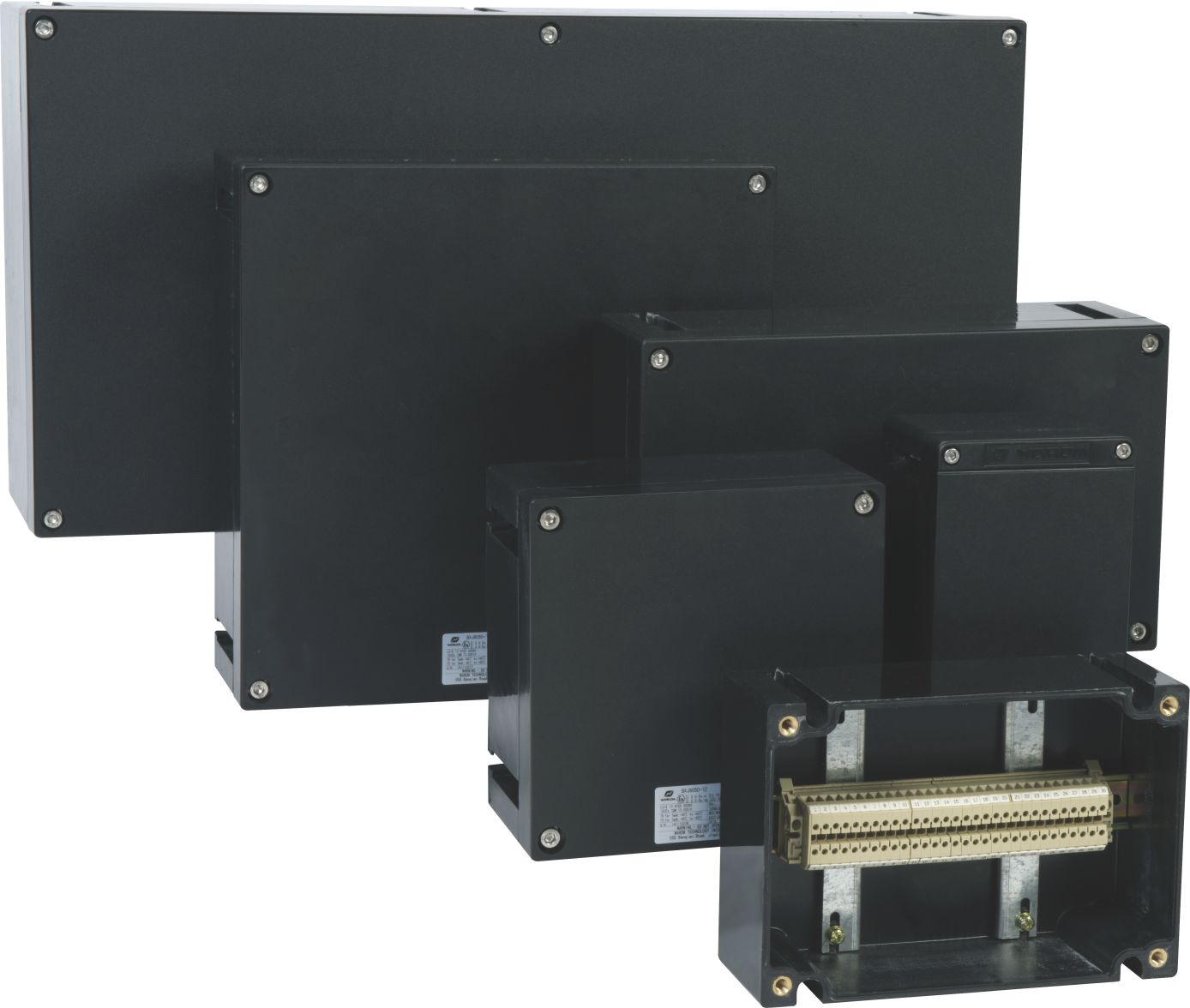
If your program has a stainless steel box with limited space and multiple armored cables, confirm the gland plate layout and Ex e terminal clearances before finalizing the bill of materials. Send the cable outer diameters and gland types to gm*@***om.com and we will check the entry arrangement against the certified design.
Cable Entry Planning for Marine Explosion Proof Distribution Boxes
Marine distribution boxes work best with bottom entry, which is how the stainless steel distribution panels we build are supplied. Bottom entry stops water from running down the cable and collecting around the gland. If top entry is unavoidable, the gland selection has to handle both the explosion protection and the water seal. On an open deck, a top entry box without a certified breather or drain can collect condensation even when the enclosure itself is IP66.
For armored marine cable, specify an Ex d barrier gland that terminates the armor and seals the inner sheath. The gland body material must be compatible with the stainless steel gland plate. Nickel plated brass is common, but stainless steel glands are better where salt spray is direct and maintenance intervals are long. Avoid untreated brass glands against a stainless steel plate because the galvanic difference accelerates corrosion at the thread.
Spare entries cause more certificate issues than active circuits. Every unused hole should be closed with a certified stopping plug from the enclosure manufacturer. A standard conduit plug may keep water out but may not maintain the flameproof rating. I also ask for the entry direction and hole size on the drawing before the plate is machined, not as a note added after fabrication.
Factory Documentation and Final Specification Review
Most marine stainless steel distribution box failures that reach us are not material failures. They are documentation gaps discovered too late: the classification society was not listed, the certificate did not cover the exact gland arrangement, or the cable entries were altered after type testing. Checking these details before shipment costs days; fixing them after installation can cost a charter window. That is the moment when a procurement decision becomes an operational risk.
Send your vessel or platform zone classification, gas group, temperature class, cable schedule, and the classification society that will survey the installation to gm*@***om.com. We will confirm the stainless steel enclosure grade, gland plate layout, earthing arrangement, and certification path, and return a marked drawing before you commit the order. To speak with an engineer, call +86 21 39977076 or +86 21 39972657.
Common Questions About Marine Explosion Proof Distribution Boxes
Does a marine distribution box need 316L, or is 304 enough?
Start with 316L for any open deck or cargo handling area. 304 can survive in a sheltered control room, but it is the wrong default because chloride pitting starts at the same weld edges and threaded entries that are hardest to inspect. 316L buys more than cosmetic resistance. The molybdenum addition resists pitting, and the low carbon content keeps welded seams less sensitive. If the box sits below deck in an air conditioned space with only occasional washdown, 304 may be acceptable, but the saving is small compared with a premature enclosure replacement.
Is IP66 the same as explosion proof?
Many buyers assume IP66 covers hazardous area protection. It does not. IP66 addresses water and dust ingress, not the containment of an internal explosion. An enclosure can be IP66 and still be unsuitable for Zone 1. Explosion proof protection comes from the Ex d flame path or the Ex e terminal design, verified by an IECEx or ATEX certificate. For marine service, both ratings are required. IP66 keeps the coastal environment out, and the Ex certificate keeps an internal fault from becoming an external ignition.
Which classification society approval should I request?
It depends on where the vessel will be flagged and which body will review the project. Chinese newbuilds and many offshore support vessels follow CCS, while European and international projects often accept BV, DNV, or ABS. Ask the project owner or the shipyard which society will survey the installation, then request that society’s type approval before ordering. Some owners also accept IECEx and ATEX plus a DNV marine environmental approval; others want the exact society certificate. Confirming this before drawings are issued avoids a later certificate gap.
How are cable glands matched to a stainless steel distribution box?
In deck and pump room work we start from the cable construction, not from the enclosure material. Armored marine cable needs an Ex d barrier gland that terminates the armor and seals the inner sheath. Unarmored cable needs a gland with an outer seal. The gland material should suit the enclosure plate. Nickel plated brass is common, stainless steel glands are better for direct salt spray, and untreated brass should be avoided against a stainless steel plate. If the cable schedule changes late, recheck the gland plate thickness and the certified hole layout before drilling. Share your cable schedule and zone classification with gm*@***om.com, and we will confirm the entry plan before you release the plate for drilling.
If you’re interested, check out these related articles:
2024 Merry Christmas
Day 4 of 136th Canton Fair 2024
Choosing Confined Space Lighting for Hazardous Areas: A Guide
CIPPE 2024
2023 Merry Christmas
With over a decade of experience, he is a seasoned Explosion-Proof Electrical Engineer specializing in the design and manufacture of safety and explosion-proof products. He possesses in-depth expertise across key areas including explosion-proof systems, nuclear power lighting, marine safety, fire protection, and intelligent control systems. At Warom Technology Incorporated Company, he holds dual leadership roles as Deputy Chief Engineer for International Business and Head of the International R&D Department, where he oversees R&D initiatives and ensures the precise delivery of design documentation for international projects. Committed to advancing global industrial safety, he focuses on translating complex technologies into practical solutions, helping clients implement safer, smarter, and more reliable control systems worldwide.

Qi Lingyi