
Selecting explosion proof motor switches for offshore cranes is less about matching the motor’s full-load amperage and more about designing out the failure modes that salt-laden air and constant vibration introduce. In three decades of supplying electrical equipment to marine and offshore projects, I have seen switches fail not because of electrical overload but because a corroded flame path or a loosened cable gland allowed moisture to compromise the explosion protection. The spec that matters most is not just the amp rating; it is the enclosure material, the type of protection, and the integrity of the cable entry system.
Understand the Certifications That Apply to Offshore Crane Motor Switches
Offshore cranes operate in Zone 1 or Zone 2 hazardous areas where flammable gases (typically Group IIB or IIC) may be present. The explosion proof motor disconnect switch must carry the correct markings: ATEX II 2 G Ex d IIC T4/T5 Gb for European projects, or IECEx Ex d IIC T4/T5 Gb for international projects. In the United States, NEC Class I Division 1 or 2 is still referenced, but most newbuild offshore platforms now align with the zone system. The switch nameplate must show the certificate number, notified body number, and temperature class.
Beyond the electrical certification, offshore installations require compliance with marine classification society rules. ABS, DNV, CCS, and BV all impose additional mechanical and environmental tests—salt spray, vibration, and thermal cycling—that a standard industrial Ex d switch might not meet. When we supplied explosion proof distribution cabinets for a floating production storage and offloading (FPSO) project in Southeast Asia, the classification society required type-approval certificates for each enclosure type, not just the ATEX certificate. The same applies to motor switches: if the crane manufacturer or the shipyard has not already obtained type approval, the switch supplier should provide evidence that the switch can withstand the vibration profile defined in IEC 60068 and the corrosion test to ISO 12944 C5-M high.
What ATEX and IECEx Markings Should You Check?
The key marking for a motor switch is the gas group (IIC is the most severe and covers hydrogen and acetylene; IIB is acceptable for most hydrocarbon gases) and the temperature class. For an offshore crane on a gas production platform, T4 (maximum surface temperature 135 °C) is usually sufficient, but if the ambient temperature inside the crane machinery housing exceeds 55 °C, you may need to derate or select a T5 switch. The marking must also show the ambient temperature range, for example -40 °C to +60 °C. Switches rated only to -20 °C can fail in arctic conditions when the operating mechanism stiffens.
How Do Classification Societies Affect Switch Selection?
Classification societies will want to see that the switch enclosure and its flame path are not compromised by corrosion over the vessel’s design life. ABS requires that the enclosure material be suitable for the intended environment and that the ingress protection (IP) rating is at least IP66 for exposed locations. Some societies also require a functional test of the switch after vibration and endurance testing, which is more stringent than the standard ATEX type examination. If you are ordering motor switches for a newbuild crane, involve the classification surveyor early to confirm the acceptance criteria—retrofitting switches after a non-conformance is far more expensive than specifying correctly the first time.
Choose the Enclosure Material That Survives the Offshore Environment
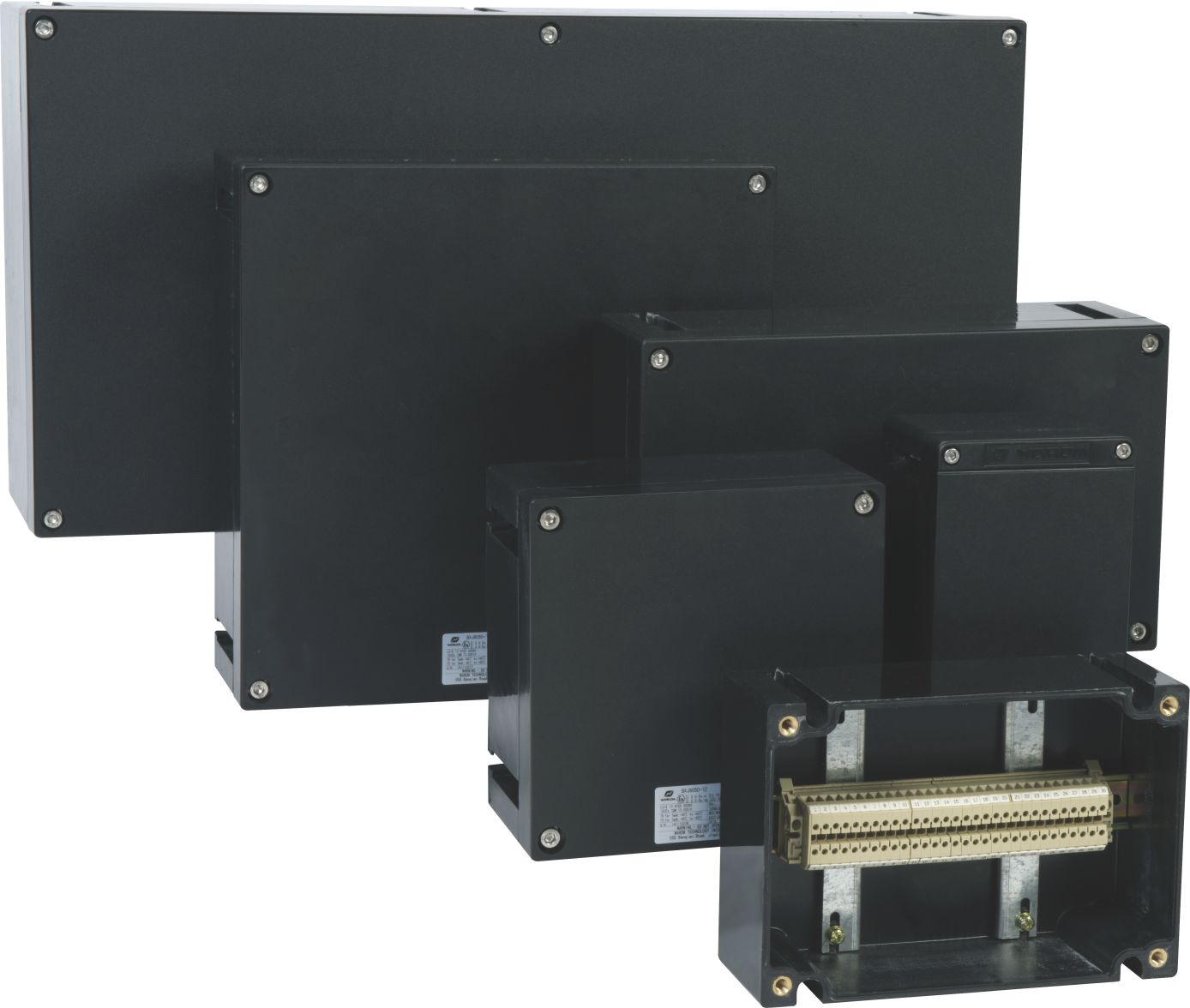
The biggest enemy of an explosion proof motor switch is pitting corrosion on the flame path surfaces. Once the precisely machined gap is damaged by rust or salt deposits, the explosion protection is lost and the switch must be replaced. For offshore cranes, I always specify 316L stainless steel (UNS S31603) for the enclosure. It resists chloride-induced pitting far better than 304 stainless or copper-free aluminum with powder coating. In our work on a North Sea platform where switch housings were exposed to salt spray 24 hours a day, the stainless steel units showed negligible corrosion after five years, whereas aluminum alloy housings with powder coating developed blistering and flame path oxidation within two years.
Copper-free aluminum is lighter and less expensive, and can be acceptable if the switch is inside a weatherproof control panel that is itself protected. However, on cranes, switches are often mounted directly on the structure near the motor, fully exposed to the weather. In those locations, the cost of a stainless steel enclosure is justified by the longer life. Some manufacturers offer marine-grade aluminum with a multi-layer epoxy coating and anodizing, but coating damage during installation creates a corrosion entry point. The safest approach is to use the material that is inherently corrosion-resistant.
Why Ex d Flameproof Protection Is the Default for Crane Motor Switches
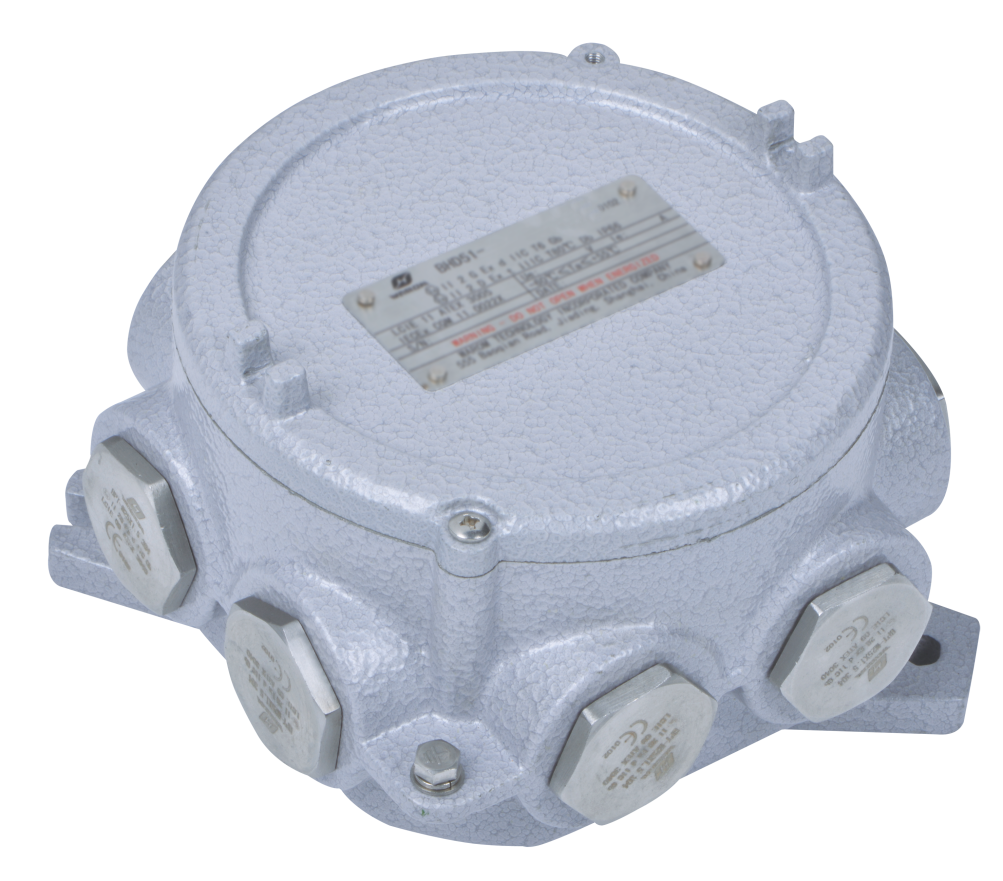
Motor disconnect switches for cranes must interrupt the motor current under load, either manually or via an undervoltage release, and therefore the switching contacts produce arcs. Ex d (flameproof) enclosures are designed to contain an internal explosion and prevent the flame from escaping through the flame path. Ex e (increased safety) enclosures, by contrast, assume no arcing or sparking components inside; they are suitable for terminal boxes and junction boxes but not for load-breaking switches.
For offshore cranes, the switching duty is severe: frequent starts, plugging, and emergency stops. The switch must also incorporate an early-make, late-break auxiliary contact for the control circuit interlock. Ex d construction can accommodate these mechanisms while maintaining the explosion protection. An Ex e enclosure would not be permitted for such arcing components.
Temperature class also affects the choice. If the crane operates in a gas environment where IIC gases are present, the Ex d switch must be certified for IIC and for the correct T class. Always check the maximum power dissipation inside the enclosure when the switch is under full load; the external surface temperature must remain within the T class limit. Some manufacturers provide a derating curve that shows the maximum allowable ambient temperature for a given load.
What If You Need a Compact Solution?
When space inside the crane machinery housing is tight, some projects use a combined Ex d motor protection switch with integral overload and short-circuit protection. This reduces the number of enclosures but increases the heat generation. For such installations, we have provided switches with a larger enclosure body to distribute heat and maintain the T4 rating even at 40 A continuous load. If you are evaluating this option, request the temperature rise test report.
When the crane operates in an IIC gas zone, the temperature class and the switch’s internal power dissipation become critical. If your load profile includes frequent motor starts or long durations at full load, it is worth requesting the manufacturer’s temperature rise test report before finalizing the bill of materials. For switches over 25 A, a thermal analysis that accounts for the enclosure size and ambient conditions will confirm the correct T class. For assistance in selecting the correct Ex d switch for your crane motor, email our team at gm*@***om.com with the motor rating and hazardous zone.
Cable Glands: The Critical Interface That Determines Switch Longevity
An explosion proof motor switch is only as good as its cable entry seal. I have seen more failures due to water ingress through poorly specified or incorrectly installed cable glands than from any other cause. The switch enclosure has two or three entry holes; each must be fitted with an Ex d or Ex e gland that is certified for the cable type (armoured, unarmoured, or braided) and the cable outer diameter. For offshore cranes, the gland must also resist saltwater corrosion, so brass or nickel-plated brass with a robust sealing ring is preferred. Warom’s DQM-II or DQM-III Ex d glands, for example, are available in nickel-plated brass and provide an IP66 seal when properly tightened.
The failure mechanism is simple: if the gland’s compression nut loosens under vibration, salt-laden moisture enters the enclosure through the cable interstices. The moisture condenses on the cold metal, initiating corrosion on the flame path surfaces. Once pitting becomes visible, the switch must be taken out of service. To prevent this, the gland should be specified with a vibration-proof locknut, and the installer must torque it to the manufacturer’s specification. For armoured cables, the inner bedding seal must compress the inner sheath tightly; any gap becomes a water path.
What to Specify When Ordering Motor Switches for an EPC Project
Based on my experience with EPC packages, a clear technical specification reduces cost and lead time. The following checklist covers the critical points:
| Specification Item | Recommendation for Offshore Crane |
|---|---|
| Hazardous area classification | Zone 1, IIB/IIC, T4 or T5 |
| Enclosure material | 316L stainless steel |
| Protection type | Ex d flameproof, IP66 |
| Cable entries | M25 x 1.5 or NPT, with nickel-plated brass Ex d gland |
| Electrical rating | Motor FLC plus service factor, 690 V AC max |
| Auxiliary contacts | 1 NO + 1 NC early-make for control interlock |
| Earthing terminal | Internal M6 and external M8 stainless steel studs |
| Operating mechanism | Rotary handle with padlockable OFF position and a guard against accidental operation |
When ordering multiple switches, ask for a factory acceptance test (FAT) procedure that includes a continuity check, a flame path gap measurement, and an IP66 pressure test. If the project requires classification society type approval, submit the manufacturer’s existing marine type-approval certificates or arrange for a surveyor to witness the FAT.
A common gap we see in EPC specifications is the absence of any requirement for tropicalization or salt spray testing. Adding a 500-hour neutral salt spray test (ISO 9227) to the coating specification eliminates switches that will fail early. The incremental cost is small, but the protection is significant.
Specifying Switches That Last
When switches fail on an offshore crane, the cost is not just the replacement component—it is crane downtime, lost production, and a difficult replacement operation in a hazardous area. In every project we support, the switches that survive the longest are those where the engineering team treated the enclosure material, the cable gland, and the flame path protection as the primary specification drivers, not afterthoughts. If you are specifying explosion proof motor switches for a new crane or a retrofit, start with 316L stainless steel, Ex d protection, and a nickel-plated brass gland with locknut. Then verify the certification with the classification society and include a corrosion test in your purchase order.
For technical support or to confirm the correct switch for your crane’s motor rating and zone, send your motor nameplate and a one-line diagram to gm*@***om.com or call +86 21 39977076. Our engineering team can provide a specification review and advise on the required certifications.
Common Questions About Explosion Proof Motor Switches for Offshore Cranes
Does an offshore crane motor switch need to be Ex d or can I use an Ex e switch inside a pressurized panel?
If the switch makes or breaks the motor load current, it must be Ex d because the contacts arc. An Ex e enclosure may only contain non-arcing components. Even if the switch is inside a pressurized panel, the switch itself must still be certified as a component suitable for an Ex p system. I have seen projects try to use a standard industrial switch inside a pressurized enclosure, but the panel certification is complex and usually more expensive than simply using an Ex d switch. Stick with Ex d for the switch.
How often should explosion proof motor switches be inspected on offshore cranes?
At a minimum, during every planned maintenance interval (typically annually). The inspection should check for corrosion on the flame path, tightness of all bolts and gland entries, and smooth operation of the handle. The flame path gap should be measured with feeler gauges and compared to the value in the manufacturer’s manual. If any pitting is found, the switch should be replaced; flame paths cannot be repaired.
Can I use aluminum enclosures if I apply a thick marine coating?
In my experience, even the best coatings eventually crack at sharp edges or around bolts on a vibrating crane, letting salt in. For a switch that will be exposed for the 20-year life of the platform, the incremental cost of stainless steel is trivial compared to the replacement cost and downtime. I reserve aluminum for switches that will be housed inside a weatherproof, vibration-damped cabinet.
What is the most common mistake in specifying crane motor switches?
Underestimating the cable gland. Engineers focus on the switch’s rating and enclosure but neglect to specify a vibration-resistant gland with locknut. In one project, a crane operator reported nuisance tripping of the motor protection; investigation revealed water in the switch enclosure from a gland that had loosened by only a quarter-turn. Always match the gland to the cable type and specify a locknut.
Does Warom supply motor switches with ABS or DNV type approval?
We do. Our explosion proof switch designs can be certified to the applicable marine class rules, and we have supplied switches for offshore platforms and vessels with ABS, DNV, and CCS approval. If your project requires a specific type-approval certificate, share your requirements with our team at gm*@***om.com. We can advise on the documentation package and lead time for classification society endorsement.
If you’re interested, check out these related articles:
Forge Ahead with Vigorous Spirit • Warom Starts the New Year with Grand Prosperity
Hannover Messe 2024
Explosion Proof AC for 50°C: Extreme Heat Solutions
With over a decade of experience, he is a seasoned Explosion-Proof Electrical Engineer specializing in the design and manufacture of safety and explosion-proof products. He possesses in-depth expertise across key areas including explosion-proof systems, nuclear power lighting, marine safety, fire protection, and intelligent control systems. At Warom Technology Incorporated Company, he holds dual leadership roles as Deputy Chief Engineer for International Business and Head of the International R&D Department, where he oversees R&D initiatives and ensures the precise delivery of design documentation for international projects. Committed to advancing global industrial safety, he focuses on translating complex technologies into practical solutions, helping clients implement safer, smarter, and more reliable control systems worldwide.
Qi Lingyi