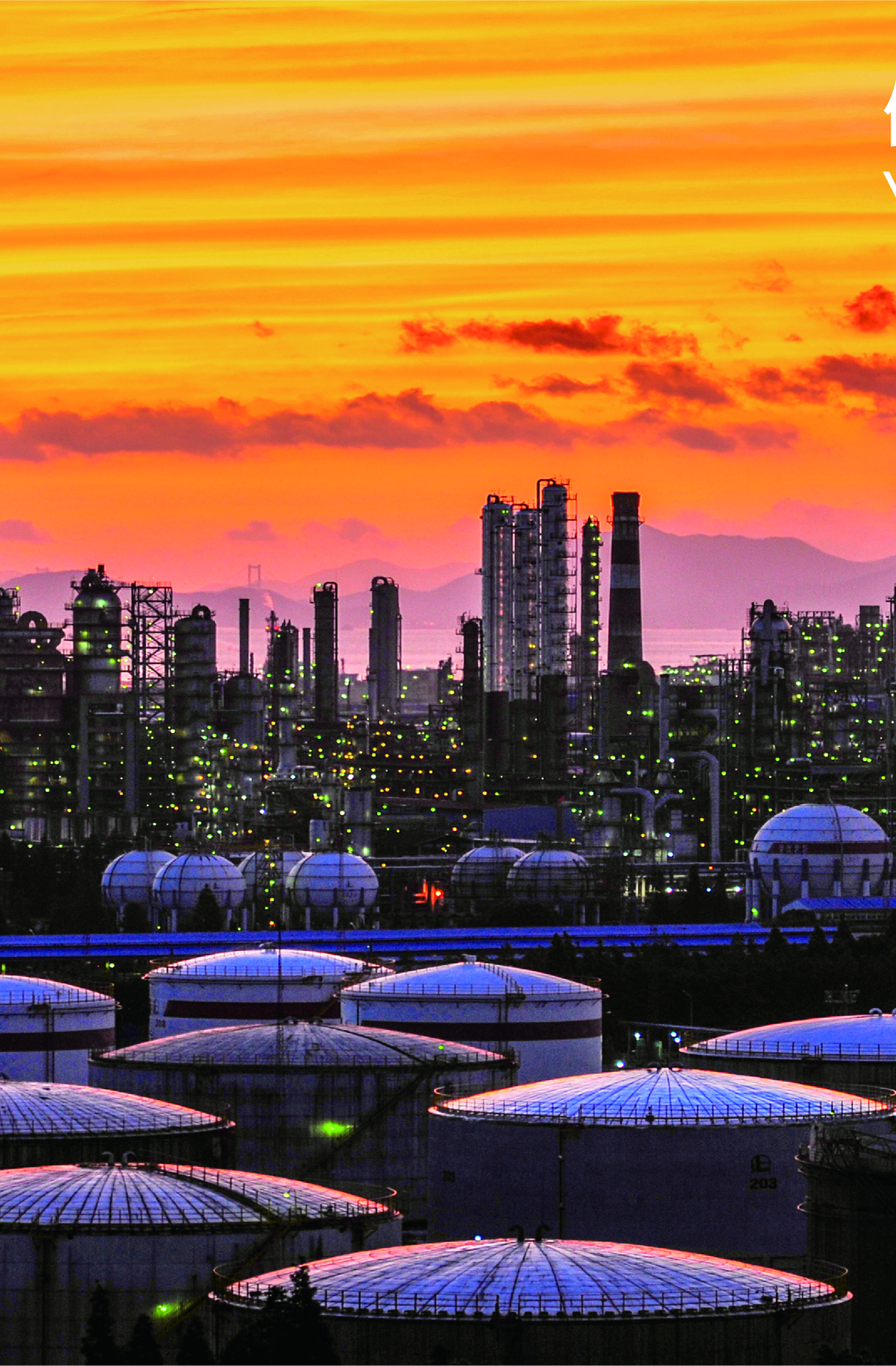
Weatherproof electrical products for desalination plant outdoor areas are usually bought on a single line in the specification: IP66, outdoor use, corrosion resistant. That line survives the tender and fails on site. A seawater reverse osmosis plant puts outdoor equipment through chloride-laden aerosol, near-saturated humidity, strong UV, a daily thermal cycle, and chemical splash from pretreatment and membrane cleaning, often at the same enclosure. The IP rating answers only one of those conditions, and it answers it for the day of the test rather than the year of the failure.
Why Coastal Desalination Sites Are Hard on Outdoor Electrical Equipment
Seawater itself is not the main problem. The problem is what it leaves behind after the spray has dried. Airborne chloride settles on every horizontal surface, and once relative humidity rises, those deposits absorb moisture and keep the surface wet long after the rain has stopped. That wet chloride film is an electrolyte sitting on metal, and it does more damage in a month than clean rainwater does in a year.
Three mechanisms follow from it. On painted aluminium and galvanised steel, a scratch or a chipped edge exposes bare metal, and the small exposed area becomes the anode against a large coated cathode, so the attack concentrates and pits quickly. On stainless steel, salt deposits and gasket lands create crevices where oxygen cannot reach the surface, and pitting begins where the metal cannot re-passivate. Inside the enclosure, the daily temperature cycle pulls moist air in through cable entries and gland plates as the internal air cools and contracts, and that moisture condenses on the coolest surface, which is usually the busbar or the terminal block.
UV and heat run alongside the chloride attack. Solar UV breaks down the polymer chain in gaskets and polycarbonate diffusers; a gasket that has lost its elasticity takes a compression set and stops sealing. Where the design ambient is high, the internal enclosure temperature runs higher still, and that internal number, not the shade air temperature, is what ages both the gasket and the electronics.
The practical consequence is that the environment has to be classified before the products are chosen. ISO 12944-2 sets out atmospheric corrosivity categories from C1 to CX, and coastal and marine sites with high salinity typically fall in the upper categories [1]. ISO 9223 provides a parallel method for classifying atmospheric corrosivity from measured deposition and time-of-wetness data [2]. Take the classification from the plant coating and civil specification, or from a site measurement where the plant is already operating, write it into the electrical specification, and require the supplier to state which category the enclosure finish is intended for.
Weatherproof, Watertight or Explosion Proof and Where Each Applies
Three terms get used interchangeably in tender documents and they mean different things. Weatherproof describes resistance to weather, and the only verifiable form of that claim is an IP rating tested to IEC 60529 [3] combined with a corrosion performance statement, because the IP test says nothing about salt. Watertight describes resistance to immersion, which is IP67 or IP68. Explosion proof describes a protection concept that stops an internal ignition from propagating into a surrounding flammable atmosphere, and it is proven by certification to the IEC 60079 series [4] rather than by an IP number.
Most desalination plant outdoor areas are unclassified: the reverse osmosis trains, the pipe racks, the lighting poles, the administration yards and the workshop areas. Weatherproof equipment with the right corrosion class is the correct and economical answer there. Classified locations do exist on some sites, typically around electrochlorination where hydrogen can be generated, around chlorine and acid storage, and inside some chemical dosing rooms. The plant hazardous area study decides this, not the electrical contractor and not the supplier. Where a room is classified, the equipment marking must carry the zone, gas group and temperature class, and a weatherproof-only product cannot be substituted however good its IP rating is.
Weatherproofing and explosion protection answer separate questions, and a product can hold one without the other. <Intrinsically Safe vs Explosion Proof: Real-World Applications Guide> covers how intrinsic safety and explosion proof protection differ in real applications, which helps when a dosing room is classified but the adjacent outdoor area is not.
The reverse error is just as common. Specifying explosion proof equipment for every outdoor position adds cost, weight and lead time and buys nothing where no flammable atmosphere exists. Map each location to its classification first, then apply the weatherproof requirements to the unclassified ones and both sets of requirements to the classified ones.
Choosing Between IP66, IP67, IP68 and IP69K
An IP rating is two digits. The first covers solids and the second covers water. For outdoor desalination duty the first digit is normally 6, meaning dust-tight, so the argument is almost always about the second digit. These are not steps on a single ladder. Each test applies a different kind of water, and a product that passes one is not automatically better than a product that passes another.
| Rating | What the test applies | Where it fits on a desalination site | What it does not tell you |
|---|---|---|---|
| IP65 | Water jets from a 6.3 mm nozzle at low pressure | Sheltered positions under roofs and canopies | Resistance to wind-driven rain on an exposed elevation |
| IP66 | Powerful jets from a 12.5 mm nozzle | Default for outdoor enclosures, poles and junction boxes | Anything about salt, UV or gasket life |
| IP67 | Temporary immersion, 1 m for 30 minutes | Sumps, pits and cable chambers that can fill with water | Suitability for permanent submersion |
| IP68 | Continuous immersion at a depth and time agreed between buyer and supplier | Permanently wet chambers and submersible connections | A fixed protection level, because the level is whatever was agreed |
| IP69K | High pressure, high temperature jet cleaning | Membrane skids and filter galleries cleaned by jet | General weather protection beyond the jet test conditions |
Two details catch buyers. First, IPX8 is not a fixed level. The standard requires the depth and duration to be agreed between manufacturer and buyer, so an IP68 claim without those conditions in writing says very little. Second, IPX9K is not a stronger version of IPX6 for general weather. It targets high-pressure, high-temperature cleaning jets, which is exactly what happens on membrane skids and filter galleries during cleaning in place.
The workable split inside a desalination plant is IP66 as the baseline for outdoor enclosures, IP67 for anything set in a sump or pit that can fill, and IP69K only where the maintenance procedure genuinely uses a high-pressure jet. Writing IP69K everywhere looks cautious and creates a cost and availability problem without adding protection where no jet is used.
Whatever the rating, remember what was tested: a new sample, fresh water, laboratory conditions. The test does not measure gasket aging under UV, movement under thermal cycling, or chloride attack on the enclosure body and fasteners. Those belong to the corrosion specification, not to the IP number.
Selecting Enclosure Materials for Chloride Exposure
Material choice decides how the enclosure ages, and it is the point where both the cheapest and the most expensive option can be wrong. The comparison has to be made against the site corrosivity category and the chemical list at that specific location, not against a general reputation for being marine grade.
| Material | Where it performs | Where it fails | Specify it when |
|---|---|---|---|
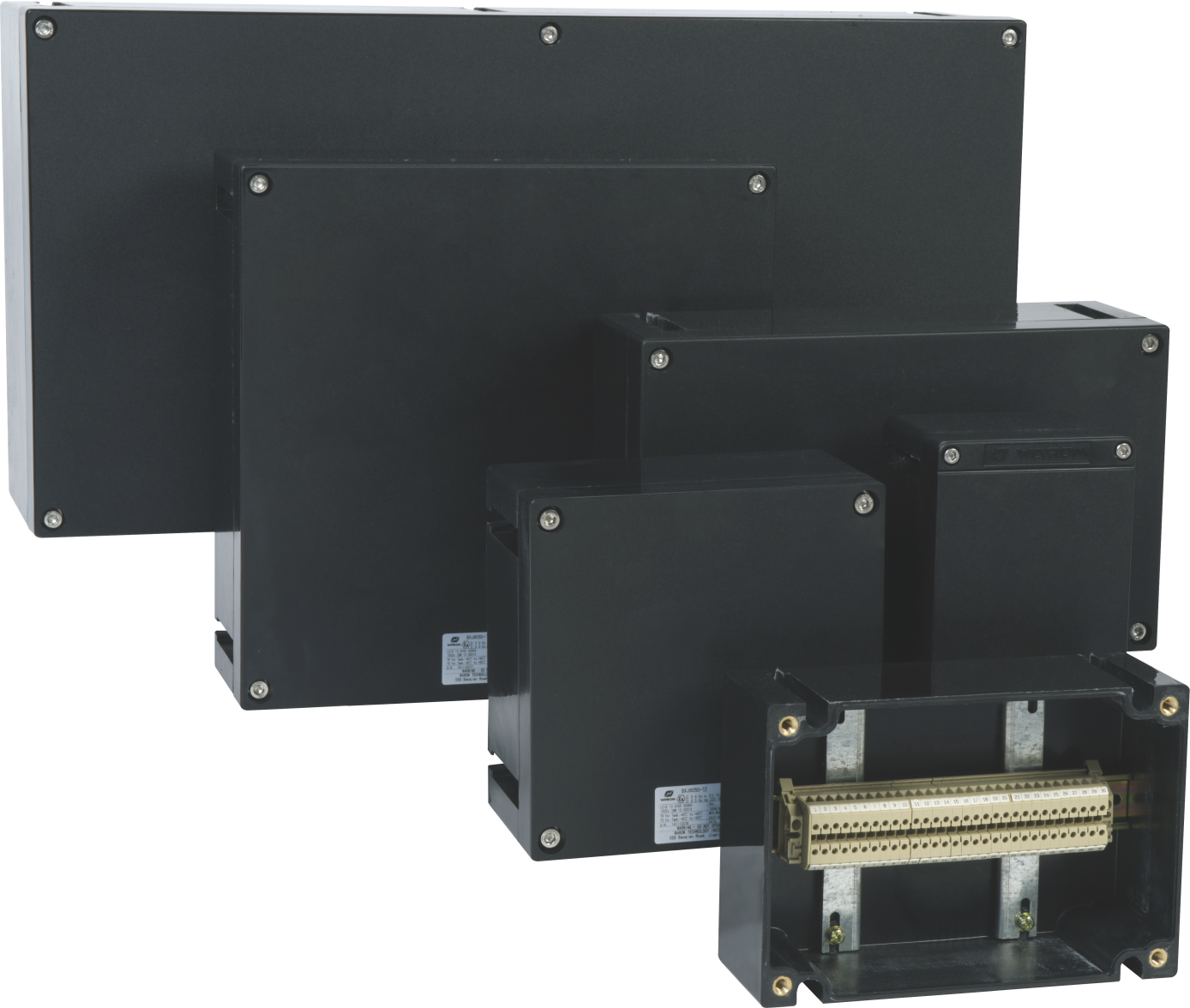
| GRP, glass fibre reinforced polyester | Salt spray, no galvanic couple with stainless fasteners, electrically insulating | UV without a protective surface veil, some solvents, lower impact strength | Enclosures, terminal boxes and boards on exposed structures |
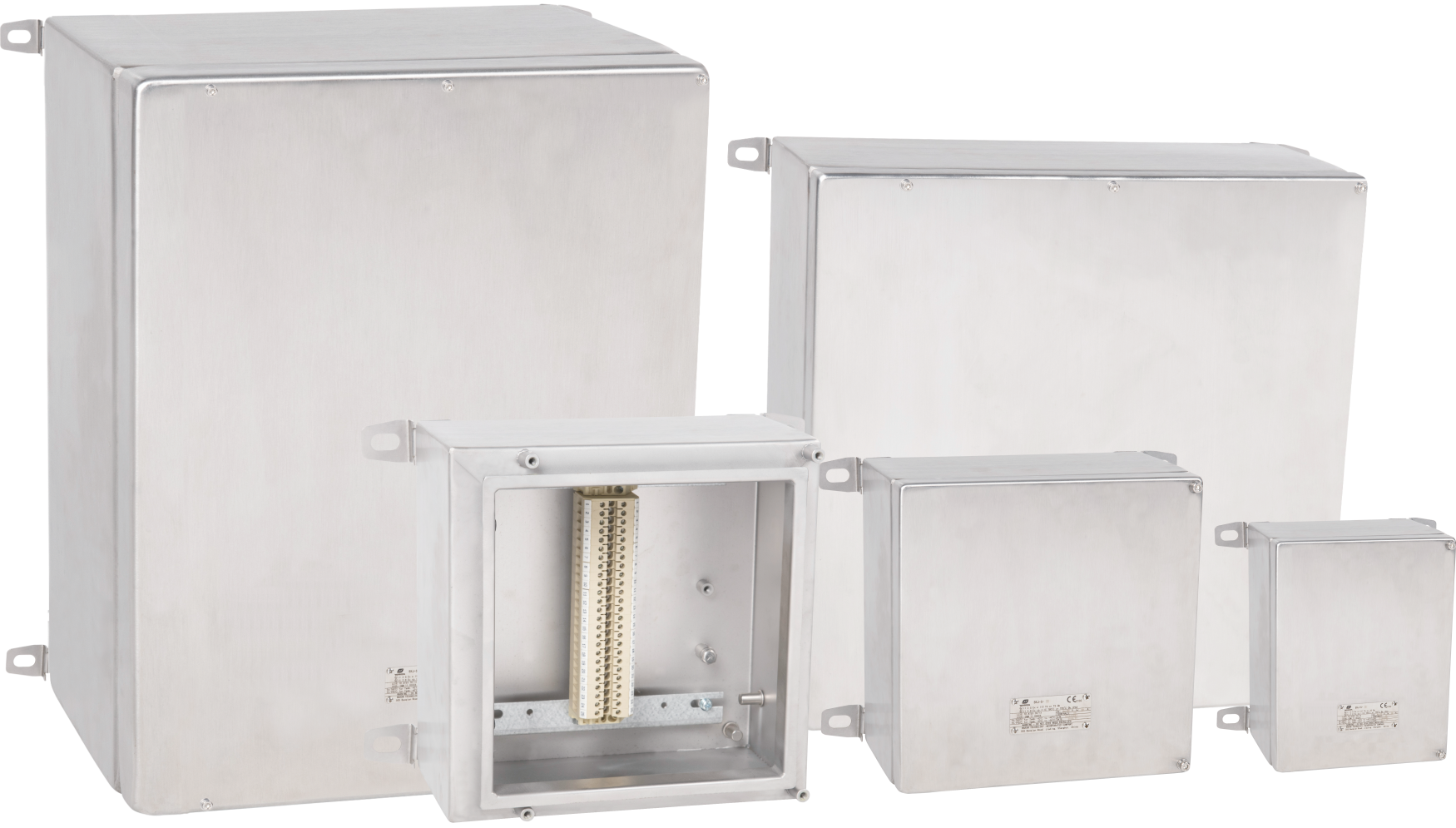
| 316L stainless steel | Impact resistance, cleanability, hot washdown areas | Crevice pitting under salt deposits, weld zones without passivation, stress corrosion cracking as chloride and temperature rise | Washdown areas and where mechanical damage is likely |
| Copper-free aluminium, powder coated | Light weight, good heat transfer, cost | Coating damage at scratches and cut edges, concentrated attack at the damaged point | Luminaires and larger enclosures with a coating system matched to the category |
| Polycarbonate | Impact resistance, visibility of internal indicators | UV yellowing without a stabilised grade, crazing under some cleaning chemicals | Windows, diffusers and small instrument housings |
| Galvanised steel | Cost and availability in standard sizes | Zinc consumption in chloride exposure, red rust at cut edges | Sheltered or temporary positions, not exposed coastal structures |
Austenitic stainless steel is the material most buyers reach for first, and it is a reasonable choice in many positions, but it is not a guarantee. Salt deposits create crevices where oxygen cannot reach the surface, and that is where pitting starts. Welded areas are more susceptible unless they are cleaned and passivated after welding. Temperature matters alongside chloride concentration: as both rise, the risk of stress corrosion cracking in the 300 series increases, which is why a hot, salt-deposited location is the worst place to rely on it by default.
Glass fibre reinforced polyester behaves differently. It has no galvanic couple with stainless fasteners, it does not corrode in the electrochemical sense, and it is a strong choice for salt exposure. Its weaknesses lie elsewhere: UV without a protective surface veil or coating, attack from some solvents, and lower impact strength and thermal conductivity than metal. That last point matters for luminaires, where the enclosure also has to move heat away from the driver.
Copper-free aluminium with a powder coat is light and thermally effective, and the copper-free alloy avoids the galvanic acceleration that copper-bearing alloys bring to a wet chloride environment. Its vulnerability sits at the coating. A scratch, a damaged gasket land or a cut edge creates a small anode against a large coated cathode, and the attack concentrates there. Tie the coating system to the corrosivity category, require a stated dry film thickness and a touch-up procedure, and inspect the coating at goods receipt rather than after installation.
Cable Glands and Condensation Control Where Most Installations Leak
A sealed enclosure fitted with the wrong gland is an open enclosure. Water rarely enters through the moulded body. It enters along the cable, through the gap between cable sheath and gland seal, or through a gland thread that was never sealed against the enclosure wall.
The recurring mistakes are predictable. An unarmoured gland on armoured cable leaves a path along the armour. A metric gland forced into an NPT entry damages both the thread and the seal. A gland tightened without its sealing washer, or overtightened until the seal deforms, passes the delivery inspection and fails in service. Cables entered from above collect water that runs down to the gland instead of away from it. Unused entries closed with tape or a plastic cap void the enclosure rating entirely.
The checks that prevent this are simple and belong in the installation method statement. Confirm the gland part number against the cable schedule, including cable type, outer diameter and armour. Confirm the thread standard matches the enclosure entry. Enter from below wherever the layout allows, with a drip loop so water runs off before it reaches the gland. Close every unused entry with a blanking plug rated to the same IP and temperature as the enclosure. Where stainless glands are fitted into aluminium enclosures, use an anti-seize compound to prevent galling and galvanic corrosion. Where several cables share one enclosure, use a machined gland plate sized from the cable schedule instead of drilling in the field, because field drilling is where the rating is usually lost.
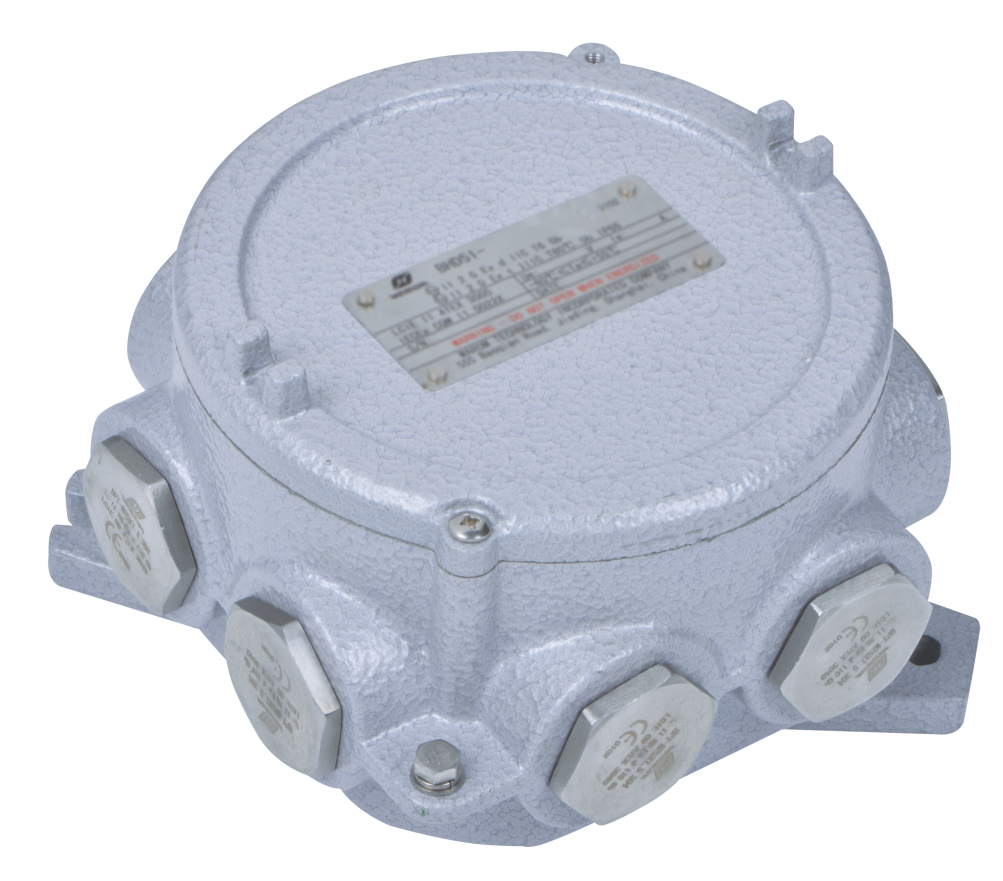
Condensation is the other path, and it does not need a leak. An enclosure sealed on all sides still breathes as internal air expands and contracts, and moisture arrives through imperfect seals and along the cable cores themselves. Two remedies are common: a pressure compensation or breather element that equalises pressure without admitting liquid water, and a small anti-condensation heater that keeps internal surfaces above the dew point. They solve different problems. Fitting a heater without a thermostat in a hot climate can push the internal temperature beyond what the components allow, so specify the control logic, not just the heater.
Specifying Outdoor Luminaires for High Ambient Temperatures
Outdoor lighting is where the ambient requirement is most often written incorrectly. A datasheet may quote a maximum ambient for the LED module while the driver, sitting in the same enclosure, has a lower limit or a shorter life at that same temperature. The number that governs the installation is the ambient rating of the complete luminaire including its driver, and it should be stated with a derating curve rather than as a single figure.
Specify the site shade air temperature plus the solar gain on the mounting surface. A pole-mounted floodlight facing west through the afternoon is not at shade air temperature. Where the design ambient is already high, the driver compartment is normally the limiting factor, and a luminaire rated below that ambient will either reduce output or lose service life.
The remaining choices are optical and mechanical. Colour temperature and colour rendering matter for night maintenance and security work, and roughly 5000 K with a colour rendering index of 70 or above is a common industrial compromise. The diffuser material decides how the luminaire ages under UV and chemical splash: toughened glass holds its transmission and resists most cleaning chemicals, while polycarbonate is lighter and more impact resistant but needs a UV-stabilised grade and can craze under some solvents. The impact rating matters anywhere mobile plant works near lighting poles.
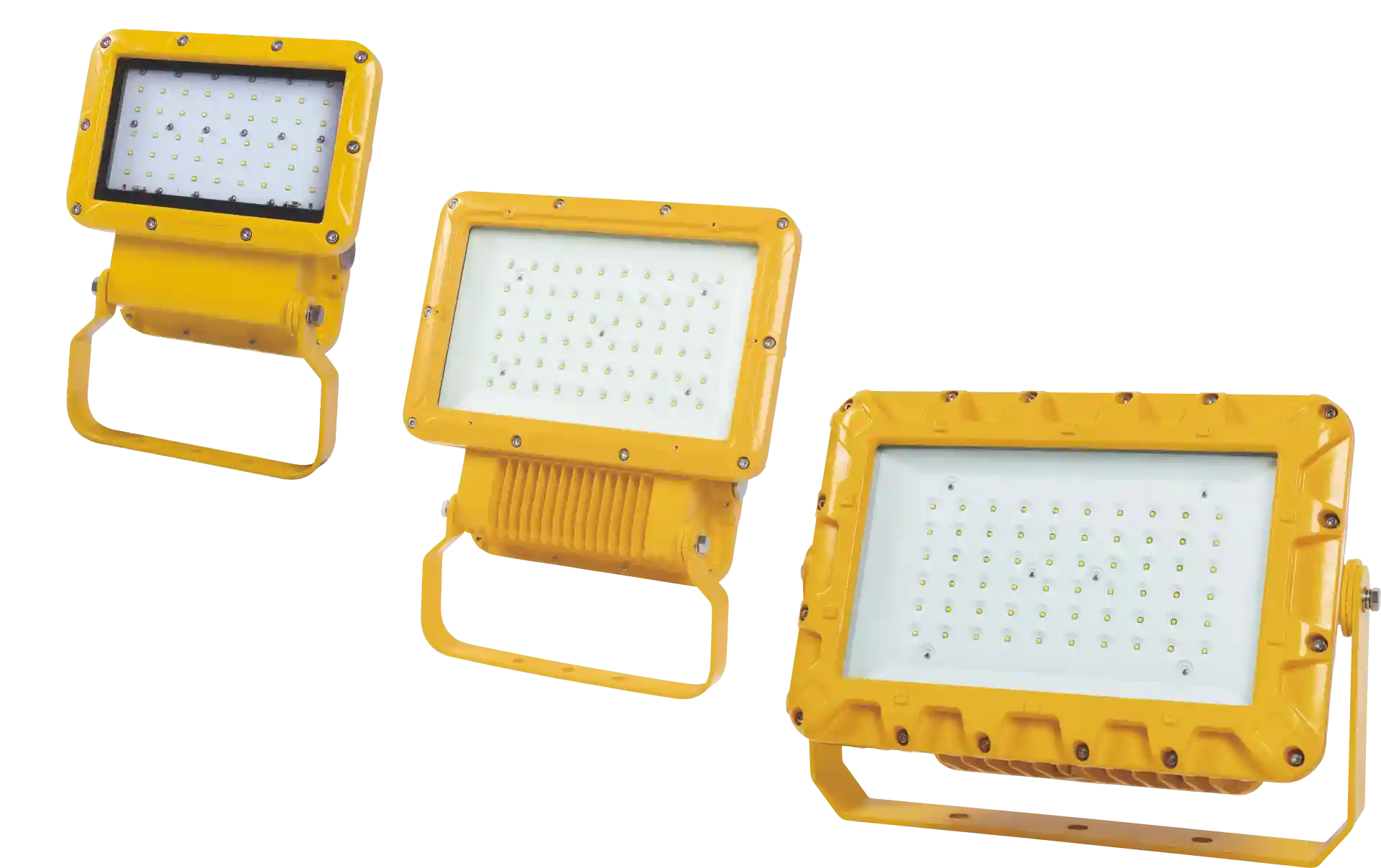
A representative weatherproof and explosion proof floodlight specification for this duty reads: IP66, corrosion resistance class WF2, ambient range from -60 °C to +40 °C or +60 °C depending on variant, 5000 K ±250 K, colour rendering index of 70 or above, wide voltage input with a constant current constant voltage driver, overload and end-of-life protection, and bracket, pole or street light mounting. Those are the fields that belong in the luminaire schedule. A model number alone does not carry them.
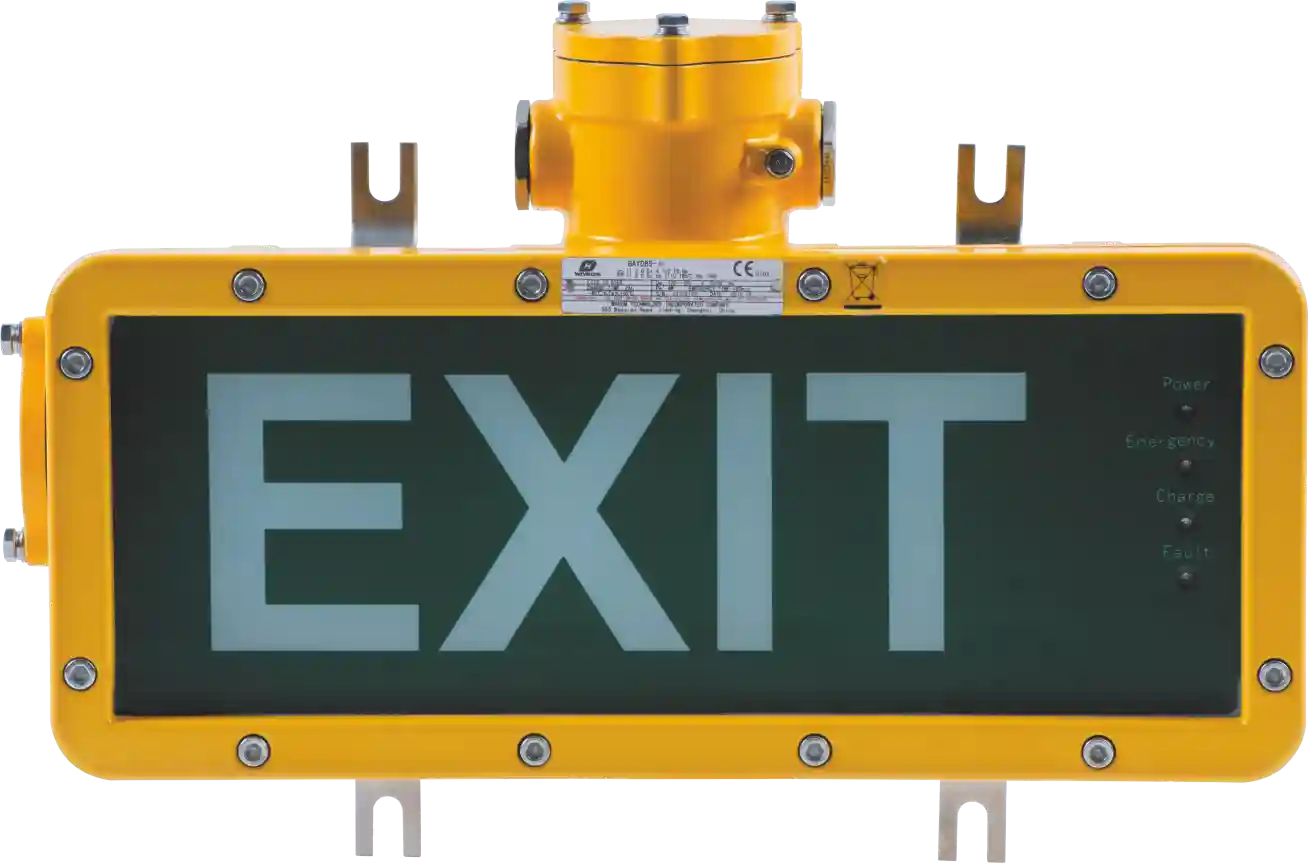
Egress lighting needs its own line in the schedule. An emergency exit luminaire has to hold a stated duration on battery, be testable from a point the maintenance team can reach, and carry the same IP and corrosion requirements as the general lighting. Battery packs are temperature sensitive, so a unit mounted where the ambient is highest will deliver less usable duration than the catalogue figure unless the derating is stated.
Maintenance access belongs in the same decision. On remote sites the cost of changing a lamp is dominated by access, not by the luminaire, which pushes the specification toward fewer, more accessible fittings and longer service intervals. On the Tilenga project in Uganda, WAROM supplied explosion-proof lighting and electrical systems across wellpads, a central processing facility and pipelines, where reliability under extreme conditions and limited maintenance access were the governing requirements rather than first cost.
What to Put in the RFQ and What to Inspect Before Shipment
A vague request produces a vague quote, and the gap is usually discovered during installation. The RFQ should carry the conditions that actually change the product.
| RFQ field | What to state | Why it changes the answer |
|---|---|---|
| Location and classification | Each area with its zone, gas group and temperature class, or marked unclassified | Decides whether an Ex certificate is needed at all |
| Corrosivity and chemicals | ISO 12944-2 category plus chlorine, hypochlorite, acid and caustic exposure | Drives material and coating choice, not just colour |
| IP rating by location | Stated per area together with the cleaning method used there | Prevents IP69K being priced into locations that are never jetted |
| Ambient and solar condition | Maximum shade air temperature plus mounting exposure | Sets the driver and gasket rating for luminaires and enclosures |
| Cable schedule and entries | Cable type, outer diameter, armour, gland thread, number of entries | Determines gland size and whether a machined gland plate is required |
| Documentation and tests | Type test reports, routine test records, material certificates, marking photographs | Makes acceptance checkable before shipment rather than after installation |
The second half of the specification is the evidence. Every document a supplier sends proves something specific, and buyers get into trouble when they read a document as covering more than it does.
| Record | Test context | What it supports | Do not infer |
|---|---|---|---|
| IP66 type test report | New sample, fresh water jet, laboratory conditions | The enclosure design passed the jet test at the time of testing | That the seal will still hold after years of UV and thermal cycling |
| IP68 declaration | Depth and duration agreed by the manufacturer | Performance at the declared depth and time | That IP68 is better than IP66 against rain and spray |
| ISO 12944-2 category | Classification of the atmospheric environment | The coating system and dry film thickness to require | That a specific product is suitable, because its own coating still has to be checked |
| WF2 corrosion claim | The manufacturer’s own declared test regime | A stated corrosion performance for the enclosure finish | That it matches a project C5 system or was tested under the same regime |
| Salt spray hours to IEC 60068-2-52 or ASTM B117 | Salt fog on test panels, continuous or cyclic | A comparative screening result between finishes | A service life in years, because coastal wet and dry cycling differs from constant fog [5] |
| Explosion protection certificate | Assessment of ignition protection for a defined zone, gas group and temperature class | Use in the classified area within the marking | Weatherproofing, corrosion performance or suitability for a washdown area |
Where the item is an assembly rather than a single enclosure, such as a weatherproof distribution board or a control panel, IEC 61439-1 applies in addition to the enclosure rating, and its verification requirements follow from that standard [6].
Before shipment, ask for the routine test record for each unit, a photograph of the nameplate and marking, confirmation that gland sizes match the cable schedule, and the packing method for sea freight. On a large order, witness the factory acceptance test: functional operation of every circuit, insulation resistance, marking check against the hazardous area drawing where applicable, and enclosure verification if the supplier offers it.
What to Send for a Site-Specific Selection
Send the corrosivity category for each outdoor area, the maximum ambient and solar exposure, the cleaning method used at each location, the enclosure schedule with circuit counts, the cable schedule with types and gland sizes, and the hazardous area drawing for any classified room. WAROM reviews that information against its weatherproof and explosion proof ranges and returns a documented selection showing the IP rating, enclosure material, cable entry arrangement and test documents for each line of the schedule, so the comparison happens before the purchase order rather than during installation.
Email gm*@***om.com or call +86 21 39977076 or +86 21 39972657 with the schedule attached.
FAQ
Is IP66 enough for a desalination plant?
For most outdoor enclosure positions away from direct jet washing, IP66 is the practical minimum and sufficient for water ingress, provided the enclosure also carries a corrosion system suited to the site and every cable entry is properly sealed. It is not sufficient in sumps, pits that can flood, or on equipment washed with high-pressure jets, where IP67 or IP69K applies instead. IP66 also says nothing about chloride attack, so pair it with a stated corrosivity category and an enclosure material chosen for that category.
Does 316 stainless steel solve corrosion on a coastal site?
It reduces the problem but does not remove it. Under salt deposits and inside crevices, 316L can still pit, and welded zones are more vulnerable unless they are cleaned and passivated after welding. Temperature matters alongside chloride concentration, because the risk of stress corrosion cracking in the 300 series rises as both increase. Use 316L where impact resistance and cleanability genuinely matter, and check the chloride and temperature combination before treating it as the default safe choice.
Do outdoor products at a desalination plant need explosion proof certification?
Only where the plant hazardous area study has classified the location. Most outdoor pipe racks, membrane trains and yards are unclassified, and weatherproof equipment is correct there. Electrochlorination rooms, chlorine and acid storage, and some dosing areas can be classified, and those locations need equipment certified for the zone, gas group and temperature class shown on the drawing. Buying Ex-rated equipment for every outdoor position adds cost and lead time without adding protection.
How often should gaskets, glands and breathers be inspected?
Set the interval from the corrosivity category and from what the first year of inspections actually shows, rather than from a fixed calendar. A workable starting point is a visual check of enclosure seals, gland torque marks, cable entry condition and breather elements at each scheduled shutdown during the first year, then extend the interval if the records show the seals holding. Replace gaskets by condition, but keep a spare set on site, because a hardened gasket cannot be reconditioned.
What ambient temperature should I state for outdoor luminaires?
State the maximum shade air temperature at the site plus the solar gain expected on the mounting surface, and require the complete luminaire, driver included, to be rated for that ambient. Many datasheets quote a module limit that the driver cannot hold. Ask for the derating curve and the driver case temperature reference point, and check that the emergency lighting battery packs are rated for the same condition, since their usable duration falls as ambient rises.
If you’re interested, check out these related articles:
Warom Technology Awarded CMMI International Certification for Software Capability Maturity
Warom Technology “International explosion-proof technology Vietnam special Forum” was successfully held
Warom Held The 2024 Outstanding Employee Commendation Conference
Explosion-Proof CCTV for Zone 1: Hazardous Area Surveillance
With over a decade of experience, he is a seasoned Explosion-Proof Electrical Engineer specializing in the design and manufacture of safety and explosion-proof products. He possesses in-depth expertise across key areas including explosion-proof systems, nuclear power lighting, marine safety, fire protection, and intelligent control systems. At Warom Technology Incorporated Company, he holds dual leadership roles as Deputy Chief Engineer for International Business and Head of the International R&D Department, where he oversees R&D initiatives and ensures the precise delivery of design documentation for international projects. Committed to advancing global industrial safety, he focuses on translating complex technologies into practical solutions, helping clients implement safer, smarter, and more reliable control systems worldwide.
Qi Lingyi