
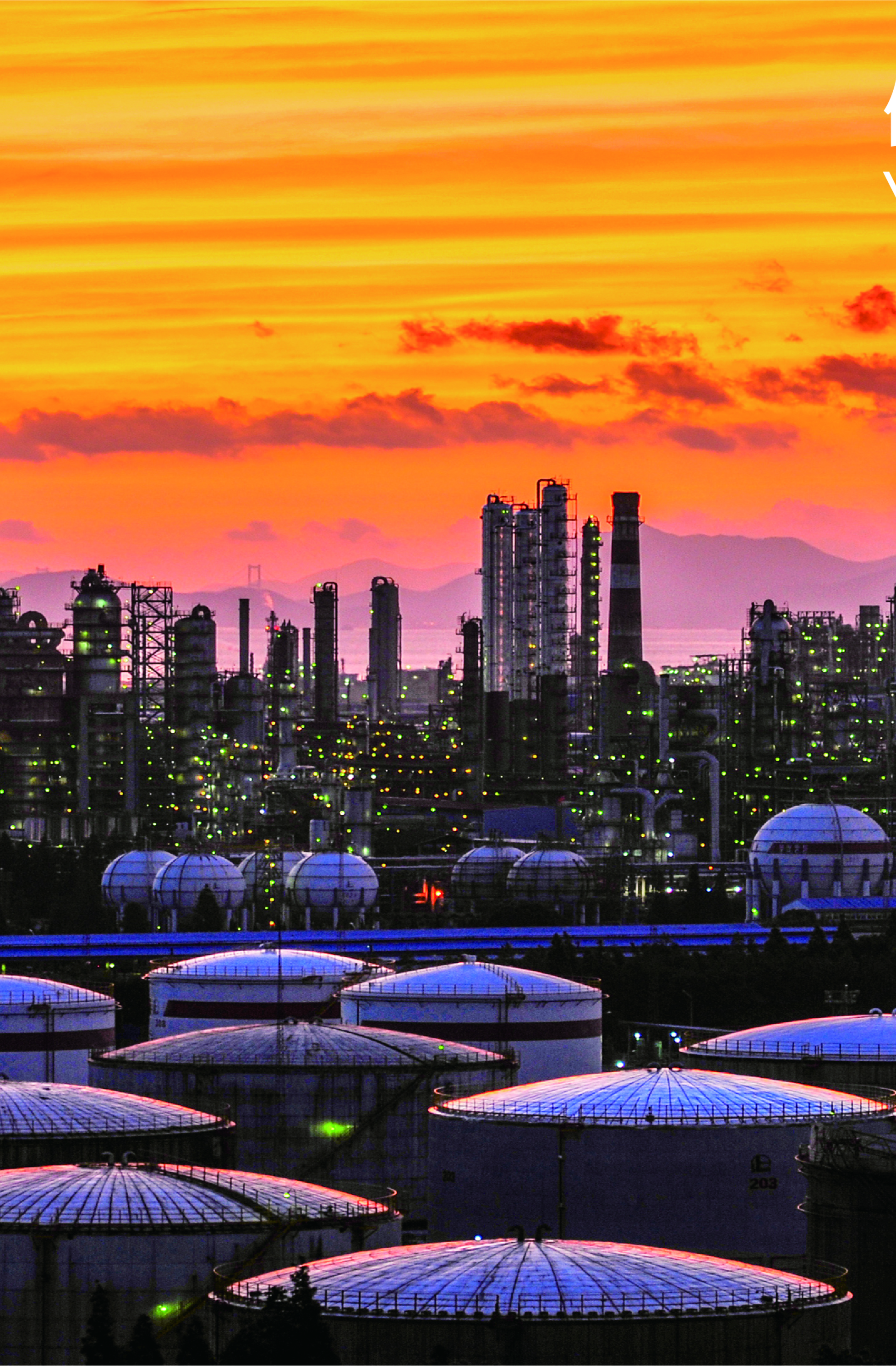
When specifying explosion proof electrical equipment for pharmaceutical production, off-the-shelf catalogs rarely address the full picture. A pharmaceutical facility combines flammable solvent atmospheres with combustible dust from API processing, often within the same building, while GMP requirements demand surface finishes and enclosure designs that standard industrial equipment cannot meet. After thirty years of engineering explosion-proof systems across industries, I have found that pharmaceutical projects succeed or fail on three factors: accurate zone classification that accounts for both gas and dust hazards, equipment protection methods matched to cleaning and sterilization protocols, and early coordination between the owner, design institute, and manufacturer. This article covers the specification decisions that determine whether a pharmaceutical electrical installation operates safely for decades or creates compliance gaps from day one.
How Hazardous Areas Are Classified in Pharmaceutical Production
Pharmaceutical plants present a zone classification challenge that simpler chemical facilities do not. In a single building, you may have solvent-based synthesis creating Zone 1 or Zone 2 gas atmospheres while adjacent granulation and tablet compression suites generate combustible dust requiring Zone 21 or Zone 22 classification. The two hazard types demand different equipment protection philosophies, and the boundary between them is where most specification errors occur.
The solvents most commonly encountered in API production include acetone, methanol, isopropanol, ethyl acetate, and toluene. These are all Group IIA or IIB substances with auto-ignition temperatures that determine the equipment temperature class. A reactor room handling toluene, for example, typically requires Zone 1 classification with T3 temperature class equipment, meaning no exposed surface may exceed 200 degrees Celsius under any operating condition. But the same building may house a dryer and milling suite where combustible dust from the finished API creates a Zone 21 area. Equipment serving that space must be rated for dust ignition protection, not just gas.
I have seen projects where the hazardous area drawing showed the entire production hall as a single zone, ignoring the fact that solvent exposure drops off significantly once you move beyond the reactor mezzanine into the downstream processing corridor. Over-classifying inflates equipment costs without improving safety. Under-classifying can render an installation noncompliant from the moment the authority having jurisdiction reviews the documentation. For pharmaceutical projects, I recommend a room-by-room assessment performed jointly by the process engineer, the safety consultant, and the electrical equipment manufacturer. Each party catches what the others miss.
Standards and Certifications That Pharmaceutical Projects Require
Pharmaceutical production facilities operating internationally typically specify equipment certified to both ATEX Directive 2014/34/EU and the IECEx Scheme. The ATEX marking confirms conformity with European requirements, while IECEx provides a globally recognized certificate that simplifies acceptance in regions that do not maintain their own certification infrastructure. For projects within China, CNEX certification applies, and equipment must carry valid CNEX certificates that match the declared protection method and gas group.
What distinguishes pharmaceutical projects from general chemical plant specifications is the intersection of explosion protection with GMP compliance. Enclosure surface finishes must be smooth, non-shedding, and resistant to repeated wipe-down with cleaning agents that may themselves be solvent-based. A standard cast aluminum flameproof enclosure may meet ATEX requirements yet fail a pharmaceutical quality audit because the flange gap collects powder residue that cannot be adequately cleaned. Stainless steel enclosures, while more expensive, eliminate this conflict. The same logic applies to cable glands: nickel-plated brass or stainless steel glands with ingress protection of at least IP66 are preferred because they resist the corrosion caused by frequent washdown cycles.
Third-party certification matters more in pharmaceutical projects than in many other industries because the owner’s insurance underwriter and, in some jurisdictions, the health authority will review the electrical installation documentation during facility licensing. Equipment supported by certificates from notified bodies such as TUV, LCIE, or PTB carries weight that self-declared compliance statements do not. In the Fushilai Pharmaceutical API facility project, every piece of explosion-proof equipment supplied to the 48,000 square meter facility carried ATEX and IECEx certificates that were submitted with the construction dossier, simplifying the compliance review significantly.
Choosing Between Ex d Flameproof and Ex e Increased Safety for Pharma
The protection method you select for each piece of equipment in a pharmaceutical facility depends as much on operational factors as on the zone classification. Ex d flameproof enclosures contain any internal explosion and prevent flame transmission through precisely machined flange paths. Ex e increased safety enclosures, by contrast, eliminate ignition sources entirely through design measures: specified creepage and clearance distances, restricted temperature rise, and secure terminations.
In pharmaceutical production, Ex e equipment offers a practical advantage for maintenance. Technicians can access Ex e terminal boxes and control stations without isolating the entire circuit, provided the equipment is designed for live working and the site permits it. In a 24-hour production facility, this reduces downtime during instrument calibration or minor modifications. Ex d enclosures, with their flame paths, require power isolation before opening, and the flange surfaces must be protected from damage during maintenance activities. A single scratch across a flame path can invalidate the certification.
However, Ex e construction is not permitted in Zone 0 or, for most equipment types, in Zone 1 areas where the gas is present continuously or frequently. The bulk of pharmaceutical solvent handling occurs in Zone 1, which means Ex d remains the dominant protection method for equipment installed in reactor halls, centrifuge rooms, and solvent recovery areas. Ex e equipment finds its place in Zone 2 areas such as utility corridors, HVAC plant rooms adjacent to classified zones, and outdoor tank farm perimeters.
| Selection Factor | Ex d Flameproof | Ex e Increased Safety |
|---|---|---|
| Typical pharma zone application | Zone 1 reactor halls, solvent stores | Zone 2 corridors, utility areas |
| Maintenance access requirement | Power isolation before opening | Live access permitted if designed for it |
| Cleaning compatibility | Flange gaps need sealed protection | Smooth enclosure, easier to wipe down |
| Enclosure material preference for pharma | Stainless steel or GRP | Stainless steel or GRP |
| Weight and installation | Heavier, requires structural support | Lighter, simpler mounting |
| Relative cost | Higher per unit | Lower per unit, simpler manufacturing |
For pharmaceutical projects where both zone types exist within the same facility, a mixed specification is common: Ex d for the production core, Ex e for peripheral and support areas. The key is documenting the rationale clearly in the equipment schedule so that the design institute and the owner’s validation team can trace every selection decision back to the hazardous area drawing.
If your project includes areas where the solvent identity or concentration is uncertain, it is worth confirming the zone boundaries with a qualified process safety consultant before finalizing your equipment specification. Share your preliminary zone drawings with us at gm*@***om.com and we will provide feedback on equipment selection within your project timeline.
Essential Explosion Proof Equipment Types for Pharmaceutical Facilities
A complete pharmaceutical electrical package extends well beyond lighting. The equipment categories below reflect the systems we most frequently specify and supply for API production facilities, drawing on product configurations that have performed reliably across multiple completed projects.
Distribution cabinets and panels form the backbone of the electrical installation. For pharmaceutical Zone 1 areas, pressurized distribution cabinets or Ex d compound cabinets with separate busbar and outgoing circuit compartments are the standard approach. The HRMD92 and HRMD93 series distribution panels, constructed from copper-free aluminum alloy with IP66 protection, support modular multi-circuit configurations that accommodate the phased equipment commissioning typical of pharmaceutical construction schedules. Where corrosive cleaning agents are used, stainless steel enclosures should be specified in place of painted aluminum.
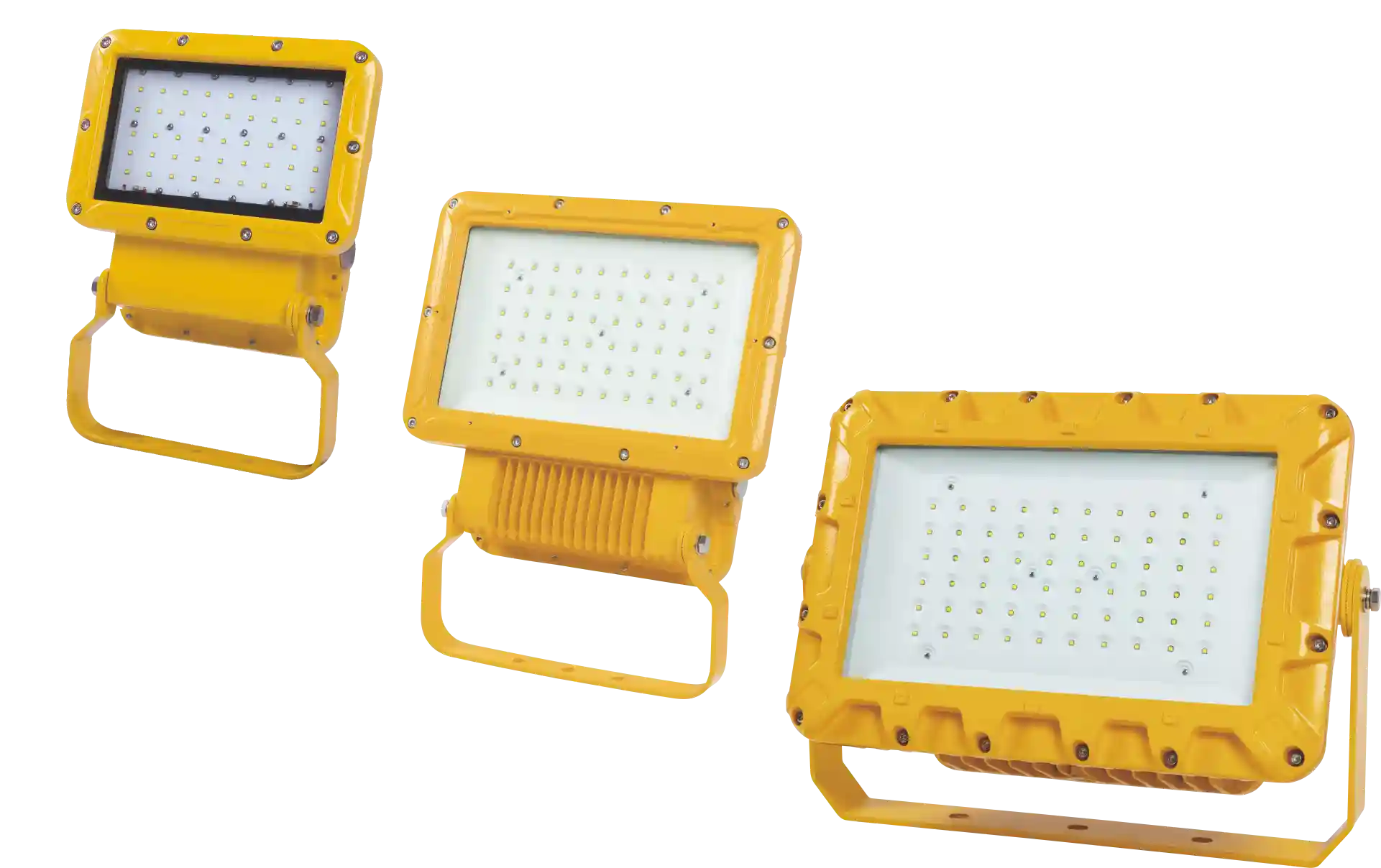
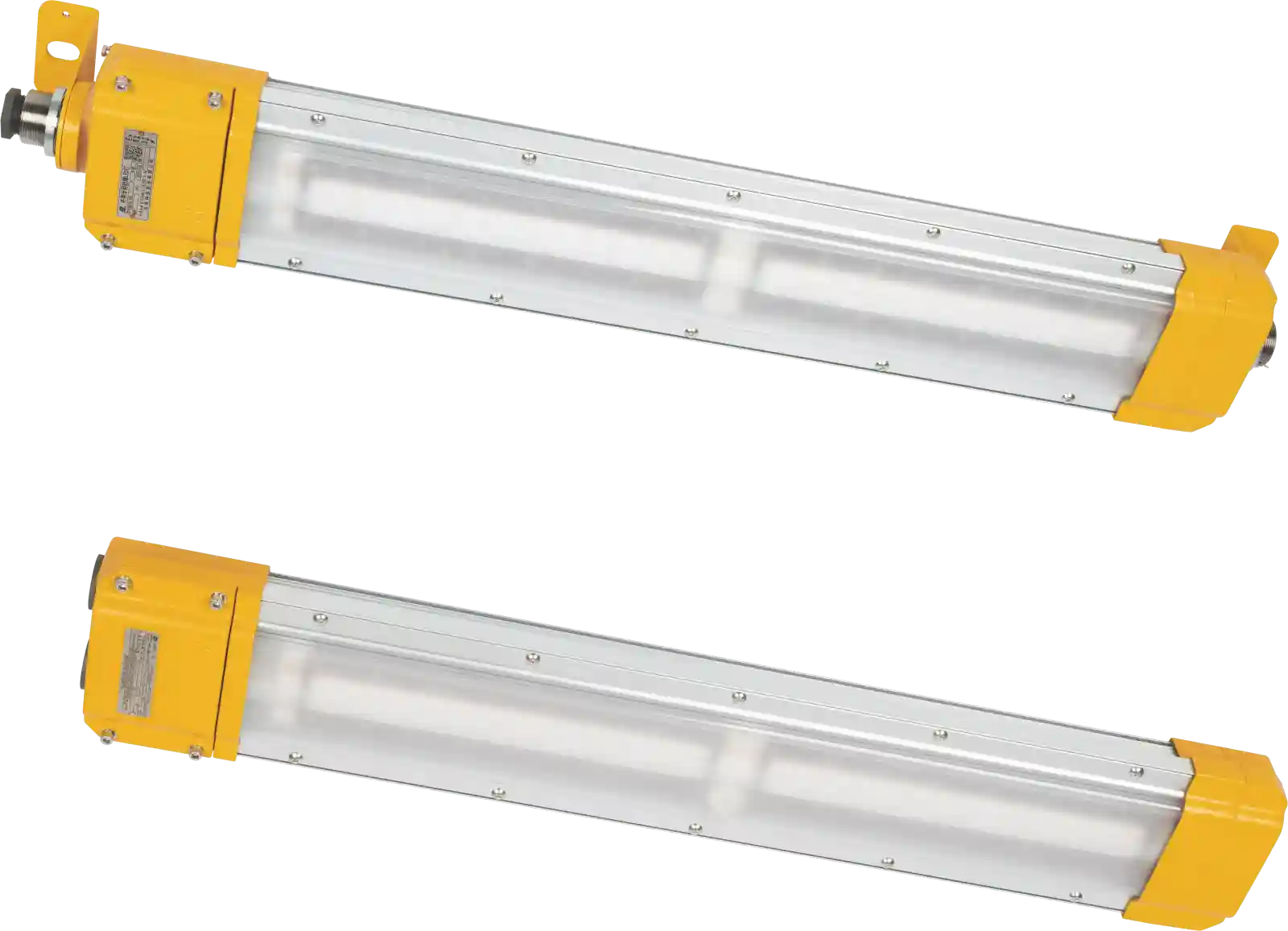
Lighting for cleanrooms and classified production areas requires fixtures that meet both explosion protection and illuminance uniformity standards. Linear LED fittings such as the HRY97 series provide even light distribution across production corridors and weigh areas, while pendant fittings like the HRY51-G C serve higher mounting positions in reactor halls and warehouse spaces. For outdoor tank farm and perimeter applications, the BAT86 LED floodlight delivers the reach and beam control needed without generating excessive glare at the facility boundary.
Cable glands are small components with outsized influence on system integrity. For pharmaceutical installations where cable routes pass between classified and non-classified zones, Ex d compound barrier glands such as the DQM-III series prevent gas migration through the cable interstices. These glands accept armored cable from M20 to M115 and maintain their IP66 rating across the full temperature range from minus 60 degrees Celsius to plus 90 degrees Celsius, which covers both ambient conditions and any heat conducted along the cable from process equipment.
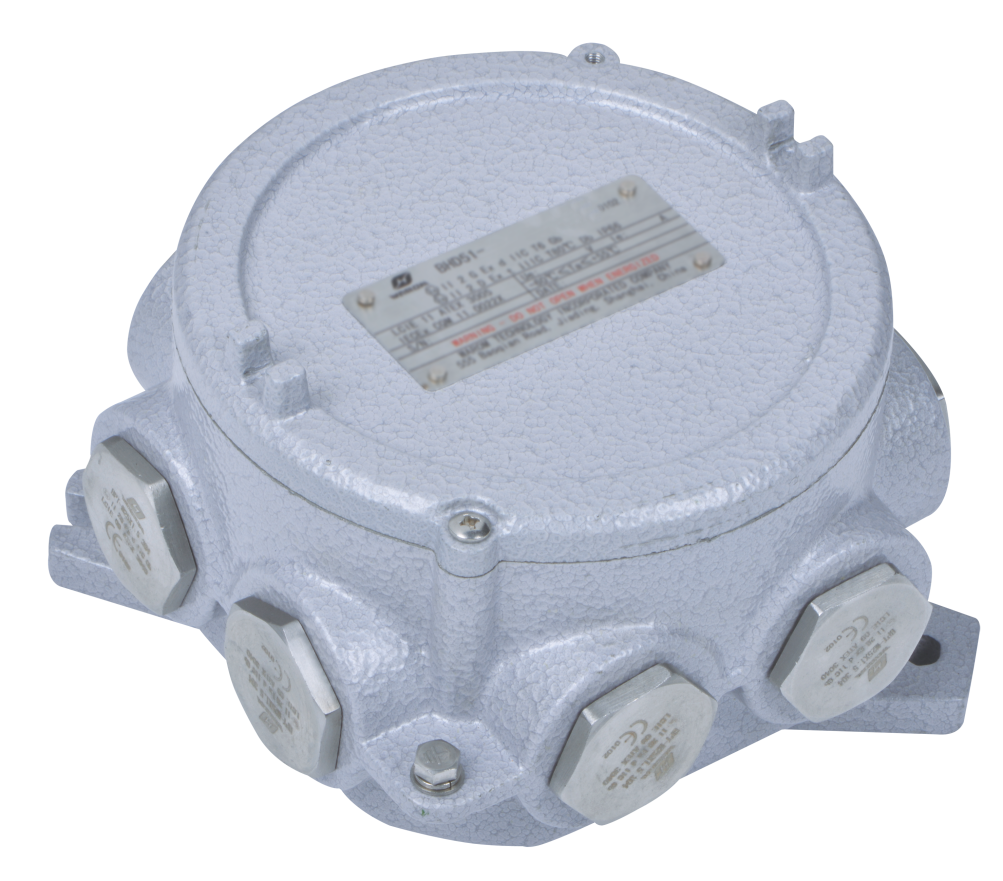
Junction and terminal boxes for instrument and control cabling require careful specification. The BHD91 flameproof junction box and BXJ8050 increased safety terminal box cover the two most common pharma installation scenarios. In Zone 1 instrument loops, the BHD91 provides segregated termination chambers with certified flame paths. In Zone 2 areas where cable marshalling density is higher, the BXJ8050 offers larger internal volume with Ex e protection and the same IP66 environmental rating.
Monitoring and control equipment completes the electrical package. Explosion-proof cameras such as the BJK-S/G series enable remote visual verification of critical process areas without requiring personnel entry into classified zones. Control stations with modular pushbutton and selector switch configurations provide local motor control at reactor agitators, pump sets, and HVAC dampers throughout the classified footprint.
Project Coordination That Prevents Specification Gaps
The most capable explosion-proof equipment will not solve a specification that was written in isolation. Pharmaceutical projects involve at least three engineering organizations: the owner’s process and validation team, the design institute responsible for the detailed engineering package, and the equipment manufacturers. When these parties work sequentially rather than concurrently, the result is predictable. The design institute specifies equipment based on zone drawings that have not been reconciled with the owner’s cleaning and material compatibility requirements, and the manufacturer delivers compliant equipment that does not fit the operational reality of the facility.
The Fushilai Pharmaceutical project in Suzhou illustrates how early coordination changes the outcome. The owner committed 500 million yuan to a 48,000 square meter facility with 15 production lines manufacturing APIs and intermediates for export. The explosion-proof equipment scope included distribution boxes for production workshops, warehouses, tank farms, and pump control stations. Before the detailed design was finalized, our engineering team engaged directly with the project promoter and the appointed design institute. This three-way coordination allowed us to align the equipment selection with the construction phasing plan, ensuring that distribution cabinets destined for later construction phases did not arrive on site prematurely and that cable entry configurations matched the design institute’s cable routing drawings before enclosures went into production.
The project launched in December 2023 with phased delivery synchronized to the construction milestones. Equipment arrived on site pre-tested with certificate packages ready for the validation dossier. No rework was required on cable entries, no enclosures had to be exchanged for alternative materials, and no certification gaps emerged during the compliance review. This outcome is not the result of superior products alone. It is a consequence of involving the manufacturer as a technical resource during the specification phase rather than treating procurement as a transactional step after the design is frozen.
For pharmaceutical EPC projects, I recommend scheduling at least two technical coordination meetings before the equipment purchase order is issued. The first should review zone drawings against the equipment schedule and GMP material requirements. The second should confirm cable entry sizes, gland types, and mounting details against the structural and electrical installation drawings. The time invested in these meetings returns multiples in avoided rework and schedule delay.
Common Questions About Explosion Proof Equipment in Pharmaceutical Plants
Is ATEX certification sufficient for pharmaceutical projects outside Europe?
ATEX certification is widely accepted in many regions, but it is not universally sufficient. Projects in Brazil typically require INMETRO certification. Projects in China require CNEX. Middle Eastern projects often accept ATEX or IECEx at the discretion of the end user and the authority having jurisdiction. For a pharmaceutical facility exporting products to multiple regulatory jurisdictions, specifying IECEx certified equipment provides the broadest acceptance because the IECEx certificate is recognized under the IECEx System rules, which now include over 50 participating countries. We recommend requesting both ATEX and IECEx certificates for each equipment type. The incremental cost is small relative to the risk of having equipment rejected during construction.
Can the same explosion-proof equipment serve both solvent and dust hazard areas?
Yes, but only if the equipment nameplate explicitly carries dual certification. An ATEX marking that reads “II 2 G Ex db IIC T4 Gb” and “II 2 D Ex tb IIIC T135 degrees Celsius Db” confirms that the equipment has been tested and certified for both gas and dust atmospheres. Equipment marked only for gas must not be installed in dust zones regardless of the IP rating. In pharmaceutical production, where API dust and solvent vapors may alternate in the same space during different batch stages, dual-certified equipment eliminates the risk of misapplication during zone transitions.
How does GMP compliance affect explosion-proof equipment selection?
GMP impacts enclosure material, surface finish, and ingress protection rating more than the explosion protection method itself. Stainless steel enclosures with an Ra surface roughness below 0.8 micrometers are preferred in cleanroom-grade production areas. IP66 is the minimum acceptable ingress protection because it withstands the low-pressure water jets used in pharmaceutical washdown procedures. Cable entries must be sealed against both gas migration and water ingress, which typically requires a combination of Ex d flameproof cable glands at the enclosure and IP66 compression glands at the cable outer sheath. If your cleaning procedures use solvent-based disinfectants, confirm that the enclosure gasket material and cable gland seals are compatible with the specific chemical formulation.
What lead time should pharmaceutical projects budget for explosion-proof equipment?
Standard catalog equipment typically ships in six to ten weeks from order confirmation. Custom distribution cabinets with project-specific circuit configurations, busbar ratings, and cable entry layouts require twelve to sixteen weeks for design approval, material procurement, assembly, and factory acceptance testing. Pharmaceutical projects should add two to three weeks to these estimates for certificate package preparation and documentation review. The single most effective way to compress lead time is to freeze the equipment specification before ordering. Post-order changes to circuit quantities, cable entry positions, or enclosure materials restart the design process and can add four to six weeks. If your project timeline requires equipment delivery within a specific window, share your schedule and preliminary equipment list with us at gm*@***om.com or call +86 21 39977076, and we will confirm which configurations can meet your dates without compromising certification integrity.
If you’re interested, check out these related articles:
HANNOVER MESSE 2025 is Underway
WAROM at ACHEMA 2024
Local Caution Spotlights: Enhancing Safety in Hazardous Zones
What is Portable Explosion Proof Lighting? An Expert Guide
With over a decade of experience, he is a seasoned Explosion-Proof Electrical Engineer specializing in the design and manufacture of safety and explosion-proof products. He possesses in-depth expertise across key areas including explosion-proof systems, nuclear power lighting, marine safety, fire protection, and intelligent control systems. At Warom Technology Incorporated Company, he holds dual leadership roles as Deputy Chief Engineer for International Business and Head of the International R&D Department, where he oversees R&D initiatives and ensures the precise delivery of design documentation for international projects. Committed to advancing global industrial safety, he focuses on translating complex technologies into practical solutions, helping clients implement safer, smarter, and more reliable control systems worldwide.

Qi Lingyi