

Explosion proof equipment for paint and solvent manufacturing plants is often bought the way lighting is bought: a count of fittings, a wattage, a price. That approach survives until the area classification drawing arrives, or until an inspector reads the nameplate on a distribution board and finds a marking that does not match the zone it serves. In a coatings plant the equipment list is decided by three things before any catalogue is opened: the solvent, the pigment powder, and the way the building is ventilated and drained. Settle those three and the remaining choices become narrow, checkable, and easier to defend in an audit.
Which zone applies where in a coatings plant
Area classification is the document that decides everything else, and in most plants it is written by the operator rather than by the equipment supplier. Under Directive 1999/92/EC the employer classifies the places where explosive atmospheres may occur [1]; the methods for doing so are described in IEC 60079-10-1 for gases and vapours and in IEC 60079-10-2 for dust [2], [3]. Equipment placed on the EU market must then meet Directive 2014/34/EU for its own design [4]. These are two separate duties, and buyers mix them up regularly: the plant owns the zone, the supplier owns the certified product.
The working definitions are short. Zone 0 holds a flammable atmosphere continuously, for long periods, or frequently. Zone 1 is likely to hold one during normal operation. Zone 2 is unlikely, and where it occurs it exists only briefly. Dust follows the same ladder as Zone 20, 21 and 22. Equipment protection levels map onto it: Ga suits Zone 0, Gb suits Zone 1, Gc suits Zone 2, and Da, Db, Dc do the same job for dust.
North American practice uses Class I Division 1 and Division 2, and OSHA requires employers to classify locations under 29 CFR 1910.307 [5]. Division 1 covers the conditions of Zone 0 and Zone 1 together, while Division 2 matches Zone 2, which means a Zone 0 location has no separate Division label and equipment certified under one system is not accepted automatically under the other.
| Location | Typical classification | What it means for the equipment list |
|---|---|---|
| Inside a closed solvent tank, vessel or reactor | Zone 0 gas, Zone 20 dust | Only Ga or Da equipment, so most plants keep instruments in a closed pocket or use an intrinsically safe loop instead |
| Inside a spray booth during spraying | Zone 1, Division 1 | Gb equipment; gas group and temperature class follow the solvents in the coating |
| Mixing and thinning area, open drum decanting | Zone 1 close to the opening, Zone 2 further out | Interlocked plugs and sockets, no portable non-Ex tools, local isolation within sight |
| Solvent drum and IBC storage, pump and pipe manifold | Zone 2 with good ventilation, Zone 1 in pits and sumps | Vapour is heavier than air, so the low points classify before the ceiling does |
| Pigment and powder coating charging, bag dumping | Zone 21 or 22 dust | Dust-tight enclosure plus a surface temperature limit, with group IIIB or IIIC decided by the powder |
| Finished goods warehouse, offices, control room | Unclassified if separated by a wall and kept under positive pressure | The boundary has to be documented, because a propped door changes it |
The table is a planning aid for a first pass, not a classification. Your own drawing, the ventilation study and the drain layout govern what is installed.
Why the solvent sets the temperature class before the fitting does
A solvent’s flash point tells you whether a flammable vapour exists at the working temperature. Its autoignition temperature tells you how hot a surface must be before the vapour ignites without a spark. Explosion protection deals mainly with the second number, because the enclosure keeps a spark or an internal explosion away from the atmosphere, while the surface temperature limit is what stops a hot housing or a dust-covered cooling fin from doing the igniting by itself.
IEC 60079-0 sets the temperature class scale: T1 at 450 °C, T2 at 300 °C, T3 at 200 °C, T4 at 135 °C, T5 at 100 °C and T6 at 85 °C [6]. Equipment is chosen so that its maximum surface temperature stays below the autoignition temperature of the solvent present, and the class printed on the marking is the one declared for a stated ambient range.
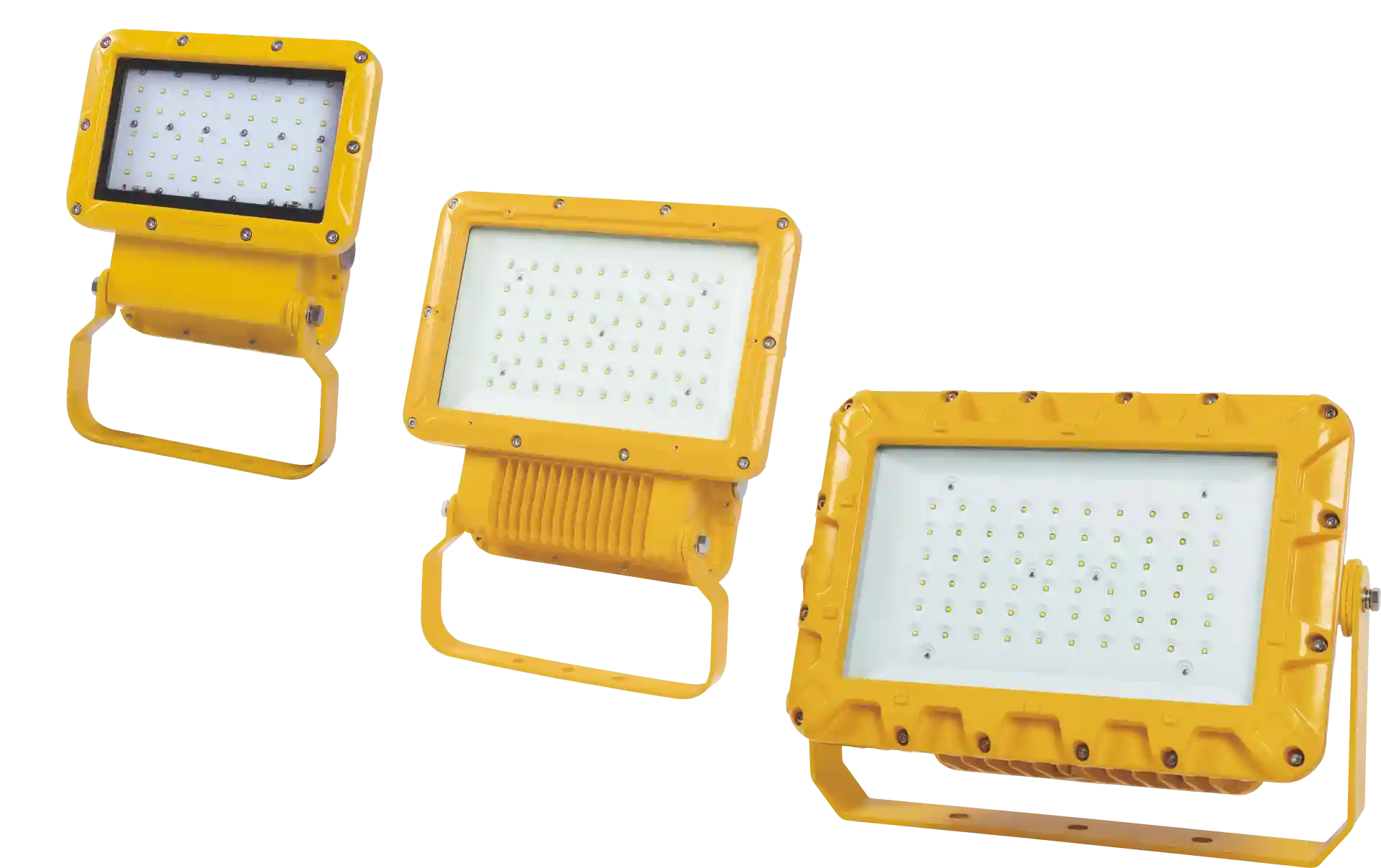
That last phrase carries more weight than it appears to. A T4 rating is declared at the ambient temperature named on the certificate, commonly somewhere between -20 °C and +40 °C, and some products are certified over a wider band. Above the declared ambient the same fitting may no longer hold T4 unless the manufacturer derates the load. A roof space, a room next to a curing oven or a plant in a hot climate is exactly where this gap shows up, and the question to ask is not “is it T4” but “is it T4 at 55 °C”. Wide-range products do exist for these conditions, such as floodlights built for -60 °C to +60 °C ambient and used on cold storage yards and hot process areas alike.
Most solvent vapours are heavier than air. They collect in pits, sumps, trenches, low-level cable trays and the bottom of a room before they reach a ceiling fitting. The practical consequence for procurement is that the pump at floor level may sit in Zone 1 while the luminaire six metres above it sits in Zone 2, so a single equipment list for the whole room will be wrong at one of those two points.
Pigment powders and powder coatings add a second atmosphere. A settled layer on top of a fitting insulates it, so the surface runs hotter than the test report describes, and the dust marking is given as a maximum surface temperature in degrees Celsius rather than a temperature class, for example Ex tb IIIC T80 °C Db. Whether the powder is conductive, group IIIC, or non-conductive, group IIIB, also changes which certified equipment can be used, and metal-effect pigments deserve a specific check on that point.
Where ignition-capable equipment gets overlooked
The visible half of the equipment list is lighting. The half that produces findings is everything else: illumination and distribution boards, terminal and junction boxes, plugs and sockets, motor starters and disconnects for mixers, pumps and fans, static grounding, gas detection, monitoring cameras, emergency and exit luminaires, and air conditioning for control cabins.
Take the motor circuit first. A local disconnect for a mixer or an extract fan is often the last item on the list and the first one an inspector asks about, because it is operated daily by people wearing gloves in a solvent atmosphere. An interlocked arrangement matters here: the enclosure should not be openable, and a plug should not be withdrawable, while the circuit is live.
Mixers, pumps and fans are switched locally in most coatings plants, which puts the disconnect at the centre of daily operation rather than at the edge of it. <Explosion Proof Motor Disconnects: ATEX and NEC Compliance> covers what ATEX and NEC each require from a motor disconnect.
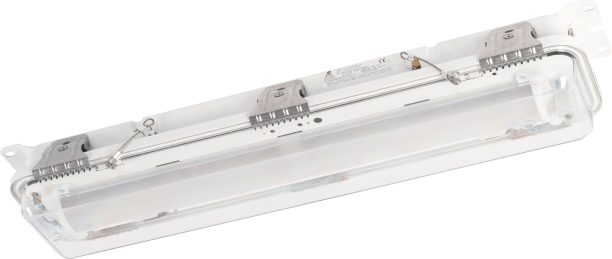
Lighting is where most of the money goes and where most of the zone errors appear, because the mounting height, the extraction pattern and the coating being sprayed all move the boundary. A pendant fitting over a mixing vessel is judged by the atmosphere at its own position, not by the classification at the door.
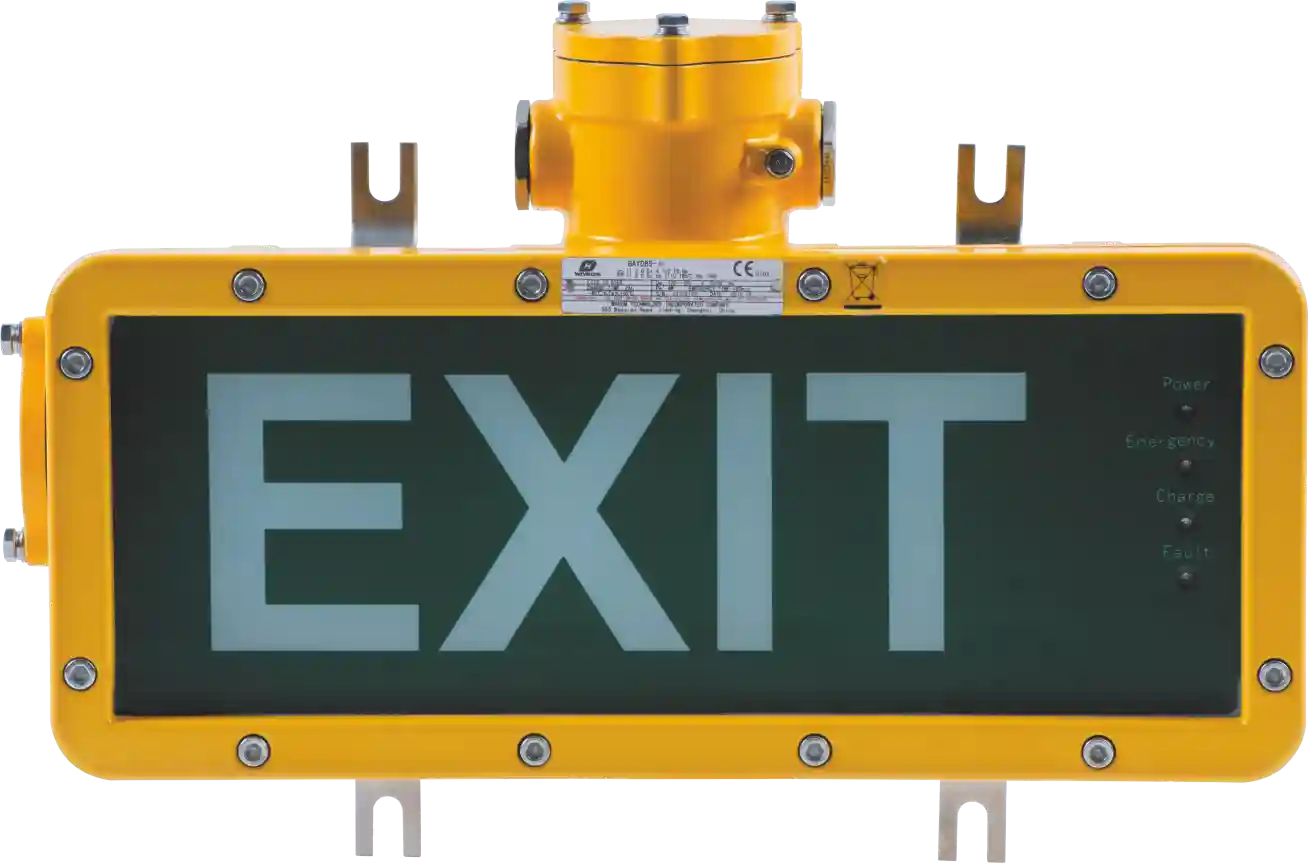
Emergency and exit luminaires deserve separate attention, since they carry a battery and the battery is the component most sensitive to ambient temperature. Ask for the declared emergency duration at the site’s design ambient rather than at a comfortable test temperature, and check that the exit sign remains legible through a solvent-laden atmosphere.
Static is the item most often left out of a bill of materials and most often named in an incident report. Solvent moving through pipes, filters and hoses generates charge, and a bonded but isolated drum or an ungrounded IBC will hold it until something provides a path. A grounding interlock that prevents transfer until the connection is proven does more for the plant than one more luminaire, and it belongs in the electrical scope rather than in the operations budget.
In one chemical plant we surveyed, the customer had flammable gas and dust risks in the same building and had been buying equipment family by family. The site diagnosis produced a single package covering gas detection, explosion proof plugs, junction and distribution boxes, static discharge devices and corrosion-protected equipment, delivered over a three-month cycle and later absorbed into the customer’s own procurement system. The lesson was not the product mix; it was that gas and dust duties in one building have to be listed together, or the second duty gets forgotten.
Matching protection concepts to each area
Five protection concepts cover most of a coatings plant, and the choice among them is a trade between cost, maintenance access and the power that has to pass through the enclosure.
| Concept and marking | How it prevents ignition | Where it fits in a coatings plant | What you accept |
|---|---|---|---|
| Ex d flameproof, for example Ex db IIC T4 Gb | The joint contains an internal explosion and cools the escaping gas below ignition temperature | Motor starters, higher-power distribution, Zone 1 luminaires | Weight and cost; flame paths must never be painted, filed or used as a step; certified glands are mandatory |
| Ex e increased safety, for example Ex eb IIC T4 Gb | No sparks or hot surfaces in normal operation, through larger clearances and better insulation | Terminal boxes, luminaires, low-power distribution in Zone 1 and 2 | It cannot contain an internal explosion, so the internal components must be certified for Ex e use and work is done de-energised |
| Ex i intrinsic safety, Ex ia or Ex ib | Energy is limited so that no ignition is possible, including under fault | Gas detection, instrumentation, sensors in Zone 0 and 1 | Low power only; needs isolators or barriers, a separate cable colour and an entity check at every repair |
| Ex ec non-sparking | No sparking or hot surface in normal operation | Zone 2 general lighting and small distribution boards | No fault tolerance; unsuitable where a single fault could create an ignition source |
| Ex t dust protection by enclosure | Sealed enclosure combined with a surface temperature limit | Pigment charging, bag filters, dust collectors | Sealing and cleanliness matter; a dust layer changes what the marking can support |
Distribution is usually where the concepts meet. A board that supplies several lighting circuits and a few small motors is commonly built as a compound enclosure, with the switching devices in a flameproof chamber and the terminations in an increased-safety chamber, so the installer works on terminals without opening a flameproof volume. WAROM builds the BXM(D)8050 series on that principle, in a glass fibre reinforced polyester enclosure rated IP66, with a modular circuit layout that is configured per project. The design point is worth understanding even if you buy elsewhere: the chamber split decides how maintenance is done for the next twenty years.
Where a plant’s circuit schedule matches no catalogue board, the chamber split, entry positions and circuit layout are normally engineered per project rather than assembled from standard parts. <OEM Explosion Proof: When Custom Engineering Elevates Industrial Safety> covers when custom engineering is the right route for explosion proof equipment.
Enclosure materials, IP ratings and cable entries
The IP code and the Ex marking answer different questions, and a quotation that lists only one of them is incomplete. The first digit of the IP code covers solids and the second covers water, so IP66 means dust tight and protected against powerful water jets, IP65 covers water jets, and IP54 covers splashing. None of that says anything about ignition, and an Ex marking does not imply IP66. In a plant that washes down floors with solvent or water, both markings matter.
Materials follow the chemistry of the site. Copper-free aluminium alloy is light, conducts heat well and needs a coating that resists the local atmosphere; the anti-static coating used on flameproof boxes is a functional layer, not decoration. Glass fibre reinforced polyester is light and corrosion resistant, and because it is non-metallic the design has to manage static and ultraviolet exposure. Stainless steel suits wash-down and coastal sites but costs more and weighs more, which changes mounting and support details. Solvent splashes also attack gaskets, cable sheaths and paints, so compatibility should be checked against the specific solvent list rather than described as general chemical resistance.
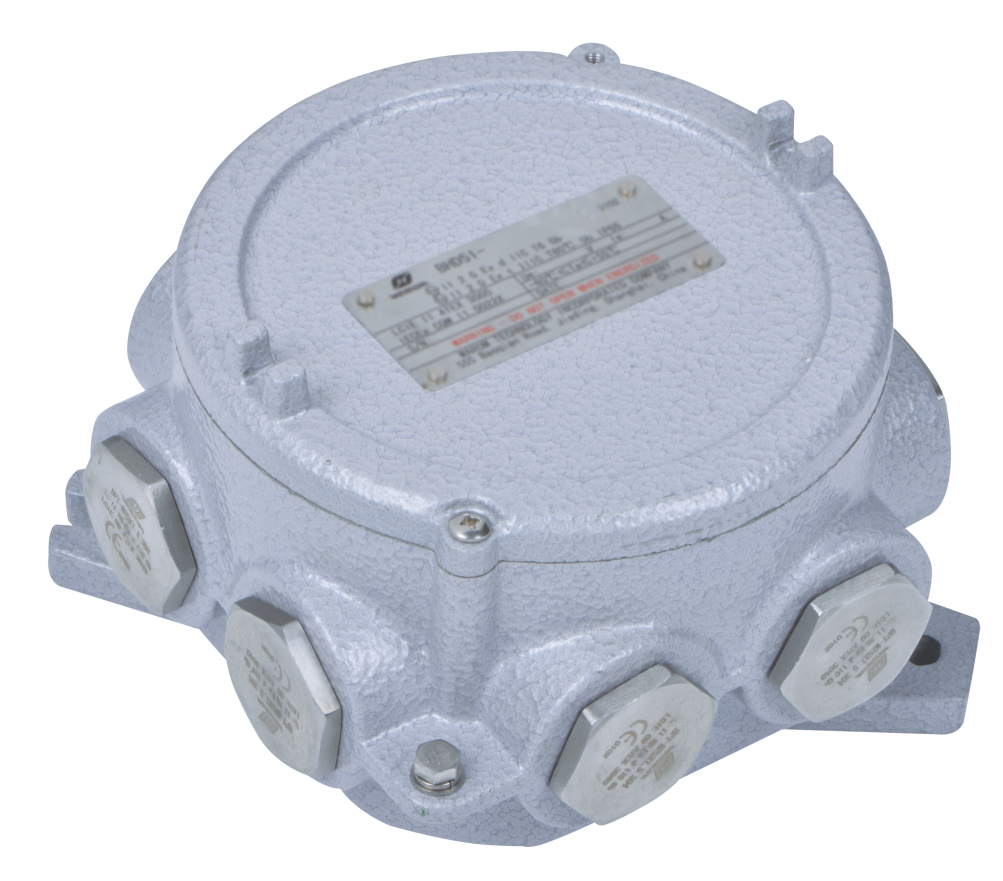
Cable entries are where otherwise correct installations fail. Every unused entry must be closed with a certified plug of the correct thread, a gland is a certified accessory rather than a consumable, and drilling an extra hole or inserting an adapter between a metric gland and an NPT entry changes the configuration the certificate covers. Armoured cable in a flameproof enclosure usually needs a barrier or sealing gland to keep the flame path effective, while an increased-safety enclosure uses a clamping gland with the correct sealing range.
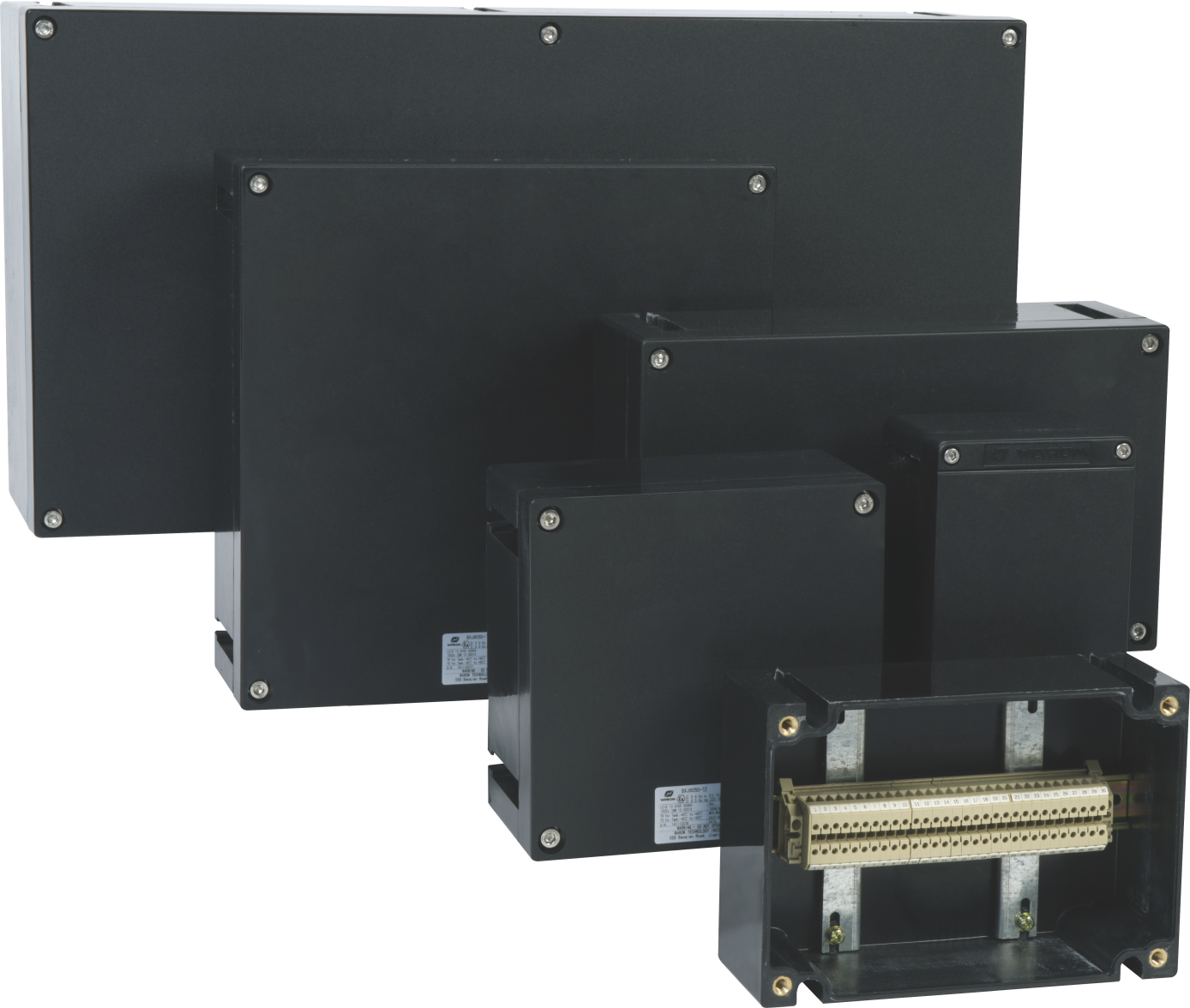
Terminal capacity is the quiet constraint. A junction box rated for 2.5 mm² conductors with twelve terminals will not accept the 6 mm² incoming cable someone later decides to pull, and re-terminating into a larger box usually means a new certified variant rather than a field modification.
What a certificate proves and what it does not
A certificate is evidence about a defined object under defined conditions. Most procurement disputes in this industry come from reading a certificate as a broader statement than it is.
| Record | What it legitimately supports | What must not be inferred |
|---|---|---|
| EU-type examination certificate for Ex db IIC T6 Gb, -40 °C to +55 °C | The listed variant, at that ambient range, meets the cited standards | That the same housing remains T6 at 65 °C in a roof void, or that a longer body with a different driver was assessed |
| IECEx certificate carrying the same marking | The type was assessed under the IECEx scheme | Automatic acceptance by a notified body, a local authority or a North American inspector |
| A certificate citing an earlier edition of the general requirements | Assessment against the edition in force when it was issued | That a newer edition is satisfied without further assessment |
| A laboratory report showing IP66 on submitted samples | The tested samples passed the ingress test | That IP66 implies explosion protection, or that every production unit is identical to the sample |
| A family certificate with a variant schedule | Only the variants named in that schedule | That a catalogue code missing from the list is certified, even if it looks the same |
| A manufacturer’s declaration of conformity on its own | The manufacturer’s own statement about the product | Independent third-party assessment of the design |
Reading a marking against a certificate takes a few minutes and settles most of the risk. Record the full marking string, the certificate number, the issuing body and the ambient range; compare the exact catalogue code with the variant schedule; confirm the gas group and temperature class against the classification drawing; and check that the certificate has not been withdrawn or superseded since the quotation was issued. Where a supplier cannot produce the variant list, the correct conclusion is that the certification status of that code is unknown, not that it is probably fine.
What to check before you reorder equipment for an existing plant
Retrofits fail differently from new builds. On a new project the equipment list is agreed early with the design institute and the owner, and construction follows it. On an existing plant the installed equipment is the starting point, and the job is to find out whether it still matches the drawing.
- Read the nameplate on each item and record the full marking, certificate number and ambient range rather than the model name from an old purchase order.
- Compare that marking with the current classification drawing, not with what the previous contractor installed.
- Inspect every entry: missing plugs, adapters between thread types, unused holes, glands of the wrong size and damaged flame paths are the four most common defects.
- Check corrosion, cover glass and earthing: corroded fasteners, cracked covers and painted flame paths all reduce protection, and none of them show up in a functional test.
- Recheck the circuit when changing lamp technology, because a lower-wattage replacement can change the driver and emergency configuration away from the certified combination.
- Confirm the documentation set: certificate copies, variant list, terminal capacity and spare entries, so the next maintenance shutdown does not become a sourcing project.
A pharmaceutical project we supplied shows the new-build version of the same discipline. The facility covered 48,000 m² with fifteen production lines for APIs and intermediates, and the explosion proof scope included distribution boxes for workshops, warehouses, tank farms and pump control. The order was secured through early coordination with the promoter, the design institute and the owner, with phased delivery from December 2023 aligned to construction progress. The coordination, not the hardware, was what kept the schedule.
Whether the scope is a retrofit or a new line, a quotation is only as good as the inputs behind it.
| RFQ field | What to state | Why it changes the answer |
|---|---|---|
| Classification per room | Zone, gas group or dust group, temperature class, required protection level | Sets the protection concept and the certificate the supplier must hold |
| Solvent list | Flash point and autoignition temperature for each product, with the worst case identified | Decides the temperature class, and whether an opening is Zone 1 or Zone 2 |
| Ambient conditions | Design minimum and maximum, plus radiant heat from ovens or roof surfaces | The declared temperature class and driver life depend on it, and wider ranges cost more |
| Materials and corrosion | Enclosure material preferences and the corrosive species present | Splash, wash-down and solvent attack decide the housing, gaskets and fasteners |
| Entries and terminations | Thread type, cable type and diameter, armoured or not, number of spare entries | Glands and plugs are certified accessories, not free options added at packing |
| Certification and documents | Required scheme, certificate copies, variant list, test reports, marking drawing | Determines who can bid at all and what arrives with the shipment |
What to send with your first inquiry
Send the area classification drawing, the solvent list with flash point and autoignition temperature for each product, the design ambient range, the required certification scheme and the cable types you intend to terminate. With those five inputs, WAROM can confirm which variants in a range carry the certificate for your gas group, temperature class and ambient condition, and which parts of the scope need a project-specific build instead of a catalogue item.
A certificate review is not a substitute for your own classification or for acceptance by the authority having jurisdiction.
Email gm*@***om.com, or call +86 21 39977076 or +86 21 39972657, with the drawing attached.
FAQ
Can standard industrial luminaires be used if the room is well ventilated?
Ventilation can reduce the extent or the level of a zone, and that is a classification decision made with the ventilation study in hand. It does not allow unclassified equipment into a room that still carries a Zone 1 or Zone 2 area. If the assessment shows the atmosphere disperses quickly enough to justify Zone 2, Gc equipment can be used, and the marking has to show it. What ventilation cannot do is protect a fitting that sits inside the booth or beside an open drum, where the release happens at the source.
Does one ATEX certificate cover every wattage and length in a product family?
Only the variants listed on the certificate. Manufacturers certify a family with a variant schedule, and a longer body, a larger driver or a different LED module can fall outside it. Ask for the certificate and the schedule, then match the exact catalogue code on the quotation to an entry on that list. Where the code is missing, the item may still be built to the same design, but the certificate does not cover it and the nameplate marking would overstate what was assessed.
Is explosion proof equipment needed for water-based paints?
Not automatically, and not never. Water-based products can still contain co-solvents, and some form flammable vapour under certain conditions, so the safety data sheet and the process temperature decide. Separately, pigment powder and dried overspray are dust risks that have nothing to do with the liquid base. Treat it as a classification question rather than a category question: if the assessment finds neither a flammable atmosphere nor combustible dust, standard equipment may be acceptable, and if it finds either, the zone governs.
What is the difference between IP66 and an Ex rating?
They answer different questions. The IP code describes how well the enclosure keeps out solids and water, so IP66 means dust tight and protected against powerful water jets. The Ex rating describes how the equipment avoids igniting a surrounding explosive atmosphere, through a flameproof joint, an increased-safety design, an energy limit or a sealed dust-tight enclosure. A fitting can be IP66 without being suitable for a Zone 1 area, and the two markings should be checked separately on the nameplate.
How often should installed explosion proof equipment be inspected?
The interval comes from the site’s own risk assessment and is usually shorter where corrosion, solvent attack or vibration is present. Inspection grades run from a visual check of marking and condition, through a close check that needs tools, to a detailed check that may require opening the enclosure. The practical minimum is that every item has a recorded inspection history, that entries and plugs are examined each time, and that a damaged flame path or a missing certified plug is treated as a defect rather than as cosmetic wear.
References
[1] Directive 1999/92/EC of the European Parliament and of the Council of 16 December 1999 on minimum requirements for improving the safety and health protection of workers potentially at risk from explosive atmospheres, Official Journal of the European Communities, L 23, 2000.
[2] IEC 60079-10-1:2020, Explosive atmospheres, Part 10-1: Classification of areas, explosive gas atmospheres, International Electrotechnical Commission, Geneva, 2020.
[3] IEC 60079-10-2:2015, Explosive atmospheres, Part 10-2: Classification of areas, explosive dust atmospheres, International Electrotechnical Commission, Geneva, 2015.
[4] Directive 2014/34/EU of the European Parliament and of the Council of 26 February 2014 on the harmonisation of the laws of the Member States relating to equipment and protective systems intended for use in potentially explosive atmospheres, Official Journal of the European Union, L 96, 2014.
[5] U.S. Occupational Safety and Health Administration, “29 CFR 1910.307, Hazardous (classified) locations,” osha.gov. [Online]. Available: https://www.osha.gov/laws-regs/regulations/standardnumber/1910/1910.307
[6] IEC 60079-0:2017, Explosive atmospheres, Part 0: Equipment, general requirements, International Electrotechnical Commission, Geneva, 2017.
If you’re interested, check out these related articles:
Zone 21 Dust Hazards: Essential Explosion Proof Electrical Equipment
Explosion Proof Equipment: Safeguarding Sugar Distilleries and Fermentation Plants
Explosion Proof LED Lighting Solutions for Hazardous Areas
Warom wishes you all a Happy Labor Day!
Expert Guide: Selecting Temporary Power Distribution Boxes
With over a decade of experience, he is a seasoned Explosion-Proof Electrical Engineer specializing in the design and manufacture of safety and explosion-proof products. He possesses in-depth expertise across key areas including explosion-proof systems, nuclear power lighting, marine safety, fire protection, and intelligent control systems. At Warom Technology Incorporated Company, he holds dual leadership roles as Deputy Chief Engineer for International Business and Head of the International R&D Department, where he oversees R&D initiatives and ensures the precise delivery of design documentation for international projects. Committed to advancing global industrial safety, he focuses on translating complex technologies into practical solutions, helping clients implement safer, smarter, and more reliable control systems worldwide.

Qi Lingyi