
ATEX cable gland markings often confuse engineers because the label carries more than a certificate number. In three decades reviewing explosion-proof cable glands for oil, chemical, and marine projects, I have seen too many teams check the ATEX certificate and then ignore the Ex marking fields, temperature class, and special conditions. Those fields determine whether a gland can actually seal the cable, suit the gas group, and remain safe in the installed environment. This article explains each marking field on an ATEX certified explosion-proof cable gland and how to apply it before procurement.
Reading the ATEX Cable Gland Marking Field by Field
On a typical ATEX cable gland, the marking is not a single certificate stamp. It is a compact series of fields on the gland body or collar. You should expect to see the manufacturer, model or type reference, serial or batch identification, CE mark and, where required, the notified body number, the specific explosion protection marking, the certificate number, and entry details such as thread and cable acceptance range. The protection marking commonly appears as a string like II 2 G Ex db IIC Gb for gas, with a dust marking such as Ex tb IIIC Db if the unit is dual rated. The order of these fields is not standardized down to the character, so you have to read the complete block rather than one familiar code.
Cable glands are usually inspected during installation, but the same fields matter at quotation stage. A marking that lists Ex db IIC Gb does not by itself tell you whether the gland accepts your 12.5 mm armored cable or your M25 entry. That information is in the thread and clamping range markings, which buyers often treat as secondary.
Decoding Ex db IIC Gb and Temperature Class
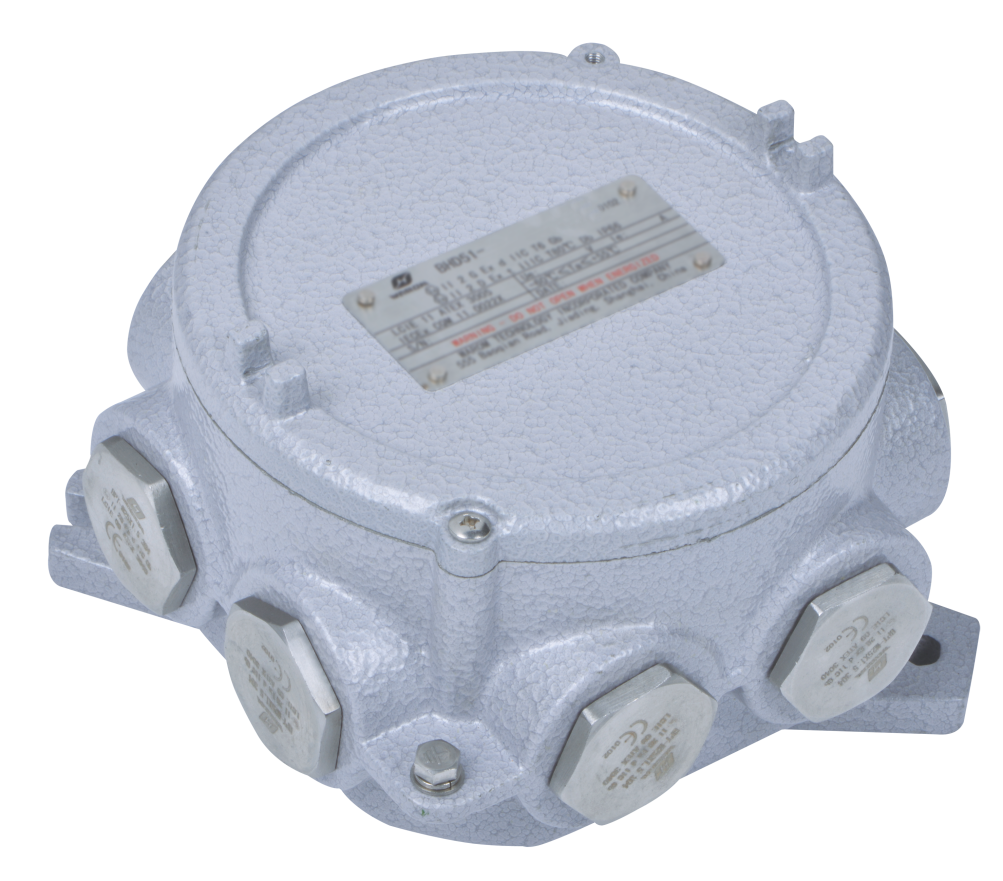
The most common protection code on an ATEX certified gland is Ex db IIC Gb. db means flameproof: the gland is designed so that if an internal explosion occurs, the flame path cools escaping gases before they can ignite the surrounding atmosphere. IIC refers to the gas group, and it covers IIA and IIB gas groups as well as the most severe IIC group, which includes hydrogen and acetylene where the specific certificate permits. Gb is the equipment protection level tied to Zone 1: suitable for Zone 1 and Zone 2, but not Zone 0.
The temperature class is the next field buyers should not skip. T6 means maximum surface temperature 85°C, T5 means 100°C, and T4 means 135°C. A T6 gland is conservative. A T4 gland may be acceptable for a gas with higher autoignition temperature, but it is not automatically wrong. The marking may also show an ambient temperature range, such as -60°C to +90°C. That range is part of the certification, not a marketing value. If the local ambient temperature at the gland exceeds that range, the certificate no longer covers the installation.
| Marking field | Meaning | Inspection question |
|---|---|---|
Ex db |
Flameproof cable entry | Is the entire gland certified, not just the thread? |
IIC |
Gas group IIA, IIB, and IIC | Does the site gas fall within IIC? |
Gb |
Equipment protection level for Zone 1 and Zone 2 | Is the area Zone 1 or Zone 2, not Zone 0? |
T6 or T5 |
Maximum surface temperature | Is the temperature class below the gas autoignition temperature? |
Ex e |
Increased safety option | Is this a reduced-spark termination? |
IP66 |
Ingress protection | Is the exterior exposed to water or dust? |
Checking Certificate Numbers and Thread Marks
Two fields require more attention than the Ex code: the certificate number and the X suffix. An ATEX certificate such as TÜV 22 ATEX 8855X identifies the specific type examination by the notified body, in this case TÜV, and the year of the certificate. The X means special conditions apply. Those conditions are listed in the certificate schedule and can cover reduced thread engagement, compound sealing, cable armor termination, or the use of a specific gland body with certain enclosures. If the installer loses the certificate schedule, the X becomes a risk because the gland may still be installed incorrectly.
Comparable IECEx certificates, such as IECEx TUR 22.0035X, should refer to the same product and the same protection concept. On a DQM-III/II Series cable gland, the ATEX and IECEx fields are both part of the conformity package, and the gas protection marking is Ex db IIC Gb for metric and NPT thread forms. Checking both certificate numbers closes a common gap where the selected gland has the right Ex code but does not match the cable entry the project actually requires.
Thread marks are part of certification too. A mark of M25 x 1.5 is not interchangeable with NPT 1/2 in simply because the diameters look close. The cable acceptance range, typically shown as a range such as 12.5 mm to 20.5 mm, tells installers what seal compression is valid. I have seen projects specify the correct protection concept and then dispatch glands with NPT threads to a metric entry hole because the bill of materials did not match the certified drawing.
Matching the Marking to Cable Type and Installation Conditions
Certification alone does not make a gland correct for your cable. The marking must align with three installation facts: cable construction, enclosure entry type, and service temperature. For an armored cable, the gland must be rated for armor retention and flamepath sealing of the inner bedding. For an unarmored or shielded control cable, an increased safety Ex e gland may be the correct choice, provided the equipment and circuit conditions permit it. The DQM-III/II Series cable gland covers armored hazardous area entries from M20 to M115, with both metric and NPT thread options, but the cable outer diameter must fall within the certified clamping range.
Temperature is another matching point. A marking of -60°C to +90°C is unusual and needs to be read with the cable jacket in mind. At low temperatures, many cable jackets become stiff, and the gland seals may behave differently. When we evaluate arctic or LNG terminal packages, we check the gland assembly as a system, not just the metal body.
Low-temperature performance is not only about the metal enclosure. <Weatherproof Enclosures for Arctic Conditions: Design Essentials> covers how seal materials and expansion differences change in arctic installations, and the same logic applies to cable glands, washers, and cable jacket cold flow at extended low temperatures.
Gas and dust dual certified glands carry an additional Ex tb IIIC Db line. Do not treat dust certification as incidental. If the process area has combustible dust, the gland must also protect the cable entry from dust ingress and surface temperature limits. Some sites in flour, sugar, or pharmaceutical solvent handling are classified for gas, dust, or both, and the equipment selection has to follow both ignition paths.
If your cable schedule includes both armored and unarmored cores in the same zone, it is worth confirming the gland clamping range and any X special conditions before finalizing your bill of materials. Send your cable specification and entry thread to gm*@***om.com.
Confirming ATEX Cable Gland Markings Before You Buy
Too many purchase orders go out after only the certificate number is checked. That leaves the temperature class, thread form, and cable clamping range outside the review, and those are the fields that create field installation problems. Before you finalize an ATEX cable gland order, send the cable outer diameter, screen or armor construction, installation zone, gas or dust classification, and any existing certificate number to our engineering team. We will verify the marking against the cable schedule and the required ATEX certificate, and we will identify any X special conditions you need to carry into the installation file. Email gm*@***om.com or call +86 21 39977076 or +86 21 39972657.
Answering Common Questions About ATEX Cable Gland Markings
Does Ex db IIC Gb mean the cable gland is suitable for Zone 0?
No, Gb equipment is not suitable for Zone 0. Gb corresponds to an equipment protection level suitable for Zone 1 and Zone 2, where explosive gas may be present under normal operation or occasional faults. Zone 0 is the continuous or long-period explosive atmosphere category and would require Ga rated equipment, which a cable gland cannot provide as a standalone connection. For Zone 0 entry arrangements, the solution normally relies on additional measures such as gas-tight separation or process isolation rather than the gland alone.
What does the X at the end of the ATEX certificate number mean?
Many buyers treat the X as a footnote, but it is one of the most important fields on the certificate. The X means special conditions for safe use apply, and those conditions are part of the type examination. They can include limits on thread engagement, required sealing compound, armor clamping, temperature range, or the types of cable construction the gland was tested with. You need the full certificate schedule and the drawing notes before installation. If those conditions disappear from the project file, a correct looking gland can be installed incorrectly and become a non-compliance.
Can an ATEX cable gland be used with a UL or NEC cable installation?
It depends on whether the device carries dual certification and whether the installation code permits it. An ATEX gland marked for IEC metric threads is not automatically accepted for a US or Canadian Class I Division installation just because the hazardous atmosphere is similar. The thread form, acceptance standard, and cable type often differ. If the equipment has both ATEX/IECEx and UL/CSA approval, use the marking that matches the governing code and the cable entry. For mixed export packages, specify the requirement up front, which avoids changing glands at site.
How do I verify an ATEX cable gland certificate before ordering?
In cable schedules we review, the most common gap is that the drawing revision and the certificate revision are not the same. Start by reading the full certificate number and notified body, then check the manufacturer’s published certificate against the exact model, thread, cable range, gas group, and temperature class you are purchasing. Request the EU declaration of conformity as well as the ATEX certificate, because the declaration ties production controls to the certified product. The X conditions must also be held in the installation file. Send your cable outer diameter and zone classification to gm*@***om.com, and we can confirm the correct ATEX cable gland marking and certificate availability.
If you’re interested, check out these related articles:
Warom Explosion-Proof Supplier Conference 2024
Warom at 40th ADIPEC 2024
Explosion Proof Equipment: Offshore Drilling Hazardous Area Safety
Stainless Steel Explosion Protection for Marine Electrical Systems
With over a decade of experience, he is a seasoned Explosion-Proof Electrical Engineer specializing in the design and manufacture of safety and explosion-proof products. He possesses in-depth expertise across key areas including explosion-proof systems, nuclear power lighting, marine safety, fire protection, and intelligent control systems. At Warom Technology Incorporated Company, he holds dual leadership roles as Deputy Chief Engineer for International Business and Head of the International R&D Department, where he oversees R&D initiatives and ensures the precise delivery of design documentation for international projects. Committed to advancing global industrial safety, he focuses on translating complex technologies into practical solutions, helping clients implement safer, smarter, and more reliable control systems worldwide.

Qi Lingyi